

Emily Blunt's 2016 Murder Mystery On Netflix Is A Fascinating Time Capsule
This article contains discussion of addiction.
"Gone Girl" is the best and worst thing to happen to one specific corner of pop culture. On the one hand, Gillian Flynn's brilliant book and David Fincher's big screen adaptation are both equally great. On the other hand, they gave us weird schlock like "The Girl on the Train," Emily Blunt's fever dream murder mystery that hit theaters in 2016 and remains a bizarre time capsule of that specific cultural period.
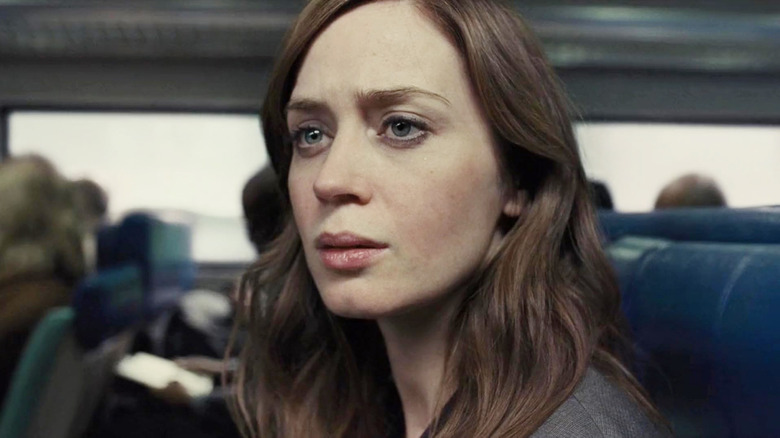
Before I get into the larger cultural context, let's talk more specifically about "The Girl on the Train," as directed by Tate Taylor (who also brought us the equally lackluster literary adaptation "The Help") and adapted by screenwriter Erin Cressida Wilson. Blunt plays the titular "girl," Rachel Watson, who spends her time furtively drinking and obsessing over a couple she sees from her train window. (In the original novel by Paula Hawkins, her train journeys are between London and its suburbs, while the film adaptation moves the setting to New York City and its respective suburbs.) When the wife, Megan Hipwell (Haley Bennett), goes missing, Rachel decides to try to solve the mystery herself, interfering with an active investigation and befriending Megan's husband Scott (Luke Evans) ... only for her own secrets to surface.
I think I've been fairly clear about this, but just in case, let me be clearer. "The Girl on the Train" is not a good movie. Hawkins' book, if you're really determined to experience this story from beginning to end, is the better option, but at the end of the day, it's still a shadow of a better story led by an unreliable narrator. So, what, specifically, is the issue with "The Girl on the Train" (which is currently streaming on Netflix)? Spoilers ahead!
The Girl on the Train tries to subvert expectations, but it ends up doing too much
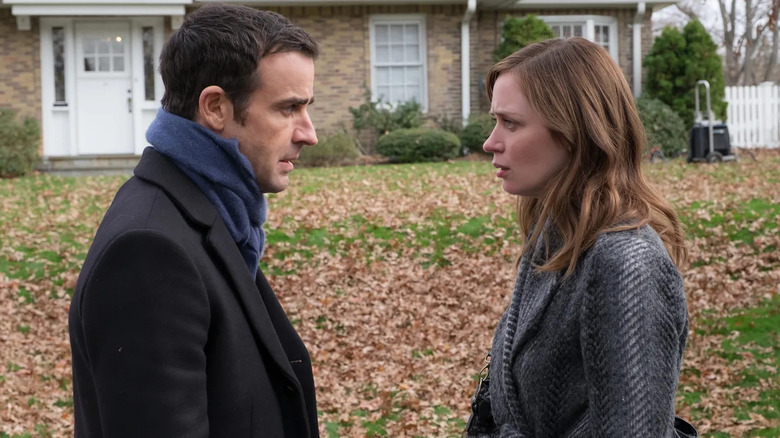
The entire conceit of "The Girl on the Train" is that Rachel struggles with alcohol abuse, so not only is she frequently unable to trust her own memories, the fact that she's almost always under the influence clouds the audience's judgment. Rachel is pretty quickly investigated by Detective Riley. (Allison Janney) since she was spotted near the Hipwell home the night Megan vanished. And even though Rachel is quite sure that she was keeping tabs on her ex-husband Tom (Justin Theroux), his new wife Anna (Rebecca Ferguson), and their baby daughter, she starts to worry she could have hurt Megan.
The plot thickens when Megan's dead body is discovered, putting Rachel in the crosshairs and giving Tom even more reasons to ensure that nobody trusts her perspective. The twist ultimately comes into play when Rachel encounters Martha (Lisa Kudrow), the wife of one of Tom's ex-coworkers, on her endless train ride and learns that Tom was the real problem in their marriage. Indeed, when Rachel's despondence over her infertility led to her abusing alcohol, Tom gaslit her into believing her behavior was abhorrent for years. Eventually, it's revealed that Tom was having an affair with Megan and killed her after she told him she was pregnant with his child. So, together, Rachel and Anna take Tom down for good.
I've left out a bunch of other plot points, and that's because they don't matter, but they're part of the story anyway. Édgar Ramírez plays Megan's psychiatrist Dr. Kamal Abdic, who Rachel suspects is the culprit, and that's just one story thread that overstuffs this frankly messy movie to the point that it's sort of absurd. (The constant slow motion effects don't help either.)
Movies like The Girl on the Train tried to recreate Gone Girl's success — and results varied wildly
"The Girl on the Train" isn't a particularly good film by any metric, but if you compare it to its predecessors like "Gone Girl" (and trust me, projects like this are basically designed to invite comparisons), it looks way, way, way worse.
Here's an anecdote, if you'll allow me. A good friend of mine just read "Gone Girl" for the first time. (I don't know how she avoided learning about its major twist, but congratulations to her for managing to do that.) Afterwards, she remarked that she finally understands precisely how many thrillers, particularly ones marketed towards female readers, have basically tried to replicate what "Gone Girl" managed to do: wow audiences with its tightly plotted story, game-changing twists, and exceptional character studies. That's the thing: Once you read the story that kickstarted the trend of dark novels featuring unreliable female narrators packed chock full of twists, you realize how all of these novels are little more than "Gone Girl" knockoffs.
Most writers ... aren't as good as Flynn. That's not my opinion, it's a fact. That's what makes "The Girl on the Train" such a fascinating look at how much "Gone Girl" influenced both the literary scene and Hollywood during the 2010s. It's not even the only example! A.J. Finn's frankly dreadful "The Woman in the Window" released in 2018 and got a film adaptation from Joe Wright starring Amy Adams in 2021. Hell, there's even a Netflix parody series starring Kristen Bell called "The Woman in the House Across the Street from the Girl in the Window" that lampoons this niche sub-genre. Now that you have the context, you can watch "The Girl on the Train" on Netflix.