

The End Of Oak Street Features A Stealth Time Travel Movie Easter Egg You'll Probably Miss
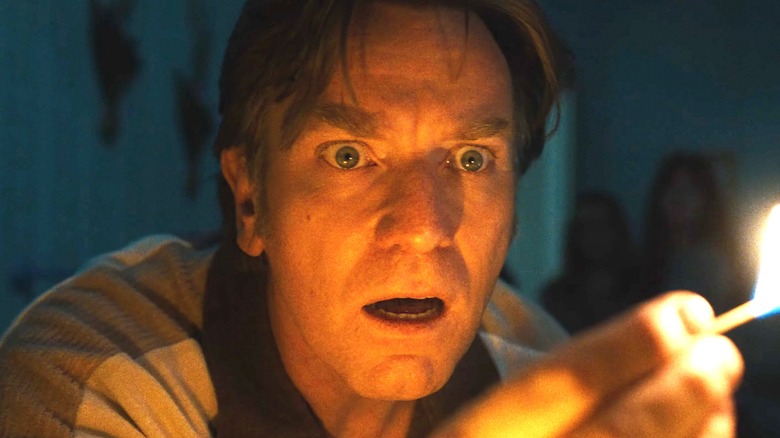
This article contains spoilers for "The End of Oak Street."
When the first trailer dropped for writer/director David Robert Mitchell's new film, "The End of Oak Street," it was readily apparent what the movie's primary influences were. The film, in which a quaint suburban neighborhood in the early 1980s is mysteriously transported to a prehistoric age teeming with hungry dinosaurs, is heavily inspired by the work of Steven Spielberg as both director and producer. To put the premise into a movie-based elevator pitch, it's "E.T."/"Poltergeist" meets "Jurassic Park." These influences were openly confirmed by Mitchell and producer J.J. Abrams at a press preview event and Q&A for the movie back in mid-July. With that, it seemed like any other surprises "The End of Oak Street" held were going to be of a smaller scale than the high-concept premise.
However, it so happens that Mitchell was saving a stealth third Amblin Entertainment homage for the finale of the film. Most of the movie concerns the Platt family, trapped in a pre-human era, trying to survive the dinos while looking for a possible way back home, which they come across in the form of mysterious spheres (which are really wormholes in the space-time continuum) that crop up randomly around the neighborhood. After the tragic demise of patriarch Greg (Ewan McGregor), matriarch Denise (Anne Hathaway) leads her kids through a dino-filled battlefield to a sphere portal. They all take a leap of faith into it, only to discover that they've arrived about 20 minutes before the neighborhood was originally swapped through time. This time travel twist is highly reminiscent of the end of "Back to the Future." Furthermore, an additional grace note in the ending recalls the paradox-filled hijinks of "Back to the Future Part II" as well.
Denise saves Greg in a manner which recalls Back to the Future
In "Back to the Future," Marty McFly (Michael J. Fox) experiences the violent demise of his friend Doc Brown (Christopher Lloyd) near the beginning of the film when the latter is shot to death by terrorists he double crossed. Later, before going back to the future, Marty attempts to give the younger Doc a letter warning him of this fate, which Doc refuses to read, tearing it up. Thus, Marty uses the time machine to go back 10 minutes before he left, which he hopes will be enough time to intervene. It's not, but fortunately, Doc ended up reading that note after literally piecing it together, allowing writers Robert Zemeckis and Bob Gale to pay off a setup element in a manner that's logically and emotionally satisfying.
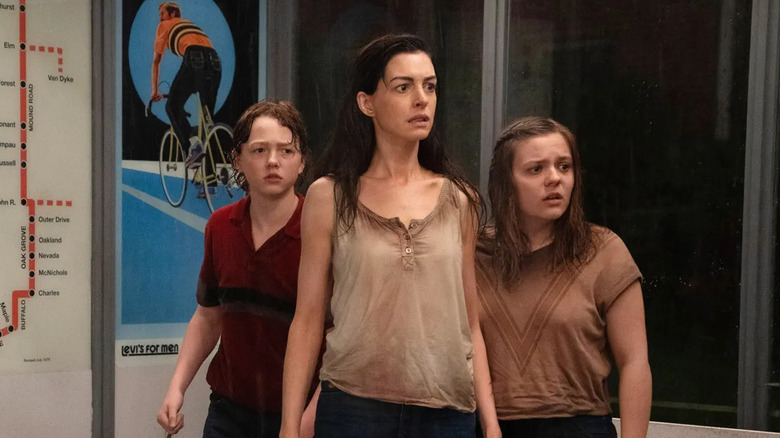
David Robert Mitchell pulls a similar trick in "The End of Oak Street." When Denise, her kids, and neighbor Jeannette (Jordan Alexa Davis) emerge back in 1982, they realize that having only 20 minutes before the town is due to be zapped back to prehistory isn't enough time to run down there and save anyone. Spotting a pay phone nearby, Denise gets the brilliant idea to call people and warn them instead. However, instead of calling herself or Greg directly (which would likely result in denial and rejection by their past selves), she orders a pizza from Greg's pizza parlor, knowing that Greg was this area's regular delivery driver. Where initially Greg's minimum wage job was an indication of his career being on the rocks and the couple's marriage being strained, Mitchell turns it into the method by which Greg's life is saved. It's a neat twist worthy of Zemeckis and Gale, or even M. Night Shyamalan.
The End of Oak Street borrows another element from the Back to the Future trilogy
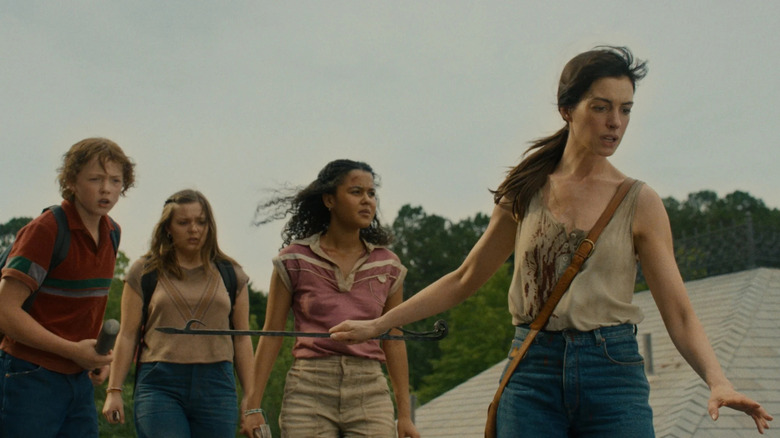
In addition to that happy ending, "The End of Oak Street" borrows one additional time travel element from the "Back to the Future" trilogy. After Denise and the kids make it back to 1982, Jeannette realizes she has time to run back to her home, saving both her parents and her past self from being transported to dino times all over again. This means that now two Jeannettes exist in the same time period, something the final shot of the movie casually reveals. It's reminiscent of the paradoxical events caused by time travel in "Back to the Future Part II," in which multiple Martys and Docs are operating in the same space. In those films, however, Marty and Doc generally set the timeline back to the way it should be (or ought to be), and don't leave any multiples of themselves or others behind. This little grace note in "Oak Street" is an ominous one, raising all sorts of ethical questions in addition to physics-based ones.
Ultimately, the double Jeannettes are a clever wink of an ending more than a hint at a potential sequel or anything else. It's David Robert Mitchell's way of giving the generally sweet movie a little bit of bitter aftertaste, coming as it does during an epilogue in which we're shown how the dinosaurs which came forward through time have been permanently displaced themselves. This finale seems to say that even though things have turned out alright in general, the old Oak Street as folks used to know it is indeed no more.
"The End of Oak Street" is in theaters now.