

A First-Time Director's Sci-Fi Movie With No Stars Earned A Best Picture Nomination—It Opened 17 Years Ago Today
Two decades might as well be an eternity in the moviemaking business. In 2009, James Cameron's original "Avatar" had yet to rewrite the rules (again) on what blockbusters were truly capable of achieving. The Marvel Cinematic Universe was but a rumor, with not a single soul fully prepared for the heights that this franchise juggernaut would eventually reach after the release of "Iron Man" a year prior. And, at the time, audiences couldn't have imagined what some little-known, South African-Canadian filmmaker by the name of Neill Blomkamp was about to unleash on the science fiction genre at large.
Despite having 17 years of history to work with, nothing about "District 9" would seem to lend itself to such breakout potential. An unknown name making his feature film debut, a lead actor with no star power whatsoever to speak of (also making his big screen debut), and a genre that would hardly seem to lend itself to box office glory ... let alone actual awards consideration? In a vacuum, this isn't exactly a recipe for success. Nonetheless, this ground-level, documentary-inspired, and radical new take on science fiction ended up overcoming the impossibly long odds against it and established itself among the best that modern Hollywood has ever had to offer.
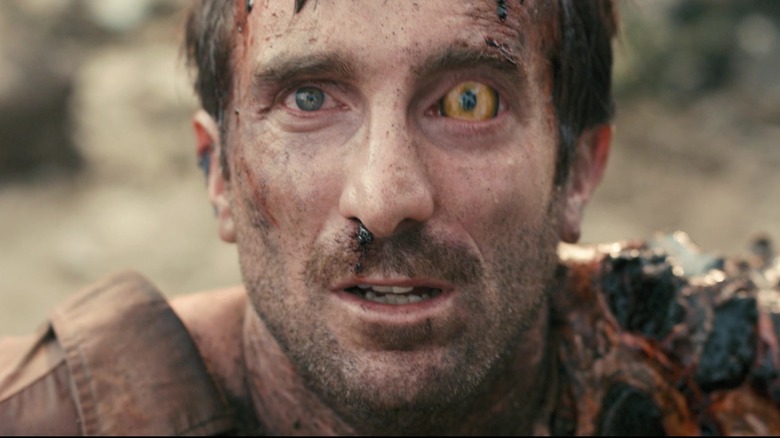
Not bad for a movie about insect-like aliens ("fookin' prawns," as we've been calling them ever since), some of the nastiest body horror you'll ever see in mainstream filmmaking courtesy of Sharlto Copley's deeply unfortunate Wikus, and an overtly political storyline exploring Apartheid-era themes. But that's the beauty of sci-fi, folks. Movies that wouldn't normally stand a chance of getting greenlit somehow sneak through the studio system, influencing moviegoers worldwide and writing their names in the history books for decades to come.
District 9's production history was just as unlikely as its success

The achievement of "District 9" would be noteworthy in and of itself, but the film only takes on even more mythic proportions when you consider the unlikely story of how it was ultimately made. Famously, the blockbuster started out as an entirely different production altogether. Coming off all the clout he accrued with his "The Lord of the Rings" trilogy, Peter Jackson embraced the challenge of producing a movie adaptation of the classic "Halo" video game franchise. A script was commissioned (written by no less a talent than Alex Garland), Neill Blomkamp was hired to direct, and props were designed and built. It all seemed destined to end in dollar signs aplenty ... until it didn't.
No matter. When their "Halo" project fell apart, Jackson and Blomkamp then pivoted to as great a Plan B as ever existed: "District 9." Repurposing much of what was originally meant for "Halo," the filmmaking team took a DIY approach in building their new sci-fi venture from the ground up. Blomkamp opted to film in his home country of South Africa, used a filmmaking style heavily reliant on handheld footage (devised alongside cinematographer Trent Opaloch), and turned a risky sci-fi movie with a $30 million budget into a $200+ million smash hit.
The rest was history, though few could've ever envisioned such a turn of events back then.
What Hollywood can learn from the legacy of District 9
Perhaps there really is no blueprint in filmmaking for what becomes a hit and what doesn't. After all, who could possibly predict the special alchemy that must come together for a movie to make it across the finish line — never mind actually secure distribution, spread awareness among potential audiences, and finally break through the pop-culture bubble to create a lasting legacy of its own? It's nothing short of a miracle that here we sit, 17 years later, still talking about "District 9."
There's a very good reason for that, as it turns out, and Hollywood would be wise to take notice. "District 9" remains a lesson in how filmmaking is a product of timing more than anything else, but it's also an example of trusting in new voices and up-and-coming creatives. Peter Jackson's recognition of a kindred spirit in Neill Blomkamp was just as integral to success in the first place as the brilliantly-conceived script (co-written by Terri Tatchell, who is married to Blomkamp). Only an industry outsider, with no preconceptions of how things are "supposed" to be done under more traditional circumstances, could've made a movie as bold and audacious and singular as this.
The struggles to produce a long-awaited sequel film tentatively titled "District 10" only further underscores the point. We're fortunate that we live in a world where "District 9" exists. Somewhere, perhaps the next original success story is already being dreamed up, ready to surprise us all and stand the test of time.