

How Christopher Nolan's The Odyssey Was Influenced By The Original Star Wars
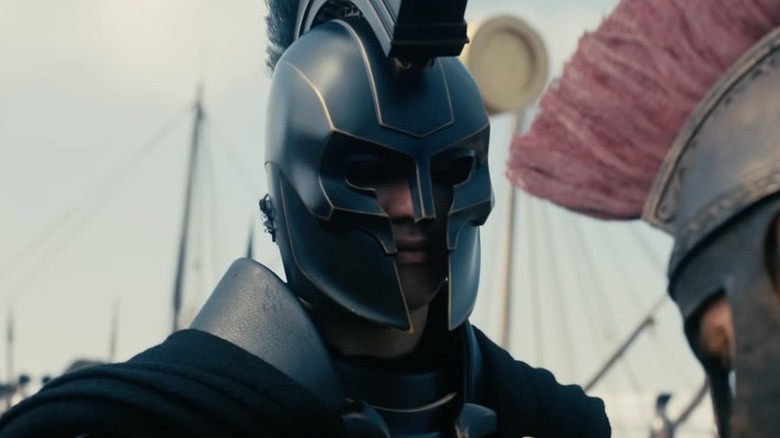
Ahead of Christopher Nolan's "The Odyssey," many weren't sure how he would approach the epic's gods and monsters. Nolan is a director who favors at the least the aesthetic of realism and tactile filmmaking; he shoots on physical film stock and tries to avoid CGI. On "Oppenheimer," he even recreated a nuclear explosion without any CGI.
But now "The Odyssey" has arrived, awaited like Odysseus (Matt Damon) himself coming home to Ithaca, and it doesn't cut out the supernatural. Sure, you can write off the goddess Athena (Zendaya) appearing before Odysseus as a hallucination, but the sixty-foot tall Cyclops (Bill Irwin)? Not so much. Nolan's push for tactility only makes the monsters creepier and more alienating. The witch Circe (Samantha Morton) doesn't cast some magic spell with glowing hands to make Odysseus' crew painlessly shift into hogs. No, she grabs them and physically remolds their bodies into pigs.
Yet the film also opens with text telling us this is "a time of apparent magic." Is that Nolan's concession that some things in "The Odyssey" can only be explained by the supernatural? Or is it a framing that the less advanced peoples of the Bronze Age themselves could only grasp certain phenomena, even something simple like the changing of the seasons, as magic?
In a conversation with filmmaker Park Chan-Wook about "The Odyssey," Nolan compared his opening text in "The Odyssey" to "A long time ago, in a galaxy far, far away..." in the original "Star Wars."
"That immediately told me how to watch ['Star Wars']. It put me in the right frame of mind to receive the imagery," Nolan said. He believes introducing audiences to "The Odyssey" by describing its world as "a time of apparent magic" does the same.
With The Odyssey, Christopher Nolan wanted to transport audiences like Star Wars had
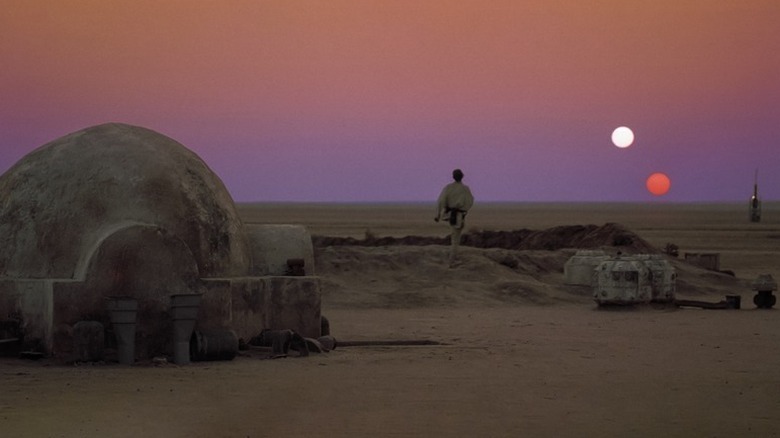
It's hardly novel to say the original "Star Wars" drops you into a world that feels wholly formed, with a complete history we only see or hear fragments of. Luke Skywalker's journey feels like the most important thing in the galaxy as you watch the film, but you never forget it's a huge galaxy out there. George Lucas had ideas about that history, though, and eventually used that worldbuilding as the foundation for his "Star Wars" prequel trilogy.
That only strengthens parallels to "The Odyssey," frankly, which is itself a sequel to another epic, "The Iliad." Nolan definitely does not elide any relevant history in "The Odyssey" but, like when you first watch "Star Wars," the film's setting feels both fully-realized and yet not quite like our own world.
"I felt with ['The Odyssey'] it was chasing that kind of experience where you want to create a world where the audience loses themselves, and takes on its own terms," Nolan said, and he settled on the phrase "apparent magic" as a way to help the audience reaching the understanding he wanted them to.
"The word 'apparent' in particular to me was very much about acknowledging the idea that, yes, if we tell the story realistically, to some extent we have to explain why there's magic. And I was very interested in the idea that — a person living in the Bronze Age, there's magic all around you, there's things that you cannot explain. [...] I wanted to put that in people's heads as they started to watch the film."
In its conciseness, "a time of apparent magic" does rival "A long time ago, in a galaxy far, far away..."