

Quote Of The Day By Andrew Stanton: 'Make The Audience Put Things Together.'
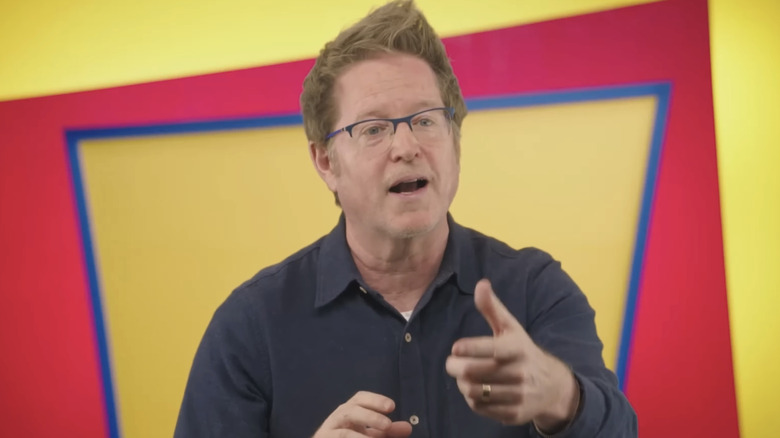
Filmmaker Andrew Stanton is best known for his longtime collaboration with Pixar Animation. In 1990, Stanton became only the second animator and the ninth employee overall to join the company that would change the face of big screen animated entertainment forever.
After helping to pioneer the rise of computer animated films, Stanton would go on to to write Pixar's first animated feature, the beloved "Toy Story," and he's been creatively involved with the entire franchise ever since. Outside of giving us the loveable duo of Woody and Buzz Lightyear, Stanton wrote and directed the groundbreaking ocean adventure "Finding Nemo," a beautiful story of fatherhood, as well as the Oscar-winning "WALL-E," which was also honored by being entered into the Criterion Collection.
Unfortunately, Stanton stumbled a bit while attempting a transition into live-action filmmaking with the sci-fi adaptation "John Carter," although the film still has some passionate fans (including some here at /Film), and after flopping at the box office, it's become a bit of a cult favorite. But he's since made an impression directing live-action television, having helmed episodes of "Stranger Things," "Breaking Bad," "Obi-Wan Kenobi," and "For All Mankind."
Most recently, Stanton wrote and co-directed the box office smash-hit "Toy Story 5," proving that he can still deliver the goods at Pixar with just as much heart and humor as when he began his journey into computer animation. During a TED Talk back in 2012, Stanton even offered some insight into how he and the other storytellers at Pixar create such compelling movies — and there's one bit of advice that today's filmmakers and audiences need to understand.
Quote of the Day by Andrew Stanton
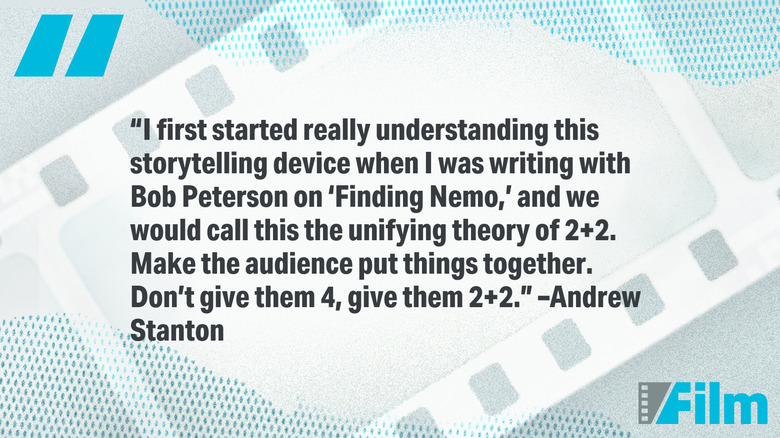
During his TED Talk, Andrew Stanton recalled a philosophy that he shared with a fellow Pixar filmmaker:
"I first started really understanding this storytelling device when I was writing with Bob Peterson on 'Finding Nemo,' and we would call this the unifying theory of 2+2. Make the audience put things together. Don't give them 4, give them 2+2."
Bob Peterson is the co-director and writer of Pixar's "Up." For anyone who's seen that film's opening montage or watched the brilliance of "WALL-E," you're well aware that Stanton and Peterson are both exquisite visual storytellers. They know how to show and not just tell. Both movies allow the audience to interpret what they're seeing, especially in scenes that don't have dialogue. As Stanton explained:
"Storytelling without dialogue is the pure form of cinematic storytelling. It's the most inclusive approach you can take, and this confirmed something I really had a hunch on, that the audience actually wants to work for their meal, they just don't wanna know that they're doing that. That's your job as a storyteller. is to hide the fact that you're making them work for their meal."
This is where filmmakers (primarily the producers and executives behind them) and audiences need to take note. Not everything needs to be spelled out in black and white through clumsy, expository dialogue just because people like to do laundry while mindlessly streaming movies and TV shows.
Deeper Meaning of Andrew Stanton's Quote — Audiences need to be engaged
Andrew Stanton's lesson is one that still resonates today. Because audiences are accustomed to watching media at home, notes from studio executives, especially for streaming exclusives, often play to the lowest common denominator of viewers — specifically, those who watch movies and TV while also scrolling on their phones. The Guardian even took a deep dive into projects that Netflix executives deemed "[not] second screen enough" for their audience, which is exactly the mentality that is ruining movies and TV shows.
A good movie or TV show shouldn't have to spoon-feed thematic elements, character arcs, or even simple details to audiences. It should express those things without simply providing the obvious answer. They should be showing, not telling. When Stanton says, "Don't give them 4, give them 2+2," he means that the audience should have to do a little bit of work to understand what's happening in the film. That doesn't mean you have to be a media scholar or film critic to pick up the point a movie is trying to make. After all, 2+2 is a pretty easy math problem. Rather, it's about making the audience want to solve that problem without realizing they're doing the work.
Returning to "WALL-E," if you were to only hear most of the movie, you likely wouldn't have any idea what's going on. If you were folding laundry while watching, you just wouldn't get it. That's because it's a largely visual film, as neither the titular robot nor his love interest EVE speak actual dialogue beyond their own names. But anyone, even kids, can deduce what's being communicated between WALL-E and EVE at any moment. Anyone can do the math without being confused, especially if they're only watching one screen.
More Quotes from Andrew Stanton
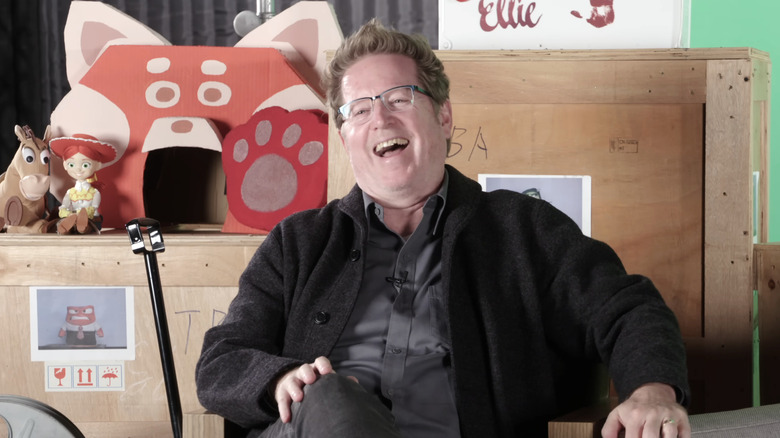
Here are some more great quotes from Andrew Stanton about filmmaking:
"The greatest story commandment [...] is "Make me care."
"Art is messy, art is chaos — so, you need a system."
"I'm a family man, I have kids, and I go to the movies. And I'm just going to make the kind of movie I want to see."
"If you want someone's attention, whisper."
"Use what you know. Draw from it. It doesn't always mean plot or fact. It means capturing a truth from your experiencing it, expressing values you personally feel deep down in your core."