

Teenage Sex And Death At Camp Miasma Review: An Ultra Post-Modern Take On Slasher Flicks
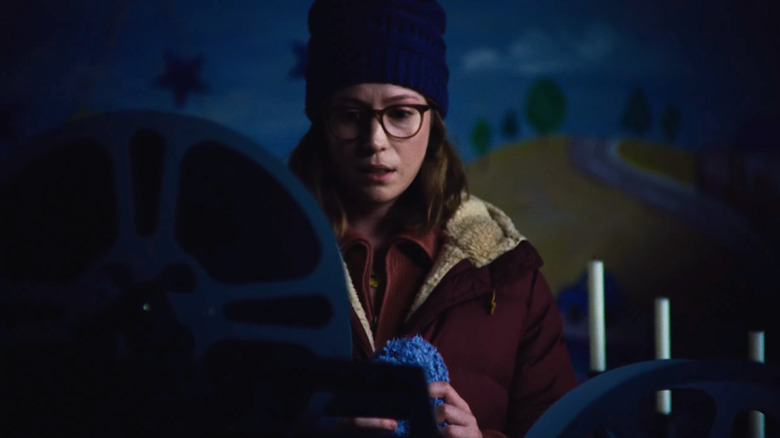
Jane Schoenbrun has said in interviews that their 2024 film "I Saw the TV Glow" was about the "egg crack," that is, the moment when a trans person realizes that they're trans. Schoenbrun, however, was also also making a very frank media study about the way our favorite teen TV shows came to inform — or perhaps misinform — our most formative years. A great TV show or movie can be there for us when we feel like we're alone, and it may even have vital information about ourselves and our personalities embedded within it, but it also can fail us in a profound way. Watching a great TV series may make us think we're getting what we need for a stronger, more well-adjusted life, but in a very tragic way, all we're doing is watching a TV glow. We need to relitigate our favorites and constantly rediscover why we liked them to begin with.
Schoenbrun's new film, "Teenage Sex and Death at Camp Miasma," is also a profound and emotional work of media analysis, this time targeting the corny, sexist, transphobic slasher movies that Gen-X grew up watching in the 1980s. Schoenbrun, however, born in 1987, isn't making a late-stage slasher (like in the late '80s) or a self-aware meta-slasher (like in the '90s), or a violent reinvention of the slasher (like in the '00), or even a thoughtful, essaying dissection of the genre revealing its inherent queerness/misogyny (like one might read in the '10s). All of those things, in fact, are namechecked (sometimes with an eyeroll) in "Sex and Death."
"Sex and Death," then, becomes a '20s essay on the sexual realities that rest within the genesis of all slashers. It loops back around and rediscovers the cathartic sex and death that sparked all this mess to begin with.
Teenage Sex and Death at Camp Miasma is a glorious media analysis for the '20s
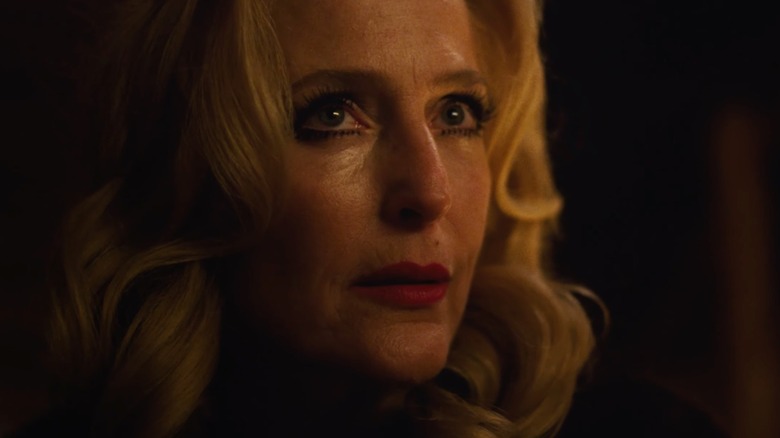
The main character of "Sex and Death" is a queer filmmaker named Kris (Hannah Einbinder) who knows all about recent film history, and who is very well-versed in slashers. She has been hired to remake a fictional 1980 slasher film called "Camp Miasma," a corny, dated movie very much like "Friday the 13th." Many will also likely be thinking of "Sleepaway Camp," and all the transness therein. "Psycho" has a lot to answer for.
In a brilliant opening montage (set to a cover of R.E.M.'s "Nightswimming"), we see the lifecycle of "Camp Miasma" from 1980 to the present. It was poorly reviewed, but financially successful. It racked up sequels. Critics wrote hang-wringing essays about violence in cinema. It spawned merchandise and corny video games. The montage even includes revisitation essays written by a new generation of critics who point out that "Camp Miasma" is misogynistic and transphobic (the slasher in the movies is a trans character).
Schoenbrun does a great job of capturing Kris' — and the audience's — ambivalence about slasher movies. We love something about them, even while acknowledging that they are trash and based in bad ideas. Kris also understands where she stands when making a remake of a 1980 slasher almost 50 years later. In a speech she gives to actress Billy Presley (Gillian Anderson), star of the first "Camp Miasma" film, she understands that she was only being hired because she was queer, and that her queerness is being used as a palliative to any modern criticism about keeping a misogynistic "zombie I.P." alive.
What's really in the middle of Sex and Death at Camp Miasma
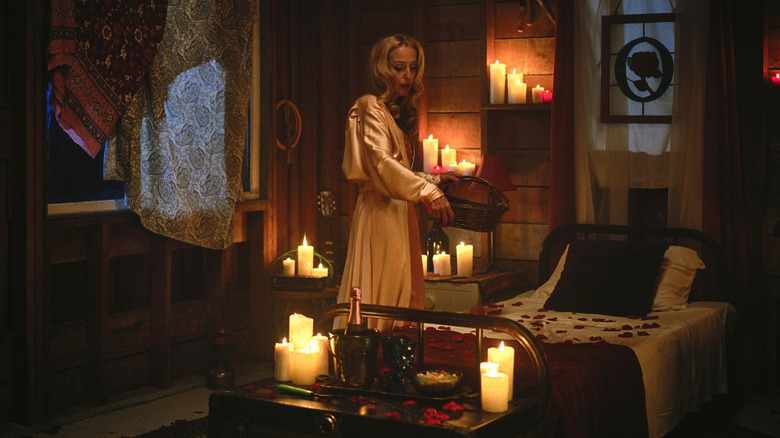
The movie follows Kris as she travels to where the original "Camp Miasma" was filmed in order to meet Presley, who was the teen star of the original movie. In a Norma Desmond-like twist, Presley lives in a cabin in the fictional camp. They will spend the movie dissecting what "Camp Miasma" was all about.
"Sex and Death at Camp Miasma" centers on the conversations between Kris and Billy. Kris, being a young filmmaker, is prone to overanalysis — as seen in my own lengthy amount of context in this very review. As Kris talks about the place that "Camp Miasma" has in the pop consciousness, Billy listens patiently. She then sparks up a joint and begins to ask what sort of emotional reaction Kris had to "Camp Miasma." She says it's about flesh and sex. The pair zeroes in on a specific moment in the original movie when the young Billy (Amanda Fix) had a very intense look in her eye, and they begin to unpack what was happening in that scene.
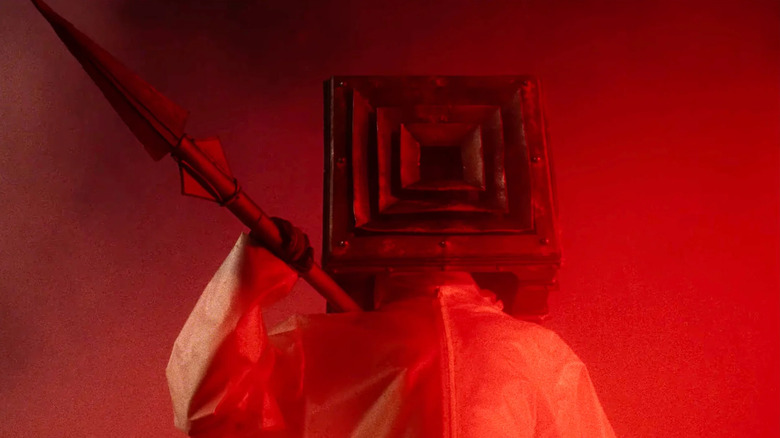
There are frequent looks into the 1980 "Camp Miasma" as well. The movie was about a trans character (played by Jack Haven) that was drowned by campers, and then returned as a vengeful ghost. In an absurd visual, the killer wears a massive, unwieldy cubic air vent on his head. When he cuts off a victim's head, hundreds of gallons of cartoony blood spurt fifty feet into the air. The film-within-a-film is an abstract, almost slapstick riff on 1980s slashers.
Teenage Sex and Death at Camp Miasma is a post-analysis explosion of cathartic queerness
The most telling clue in "Sex and Death," however, is that the killer is nicknamed Little Death. Naturally, the audience will be thinking of "le petit mort," the classic term for post-orgasmic clarity. Billy seems to know that slasher movies are all about the catharsis of sexual discovery, and seems to be guiding Kris in the same direction. As the days pass, the filmmaker and actress become intensely, emotionally entwined, sharing their mutual hangups about sex and orgasms.
And that only brings us about halfway through "Teenage Sex and Death at Camp Miasma." The film eventually spins out into a semi-abstract recreation about what the killer gets out of the movie, what Kris got out of a 1980 slasher, and the function they all really serve. And it all surrounds the sexual tension between a skittish young queer woman and Gillian Anderson, often considered a queer icon. The film is heartfelt, but whimsical. Heady, yet breezy. It aims to find a new critical path we can follow into our favorite trash media, and actually finds one. This is a new type of film for a new generation.
And it's needed. Wes Craven's "Scream" sought to dissect slashers, and featured characters who were well-versed in horror movies. But even "Scream" is 30 f***ing years old at this point. Its sequels ran out of critical juice long ago, and its fans have aged into middle-aged a-holes like me. Schoenbrun now made a movie about a young queer character whose takeaway from slashers has less to do with media savvy than with emotional honesty. The '90s were a long time ago.
Teenage Sex and Death at Camp Miasma is also just great to look at
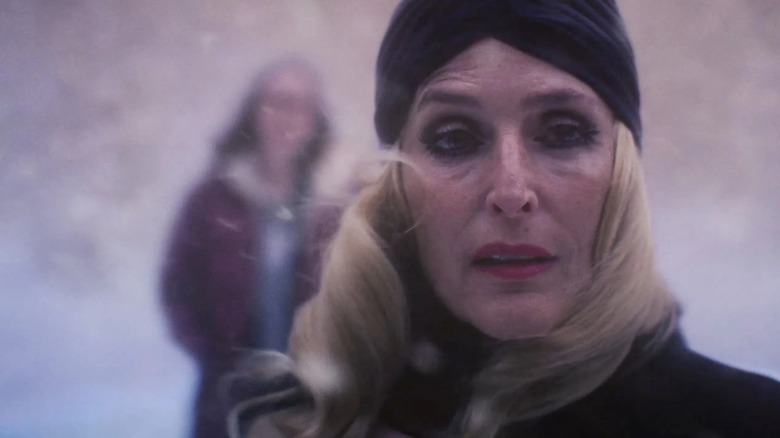
In addition to all this, "Sex and Death" is also exciting to look at. Schoenbrun constructed their film out of artificial, candy-colored backgrounds, leaving everything in a state of whimsical nonreality. The characters seem to subsist on almost nothing but candy and popcorn. When the Kris character has a Zoom call with her bosses, fields a phone call from her agent, or chats with her girlfriend (and her girlfriend's boyfriend), it feels like a call from another reality. Schonbrun's dreamlike style is out in force.
This style helps when the movie turns in on itself, and visits a bizarre Cronenbergian space where movies are flayed by the characters inside of them. Like in "Videodrome," there's a scene where someone inserts a VHS cassette into a gooey, biological aperture. "Sex and Death" makes a joke at the expense of Wes Craven's "New Nightmare" in one scene, but is also comfortably meta in itself.
But it clearly has ambitions larger than merely being a work of media criticism. The public at large, thanks to our constant access to Letterboxd, may be able to write reviews to our heart's content, but it would behoove us to also remember why we're into movies to begin with. How did our favorite movies actually touch us? We might need to look deep into ourselves to find that out.
The film stumbles. It's long-winded in making a pretty simple point, for one. Also, after all the themes have been explored and the messages clearly communicated, Schoenbrun tacks on an optimistic epilogue that felt more like padding than anything. But it doesn't undo the quirky, earnestness of the film that came before it.
/Film Rating: 8.5 out of 10
"Teenage Sex and Death at Camp Miasma" opens in theaters on August 7, 2026.