

This Disturbing Twilight Zone Segment Was Based On A Chilling Arthur C. Clarke Story
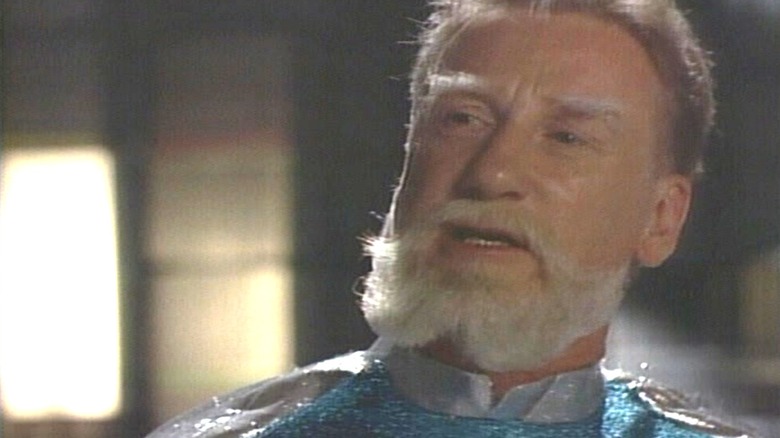
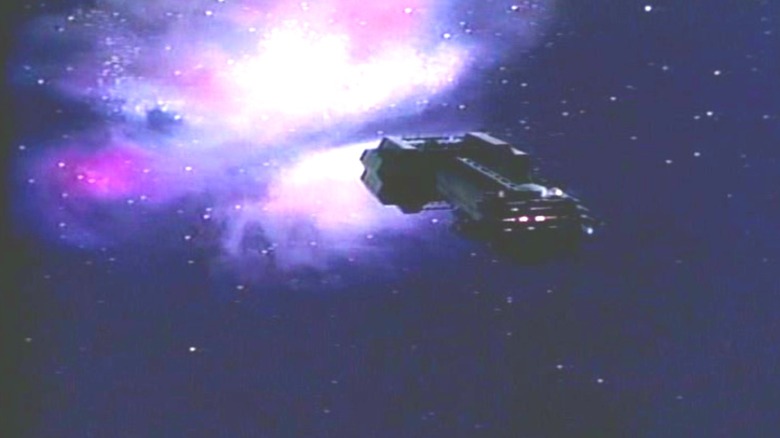
Arthur C. Clarke's story "The Star" was first published in Infinity Science Fiction Magazine back in November of 1955, and it has a doozy of a twist ending. The story follows a group of space explorers in the distant future who have come upon the ruins of a long-extinct civilization. The main character of the story is a Jesuit priest/astrophysicist who, for undisclosed reasons, is suffering from a crisis of faith. He and the other space explorers rifle through an outsize alien archive, preserved in an enormous vault, that kept a whole record of the dead alien's society. Thousands of years earlier, the aliens knew that their sun would go supernova, and had no way of escaping total annihilation. They constructed the archive for the sake of posterity, hoping that someone would find it some day.
The Jesuit priest does some calculating about the distance of the alien world from Earth, and finds that the system's supernova actually times out perfectly to a certain star appearing in the sky over Bethlehem, right about when Jesus Christ was born. Yes, the Star of Bethlehem was actually a distant explosion, and a sign of a whole alien civilization being wiped out. Clarke ends his story on a dour note, with the Jesuit wondering why God needed to kill off an entire world just to give a sign of his Son being born on Earth.
In 1985, "The Star" was adapted into a segment on the new "The Twilight Zone" series, starring Donald Moffatt and Fritz Weaver. The story was kept largely the same, but was rewritten slightly to give the ending a more optimistic tone. It aired on December 20, making it the season's Christmas episode.
The Twilight Zone posited the astronomical origin of the Star of Bethlehem
To offer some logistics, the 1985 reboot of "The Twilight Zone" ran in one-hour episodes that were split into two or three different segments. We ranked the show highly. On December 20, the show ran three segments that included "The Star," a short called "But Can She Type?", and a remake of "Night of the Meek," a famous episode of the original series. "The Star" was directed by Gerd Oswald, a longtime Hollywood workhorse who directed the original version of "A Kiss Before Dying," and several other 1950s crime pictures. (Fans of "Mystery Science Theater 3000" might know his riffed-upon film "Agent of H.A.R.M.") He also helmed episodes of "Perry Mason," "Rawhide," "Voyage to the Bottom of the Sea," and, most prolifically, "The Outer Limits." Oswald directed two segments for the new "The Twilight Zone" before his death in 1989.
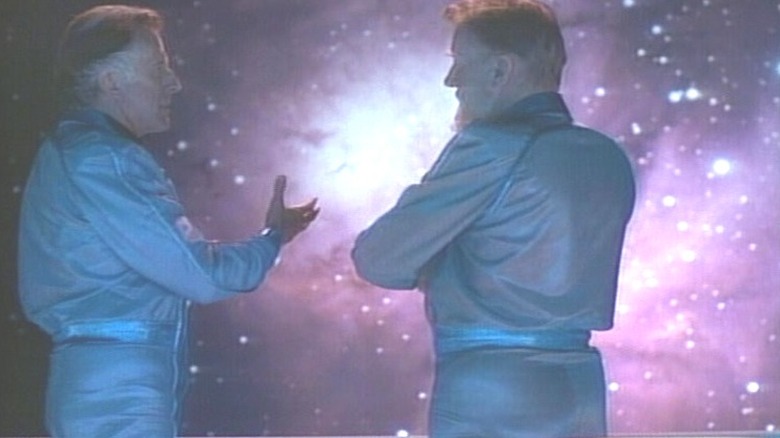
"The Star" starred Fritz Weaver as the priest/astrophysicist Father Costigan and Donald Moffat as the openly atheist Dr. Chandler. When they find the ruins of an alien civilization, it sparks a theological debate on the intent of the Almighty. Chandler asks if God killed these people, or if they were merely the victims of a random natural disaster. Chandler, while happy to confront matters of religious faith, nonetheless starts to feel bad for prodding Costigan; they are friends, after all.
Like in Arthur C. Clarke's original story, they find a distant archive of alien artifacts, and learn that an advanced, Earth-like civilization was lost. Once again, Father Costigan makes his calculations and finds that this planet's sun's supernova was the Star of Bethlehem. When he finds this out, Costigan prays to the Lord, asking why He needed to cause untold destruction just for a miracle to be seen on Earth thousands of years later.
The ending of The Star was slightly different on The Twilight Zone
The episode ends with Chandler approaching Costigan to apologize for confronting him about his faith. He also presents Costigan with an ancient alien poem wherein the extinct people asked not to be mourned. They understood that they had lived their time, their fate was their fate, and there was nothing to feel vindictive about. This comforts Costigan to a degree, seeing that this civilization was so enlightened and peaceful that they could face their extinction with grace.
The poem was not part of Arthur C. Clarke's original story. Clarke's story ended on a bleaker note, pointing out that if there is a God, He's a capricious God. The episode of "The Twilight Zone" ends on a moment of hope, pointing out that death will come for us all, and that there is a larger cosmic dance to consider. If this were to be a Christmas episode, the latter is the better message.
According to the DVD commentary track for "The Star," the screenwriter, Alan Brennert, sent a letter to Clarke, asking if the change was okay, but he never heard back. A lack of objection was approval enough for Brennert, and the makers of "The Twilight Zone" went ahead with the altered ending. Brennert maintains, however, that his altered ending is still in line with his own personal interpretation of Clarke's story. He felt that "The Star" wasn't about irony or a vindictive God, but about how death and life are intertwined.
Clarke didn't pass until 2008 at the age of 90, so if he wanted to raise any objections, he had plenty of opportunity. He never did, though — and he found time to criticize "Star Trek."