

This Must-Watch Animated Series Did The People From The Sea Before The Odyssey
The following contains spoilers for "The Odyssey" and Genndy Tartakovsky's "Primal."
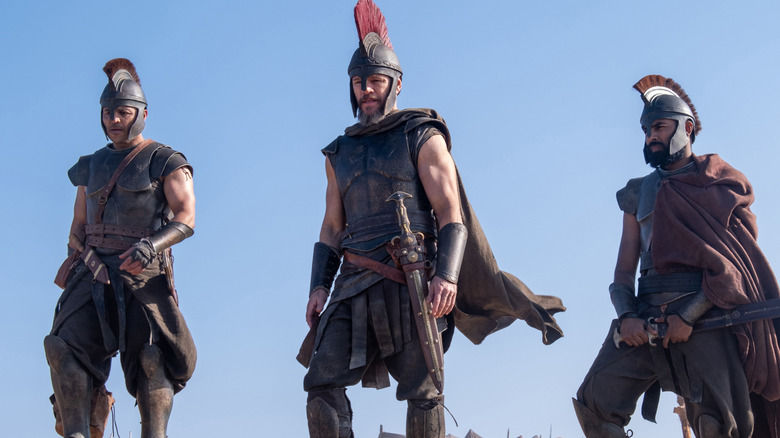
Christopher Nolan's "The Odyssey" is here, bringing Homer's classic story to life in a spectacular fashion. The movie is more than worthy of the word "epic," with huge set pieces, tactile locations, massive puppets, and more.
Arguably the greatest feat Nolan does with his take on the source material is making it a companion piece to "Oppenheimer." Both films are about men grappling with the enormous guilt of being responsible for winning a war through unprecedented means that usher the end of civilization as they know it. Oppenheimer brought about the atomic era and allowed for the push of a button to annihilate humanity. Meanwhile, Odysseus broke the sanctity of Zeus' Law with his little Trojan Horse stunt and created the ultimate betrayal.
This trick led to attacks throughout the Greek islands by some mysterious force known as the People From the Sea. Throughout "The Odyssey," we hear characters talking about preparing for attacks from this mysterious force, and even a whole island burns down their homes in anticipation of these attackers. But we never really see them.
We learn at the end of the movie that this group of raiders who have terrorized countless islands is no strange foreign force but actually the very people Odysseus fought alongside at Troy. They are not some army seeking to conquer, but they are merely people who no longer cared about rules, law, or common sense and became infatuated with war, with pillaging and plundering.
It is a great twist, one that draws from history itself. However, Nolan is not the first filmmaker to do a blockbuster story that features the People From the Sea, or the "Sea People," as antagonists. That's because Genndy Tartakovsky featured the Sea People as the primary villains in Season 2 of "Primal."
Genndy Tartakovsky's Primal features Sea People (and dinosaurs)
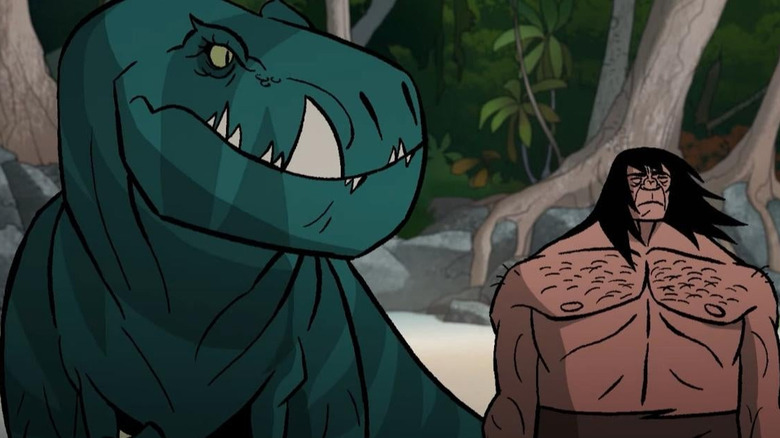
Genndy Tartakovsky's "Primal" is an animated gem with an incredibly high critics' rating that plays like a Robert E. Howard fever dream. The show follows a caveman who befriends a dinosaur and then go on adventures together, fighting witches, dinosaurs, and increasingly more advanced civilizations in a world of magic and all sorts of weird creatures.
Season 2 introduced more civilizations, with Fang (the dinosaur) and Spear (the caveman) fighting Vikings, Celtics, Babylonians, Romans, and more.
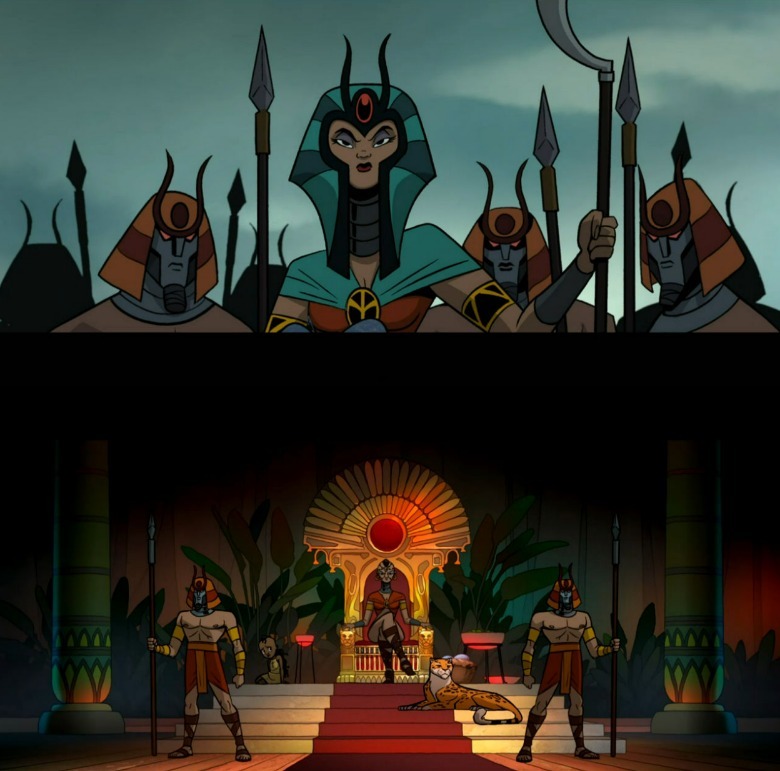
The most curious, however, is the introduction of a civilization heavily inspired by the Sea People, or the People From the Sea referred to in Christopher Nolan's "The Odyssey." They are sort of Egyptian-coded (see below) with some Ancient Egypt architecture and design, but the element of sea-faring attacks andthe giant boat they row into battle, not to mention the way they wreak havoc and destruction wherever they go, sounds very similar to the real-world sea raiders.
 Adult Swim
Yes, the People From the Sea are real. Though they get brief mentions in Homer's poem, the idea of this group of people mostly comes from Egyptian records of unidentified groups that attacked Egypt and other Eastern Mediterranean regions at the end of the Bronze Age. Though never properly identified, these are heavily believed to either be responsible for or at least quite involved in the collapse of the Bronze Age.
Such is the portrayal Tartakovsky goes for in "Primal," with the Sea People being a formidable and quite terrifying force that lives on a mega warship that hosts the entire civilization. Together they plunder and conquer several civilizations, taking survivors as slaves and stealing technology and artifacts for themselves. If "The Odyssey" only really told us the People From the Sea are scary, but "Primal" shows they were right to be afraid.
Humanity is the real monster
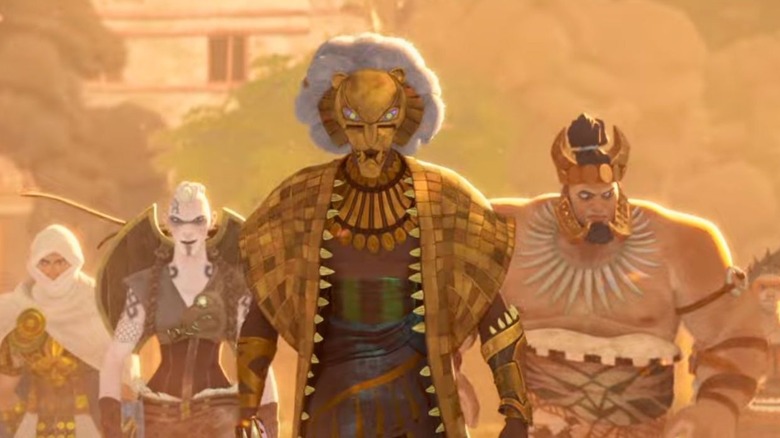
The idea of the Sea People as this unknown yet unstoppable force is alluring, for sure. It's why Marvel's "Eyes of Wakanda" animated series also incorporates them in the very first episode. In it, we learn there is a group of raiders led by a rogue Wakandan War Dog using Wakandan technology to raid and plunder the Mediterranean, attacking the Minoans. The People From the Sea make for excellent villains because we still don't know for sure who they were or if they even existed at all. They are a terrifying force that impacted the ancient world then disappeared.
This is what makes Christopher Nolan's inclusion all the more fascinating, because he makes the connection between this group and the Greeks, a connection that — while not widely accepted — has been theorized before. Authors and archaeologists Susan Sherratt and John Bennett once wrote a book on this very subject, linking "The Odyssey" to the fall of the Mycenaean world and people breaking away from a centralized civilization to raider groups. Likewise, the timeline of the fall of Troy and the fall of Mycenaean Greece aligns with Egyptian records of Sea People attacks. It's not just Nolan's film either, because Homer's poem suggests that Odysseus and his men behave exactly like the Sea People that the Egyptians describe — wandering warriors from a collapsed world that raid the seas.
Several authors had already theorized this connection before, but it hits different when watching "The Odyssey" in IMAX. Seeing Matt Damon's Odysseus grapple with his sins as he confesses his crimes to his wife is already poignant, but knowing how much of it is based on history, and knowing that the stories of the People From the Sea made a genuinely huge impact in the ancient world, makes the ending of Nolan's film all the more impactful.