

The Odyssey Review: Christopher Nolan's Massive Epic Is Both Exhausting And Exhilarating
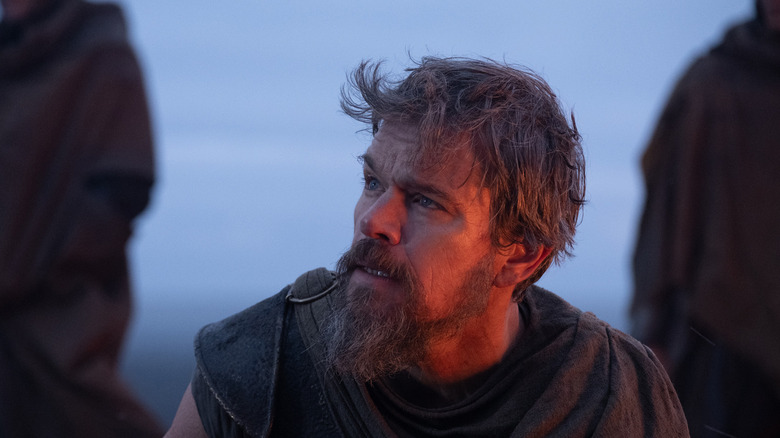
Christopher Nolan's "The Odyssey" is so massive, so sprawling, so imposing that it starts to overwhelm you. Nolan doesn't make small movies anymore, and there's something genuinely awe-inspiring about the level of scope he's able to convey with his heavy blockbusters. With "The Odyssey," Nolan has created something so grandiose that there are times where it feels like he's lost control. It left me feeling both very tired and very thrilled.
The filmmaker's previous movie, the Oscar-winning "Oppenheimer," clocked in at a full three hours, but never slowed down — it's one of the fastest three hour movies you'll ever watch. In contrast, "The Odyssey," which has a (slightly) shorter 173 minute runtime, goes through fits and starts. It drags when it shouldn't, and one gets the impression that the writer-director is striving to fit in as much material as he possibly can, pacing be damned.
Despite a certain messiness that seems entirely unlike Nolan's previous oeuvre, "The Odyssey" is spectacle filmmaking that cries out to be watched on massive IMAX screens. Nolan also achieves a level of emotional clarity here that has somewhat eluded his colder works — the film's final moments are so powerfully moving that they almost knocked the wind out of me. It's scenes like these that make "The Odyssey" worthwhile, coupled with the arresting imagery Nolan and cinematographer Hoyte van Hoytema conjure up to create a fantastical world where encounters with monsters and gods are totally normal, everyday occurrences. "The Odyssey" conveys a sense of wonder on a grand scale. It's the type of movie with multiple scenes that will have you asking, "How the hell did they do that?" That's movie magic, folks.
The Odyssey once again allows Christopher Nolan to play with time
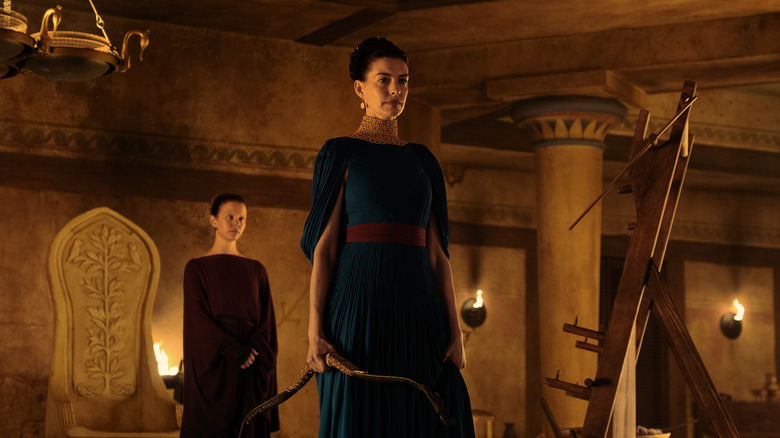
The inherent structure of Homer's "Odyssey," with its stories within stories and decade-spanning timeline, allows Nolan to once again play around with one of his favorite concepts: time. The narrative jumps back and forth through the years as characters remember and recount events that have already happened, leading towards a greater endgame where Nolan gets to unleash one of the most satisfying finales of his filmmaking career coupled with an underlying message that puts a bow on everything he's been working towards here.
Great general and king Odysseus, played by a lean, stoic, haunted Matt Damon, has been absent from his home of Ithaca for ten years now, having gone off to fight in the Trojan War. Odysseus is presumed dead, and at his palatial home, a large gang of cruel, scheming suitors have gathered for the last three years with hopes of marrying Odysseus' wife, Penelope (Anne Hathaway). This doesn't sit well with Odysseus' son Telemachus (Tom Holland), who holds out hope that his father is still alive and will return someday (even though the young man has never really known Odysseus).
Believe it or not, The Odyssey actually recalls Steven Spielberg's recent Disclosure Day
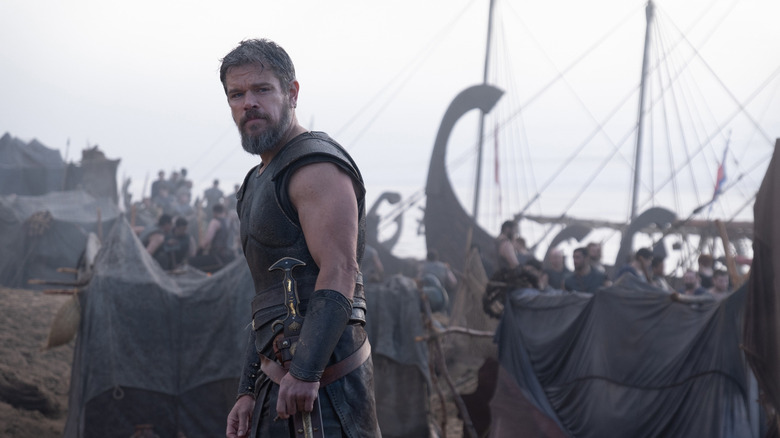
Of course, Odysseus is alive, but he's had a hell of a time getting back home — assuming he wants to come home at all, that is. The aging warrior has taken up residence on an empty island with the alluring Calypso (Charlize Theron), who has worked some magic to erase Odysseus' memories. But they slowly return to him, resulting in a lengthy series of flashbacks in which Odysseus recalls trying to sail back home after the war and encountering one fantastical mishap after the next, including a nightmarish encounter with a towering cyclops and a genuinely terrifying body horror moment where Odysseus' men find themselves transformed into pigs by the witchy Circe, played by a scene-stealing Samantha Morton. Death stalks the soldiers wherever they go, and one by one they're picked off while Odysseus looks on, tormented at his failure to defy the gods and save his men's lives.
In the midst of all this remembering, Odysseus keeps flashing back to the moment the legendary Trojan Horse was hauled into the city of Troy loaded up with soldiers waiting to strike. Nolan very deliberately keeps the outcome of this moment in his back pocket, working his way up to a stunning, harrowing sequence that underscores the entire theme of the film — a theme of finding some sort of way back to the light after succumbing to relentless darkness. Like Steven Spielberg's recent "Disclosure Day," there's a plea (and a hope, however unrealistic) for empathy in a world overrun by selfish cruelty.
The large cast of The Odyssey does great work...with one unfortunate exception
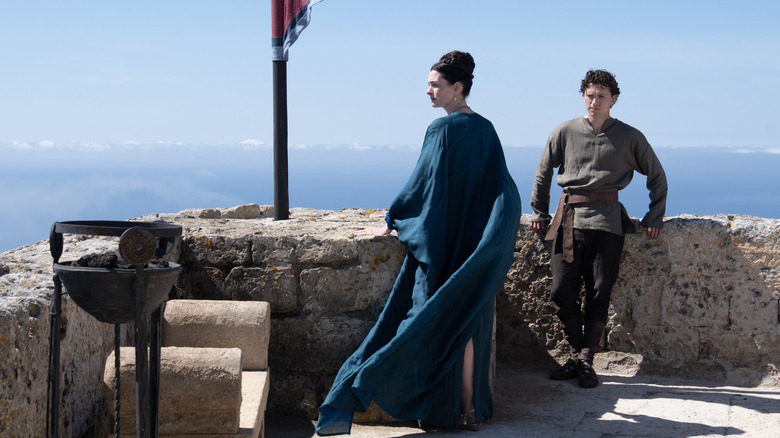
"The Odyssey" also shows Telemachus partaking in his own sidequest, trying to get to the truth of what happened to his father. Unfortunately, Holland is the film's weakest link, delivering a rather flat performance. He feels adrift, and while I suppose the case can be made that this fits his character, it's distracting. Holland is charming and likable in "Spider-Man" films, but he might be miscast here. It doesn't help that he's surrounded by a host of great actors doing wonderful work.
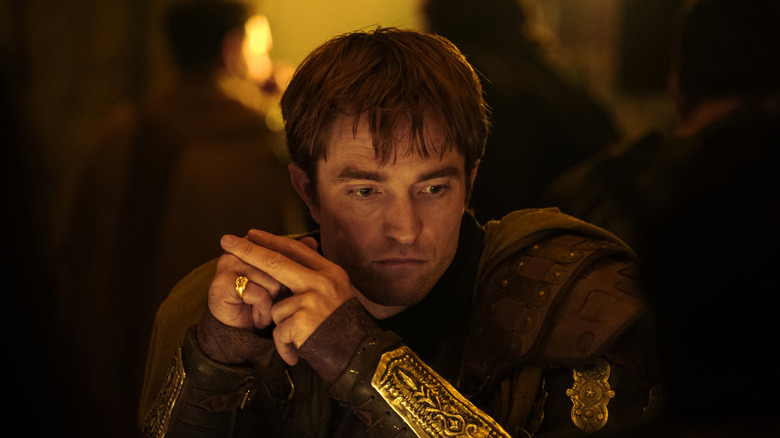
Thankfully, many of Holland's scenes are shared with Hathaway, intense and heartbreaking as Penelope, and Robert Pattinson, wonderfully detestable as Antinous, one of the suitors. The suitors are all so vile and cruel — they abuse Odysseus' loyal, ancient dog, for crying out loud! — that we hate their stinking guts, and Pattinson is pitch-perfect as a scheming creep who thinks he's worthy of being king despite having nothing to back that up.
Other standouts in the massive cast include Elliot Page as Sinon, a tragic, loyal soldier whom Odysseus visits in the underworld in one of the movie's most impactful scenes (I got chills when seemingly thousands of dead soldiers stood shoulder to shoulder on a darkened, gloomy shore), Himesh Patel as Eurylochus, Odysseus' right-hand man who grows weary of the king's decisions, Zendaya as the goddess Athena, whom only Odysseus can see (the film's eventual explanation for this is gut-wrenching), and Lupita Nyong'o as a defiant Helen of Troy, who spits venom at her cruel husband, Menelaus (Jon Bernthal). Nolan makes the fascinating choice to have his actors deliver dialogue in a modern colloquial vernacular (although many of the UK actors adopt American accents), which seems slightly jarring at first but eventually feels perfectly natural.
The Odyssey both drags and thrills in equal measure
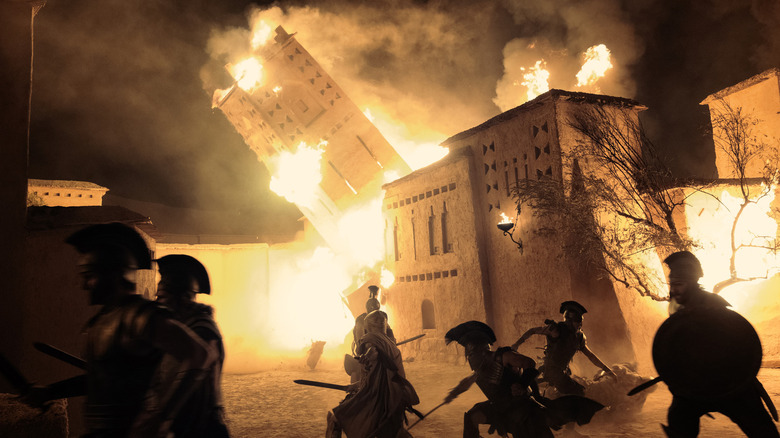
While Nolan finds a satisfying way to tie all these characters and their various threads together, there are stretches of "The Odyssey" that lag and drag, lulling the viewer into a near-stupor. On more than one occasion, I felt like the film was slipping through my grasp. The filmmaker counters this with bursts of violent action. And while many of the action sequences are invigorating, Nolan's propensity for quick, near-abstract cutting renders many of them difficult to follow and needlessly confusing. Intentional or not, it keeps these moments at arm's length when they should be enveloping us.
Nolan also creates dreamy sequences that convey a true sense of awe and wonder — the moment when Odysseus and his men sail past the island of the sirens is a real highlight, with Nolan deliberately avoiding letting us hear the sirens' call but having Damon as Odysseus recount what he heard in a chilling fashion. All of this is enhanced by Ludwig Göransson's pulse-quickening score, full of heavy percussion and, most surprising of all, moody synthesizers.
Almost all of The Odyssey's flaws all slip away during a powerful, emotional finale
It feels a little silly to dance around spoilers for an adaptation of a story written almost 3000 years ago, but I want to avoid giving too much away. Still, the final moments of "The Odyssey" are like a key that unlocks the entire movie, recontextualizing everything that came before it, and to avoid talking about them here, even briefly, would be a mistake. This conclusion is also different from the source material, so I suppose it's good to avoid full-blown spoilers.
Like "Dunkirk" (and to some extent "Oppenheimer"), "The Odyssey" is telling a story about the existential fallout of war and what it does to the souls of those who survive. Nolan isn't interested in a tale of conquering heroes and classical honor. Instead, he's focused on what happens when the dust has settled and the blood begins to dry.
In the film's grand crescendo, Nolan finds a way to tie this ancient story to our modern world in an almost ingenious way, providing an emotional gut-punch that might surprise many of his harsher critics who think his films lack sentiment. It's so effective and so masterful that it essentially smoothed away the film's rough edges for me. Nolan is pulling a grand magic trick here. Like all good magic tricks, we can sort of see the method behind it, but we also want to be wowed by the experience. We want to believe. "The Odyssey" isn't Christopher Nolan's best film, but it is the type of film that only he could make.
/Film Rating: 8 out of 10
"The Odyssey" opens in theaters on July 17, 2026.