

The Odyssey: Zeus' Law Explained
Don't bother following any laws set by gods or men if you haven't watched Christopher Nolan's adaptation of "The Odyssey." Massive spoilers ahead!
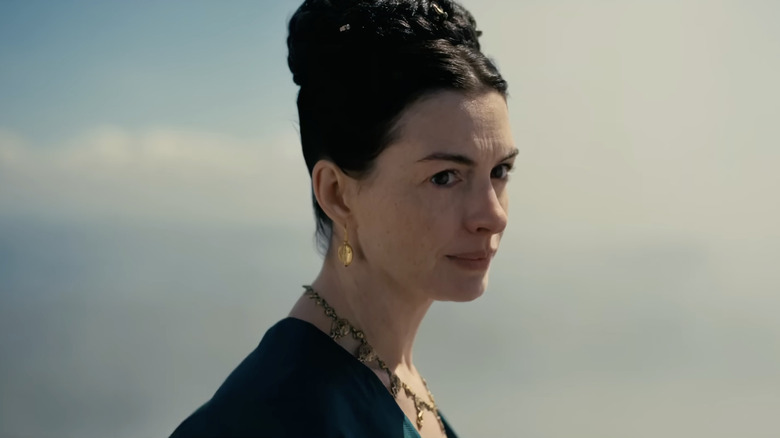
Throughout Christopher Nolan's adaptation of "The Odyssey" (which Chris Evangelista reviewed for /Film), characters like Penelope (Anne Hathaway), her son Telemachus (Tom Holland), and her long-lost husband and our hero Odysseus (Matt Damon) frequently invoke something only known to as "Zeus' Law." So, what does that mean? Well, the gist is "don't be a jerk," but I'll get a little more specific: Zeus' law stipulates that you must treat others as you yourself would wish to be treated. Basically, it's what you might know as the "golden rule."
There's a little more to it than that, though. As we see late in Nolan's take on the legendary epic Greek poem attributed to Homer, when Penelope kindly welcomes a stray beggar into her house who just so happens to be Odysseus in disguise, she makes it clear that, in accordance with Zeus' law, she must treat him with kindness and respect. All of this ties to xenia, a Greek concept of unfettered hospitality.
Zeus is, of course, king of the gods — and even though we don't see him in Nolan's much more human-focused approach to "The Odyssey" (which cuts out pretty much all supernatural interference aside from the interludes where Zendaya's goddess Athena appears to Odysseus in times of need), his name looms large. In fact, breaking Zeus' law is believed to potentially bring about the end of society or civilization, in that a world without kindness and consideration could quite easily cause said world to fall. So, what does Nolan have to say about Zeus' law?
Christopher Nolan has directly addressed his use of Zeus' law in The Odyssey
During an interview about making "The Odyssey" for The New York Times, writer Melena Ryzik asked Christopher Nolan about the frequent invocations of Zeus' law and how it still feels relevant today. (It feels important for me to note this: This version of "The Odyssey" is pretty blunt in its political messaging about war, destruction, and welcoming strangers with kindness and generosity.) When Ryzik pointed this out, Nolan responded:
"The greatness of the poem is such that you approach these things as if they're foreign and ancient, then as you explore them, they suddenly become stunningly relevant. Zeus's law, it's the Golden Rule — treat as you would be treated — and with a theological underpinning in their world, that you might be a god in disguise."
Not only that, but Nolan called it "basic survival," pointing out that anyone who leaves the safety of their home is entering a world that "The Odyssey" depicts as fraught and difficult — so, "you are by definition throwing yourself at the mercy of strangers." That's the heart of the matter, according to Nolan: "That's everything in terms of holding civilization together, or even defining civilization."
According to a piece with Nolan, Anne Hathaway, and Matt Damon in People Magazine, though, Nolan practiced what he preached on set. When Hathaway and Damon recalled moments of kindness (from warm coats to sandwich breaks during long shoots), Nolan pointed out that practicing some form of Zeus' law on a film set is a must so that everyone can be at their best. "So, you see so many little acts of people helping each other along the way to get it done, and it's a really special thing to be a part of," he concluded.
Breaking Zeus' law breaks Odysseus in Christopher Nolan's take on The Odyssey

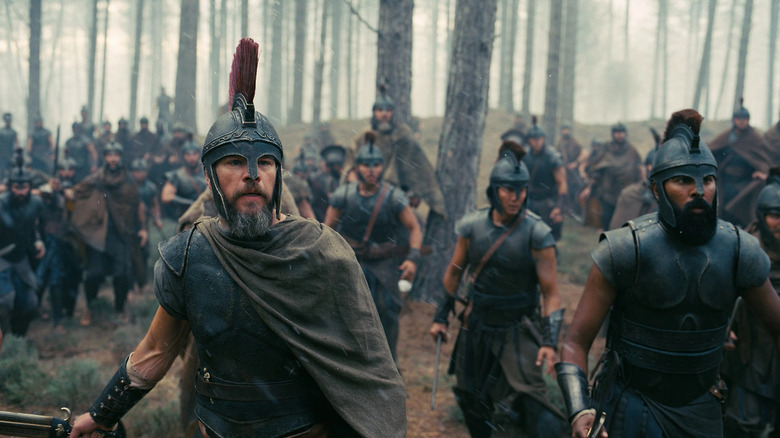
Zeus' law isn't just a concept that characters in "The Odyssey" mention to illustrate the basic social rules of this ancient world; it's something that Odysseus directly breaks, and he eventually understands that he suffers consequences for the actions that defied this law. Anyone who has even a passing familiarity with Greek mythology and history is familiar with the Trojan horse, which was offered as a false gift to the city of Troy but was actually filled with Greek soldiers ready to attack under the cover of night. We see this play out in "The Odyssey" as Odysseus, overcoming memory loss caused by lotus flowers provided by his nymph girlfriend Calypso (Charlize Theron), details exactly what it was like inside the horse and what it was like to watch the sacking of Troy in real time. (The answer to that first thing, by the way, is gross. Lots of bodily fluids with nowhere to go, but I digress.)
During a final-act monologue (masterfully delivered by Matt Damon, by the by), Odysseus grapples with the fact that, by presenting the horse to the Trojans under false pretenses and giving them a deadly "gift," he and his men violated Zeus' law ... and considering the ordeals he faced at sea during his travels from Troy back to Ithaca, it's fair to say he and said men paid the price. Christopher Nolan is, for better and for worse, a pretty direct filmmaker, and his message here is clear: be kind to others or suffer dire consequences.
"The Odyssey," which may yet surpass Nolan's Oscar-winning epic "Oppenheimer" at the box office, is in theaters now.