

The Odyssey's Agamemnon Has A Dune Connection You Might Have Missed
Christopher Nolan has unleashed his "Odyssey" upon audiences, and it is an exhilarating cinematic experience. The filmmaker adapts Homer's epic poem by delivering a spectacle that captures the grandeur of the story, including huge set pieces for the siege of Troy, the partial use of a massive puppet for the cyclops, and some clever camera trickery for the Laestrygonians. And yet, Nolan also delivers a rather intimate and grounded story of a guy who realizes that his greatest achievement was also his greatest sin. It's a story about a literal guilt trip.
Still, it's one hell of a moviegoing experience. The scope of "The Odyssey" is matched by its incredible cast. Nolan packed "The Odyssey" both with regular collaborators and familiar faces, like Elliot Page, Anne Hathaway, and Himesh Patel, while also bringing in some unexpected names that make big impressions, like Samantha Morton and John Leguizamo.
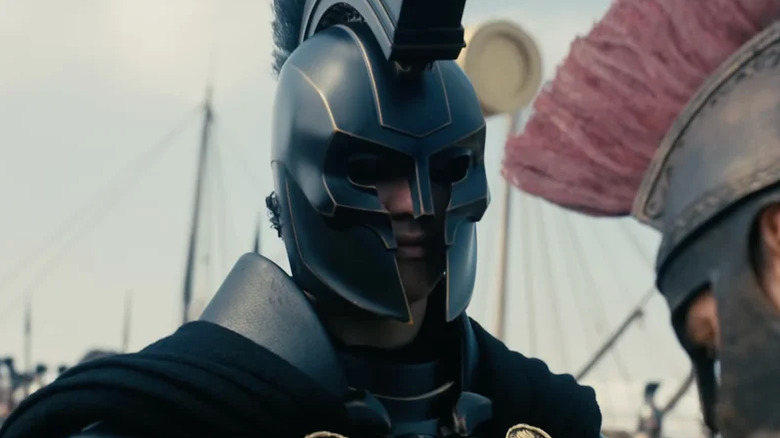
Every role in the film is cast for maximum impact, and every role (no matter how small) is memorable. Such is the case for King Agamemnon, commander of the Achaeans during the Trojan War. Agamemnon is played by Benny Safdie, who gives the character an imposing presence while saying rather little. From his commanding physicality to his stunning black armor, the moment Agamemnon steps onto the stage, he is very clearly someone important that men will follow.
It's no wonder, then, that Agamemnon has a significant connection to Frank Herbert's "Dune" — one that many fans may have missed. You see, in the world of "Dune," Paul Atreides (the character played by Timotheé Chalamet in the most recent films) is actually a very, very, very distant but direct descendant of Agamemnon himself.
The Odyssey is (technically) a prequel to Dune
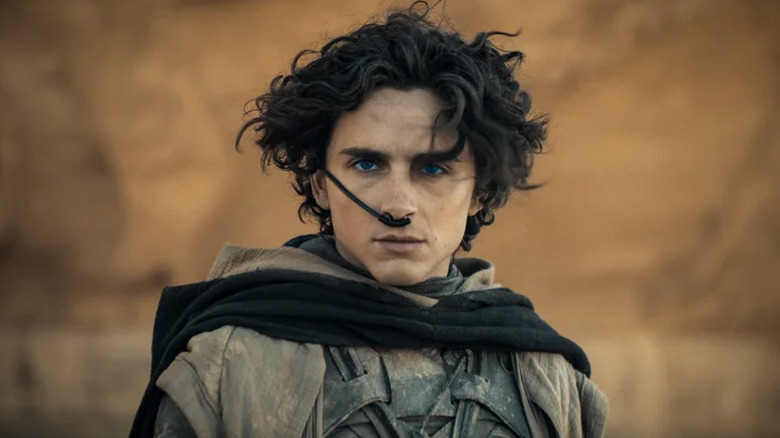
The world of "Dune" may feel very alien, but it's surprisingly close to our reality. Sure, it takes place in an extremely far future, but it's set in a universe in which Earth once existed (but is now a giant national park). In the books, after becoming Emperor of the Known Universe, Paul Atreides reads of past Earth dictators and compares the number of dead under his reign to those under Stalin and Hitler.
In "God Emperor of Dune," however, we get an even bigger connection between the Atreides and real Earth history. While journaling during his endless existence, Leto II (now turned into a worm-hybrid monstrosity) writes that "My paternal grandfather was The Atreides, descendant of the House of Atreus and tracing his ancestry directly back to the Greek original." Leto II is referring to the Greek hero Atreus, the father of Agamemnon and Menelaus. That makes Benny Safdie's character a direct ancestor of Leto, Paul, and ultimately Leto II. Paul's last name, Atreides, translates to "Son of Atreus."
This would mean the entirety of "The Odyssey" is technically a prequel to "Dune," so we should all start adding "Troy" and now Christopher Nolan's movie to our "Dune" marathons before "Part 3" drops later this year.
What makes this more than just a cool nod is that Agamemnon's family history kind of mirrors that of Paul. See, the House of Atreus is known for its multi-generational curse in Greek myths. The founder of the house, Tantalus, was cursed by the gods for trying to kill his son and feed him to the gods, and for four generations thereafter, tragedy struck his house in the form of murder, adultery, and even cannibalism. Now, imagine telling Benny Safdie's Agamemnon that a descendant of his will one day turn into a giant worm.