

If You Loved Christopher Nolan's The Odyssey, Stream This Movie For Free Next
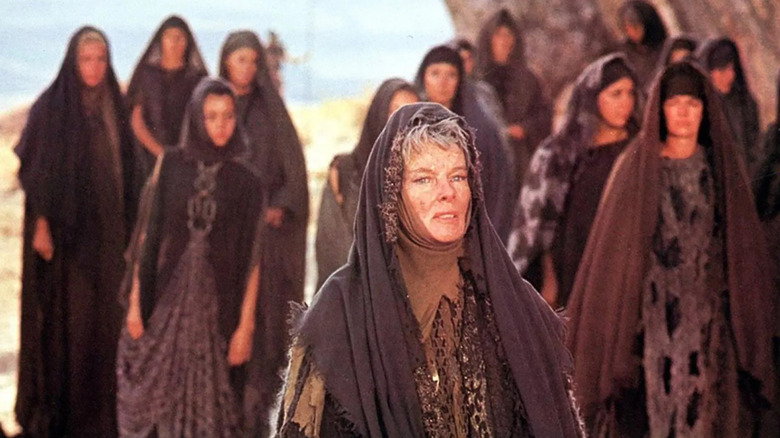
Christopher Nolan's epic adaptation of Homer's "The Odyssey" is already proving to be one of the best films of the year, and it has sparked renewed interest among moviegoers in Greek literature, mythology, and the countless film adaptations of it all. "The Odyssey" is a nearly 3,000-year-old text, yet the story of a man's journey back home to Ithaca following the end of the Trojan War is still captivating after all these years.
But what of the other stories after the fall of Troy? One of the all-time greats is "The Trojan Women," a tragedy written by the Greek playwright Euripides, first produced about 200 years after "The Odyssey." The play has inspired countless other works, but it was most notably adapted into a feature film in 1971, boasting a star-studded cast including Katharine Hepburn, Vanessa Redgrave, Geneviève Bujold, Irene Papas, and Brian Blessed.
Using Edith Hamilton's translation of the play, director Michael Cacoyannis' "The Trojan Women" marked his return to classical Greek literature following the start of his "Greek tragedy" trilogy with "Electra" in 1962. Save for the omission of the Greek deities' presence in the play, "The Trojan Women" is faithful to a fault, with the dialogue feeling as presentational as the stage play, which might be jarring to some viewers. But it's the shift in perspective that makes the story such a worthwhile companion piece to "The Odyssey." The story is a moral sleight of hand, taking one of the foundational acts of heroism, dwelling instead on the cruelty, grief, and dehumanization that the "conquest" left behind. Instead of celebrating victory, "The Trojan Women" focuses on the women now condemned to survive in its aftermath.
The Trojan Women is an anti-war story
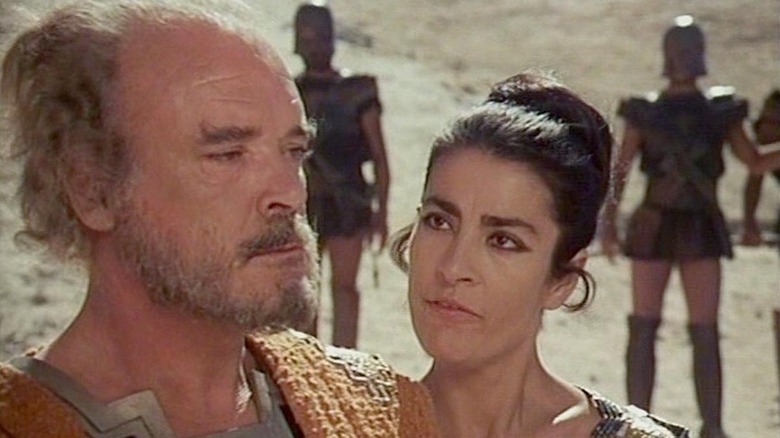
Michael Cacoyannis was a Greek Cypriot filmmaker, playwright, actor, and lawyer, and consistently centered Greek stories, actors, and language in his work. By casting Katharine Hepburn and Vanessa Redgrave in "The Trojan Women" and telling the story in English, he was clearly attempting to emphasize the universality of war's brutality to the largest possible audience, and used the vehicle of two of Hollywood's biggest names to deliver the warning. Detractors will say that "The Trojan Women" reads too much like a play and that the film's constant emotional intensity at an 11 becomes exhausting or grating after a time, but that's a bizarre and misogynistic criticism given what the film is about.
No one complains when an action drama consists of men screaming for two hours about the perils of war, but it's apparently shrew when women who have had their city burned, their families slaughtered, their loved ones (or themselves) raped, and the entire existence of their world erased overnight dare to vocalize their agony. If there were ever a situation that justified inconsolable grief, this would be it. The inhuman sound of agony Redgrave's Andromache delivers upon learning of her son's impending execution is rivaled only by Jessie Buckley's in "Hamnet," and Hepburn's Hecuba softens her iconic vocal patterns for one of the most vulnerable performances of her career.
And they're supported by standout turns from Geneviève Bujold as the maniacally prophetic Cassandra, while Irene Papas leans beautifully into Helen's essential ambiguity. Fascinatingly, while her sister Clytemnestra does not appear in "The Trojan Women," Cacoyannis cast Papas to play her in 1977's "Iphigenia" — the dual role Lupita Nyong'o replicated in "The Odyssey."
The Trojan Women continues to be relevant
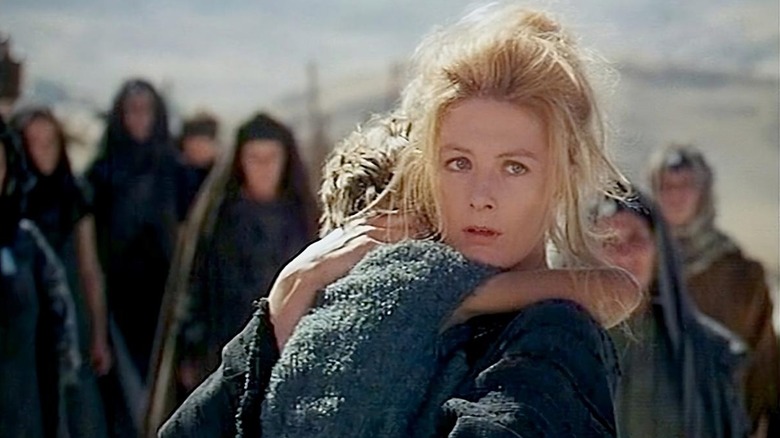
Anti-war movies are understandably dominated by stories about those who experienced the hell of serving on the front lines, as seen in Academy Award winners like "All Quiet on the Western Front" and "Saving Private Ryan." Less time is dedicated to those ravished by the war simply for existing.
As an adaptation, "The Trojan Women" captures the spirit of Euripides' play in that it isn't interested in catharsis or triumph, but in wallowing in agony. In recent years, the books "A Thousand Ships" by Natalie Haynes and "The Silence of the Girls" by Pat Barker have both retold the mythology of the Trojan War from the perspective of the women involved. After the success of "The Odyssey," it's not out of the realm of possibility that "The Trojan Women" might be adapted once again (everyone loves familiar IP!), or that one of these novels is given the feature film treatment next.
The story of these women is both timely and timeless. The 1971 film features a closing dedication that reads, "We who have made this film dedicate it to all those who fearlessly oppose the oppression of man by man." It's an evergreen statement if there ever was one, especially in the face of everything happening around the globe right now. Women and children in countries like Palestine, Iran, Ukraine, Sudan, Myanmar, and Syria are suffering in the wake of wars destroying their homes, killing their families, and obliterating their communities. Their stories deserve to be told, and their experiences validated because war doesn't just impact the people who fight in it.
"The Trojan Women" is currently available to stream on Kanopy, which is free with your public library card from participating libraries or a university login.