

Strange New Worlds Season 4 Finally Gives Star Trek A Proper Martian Alien Race
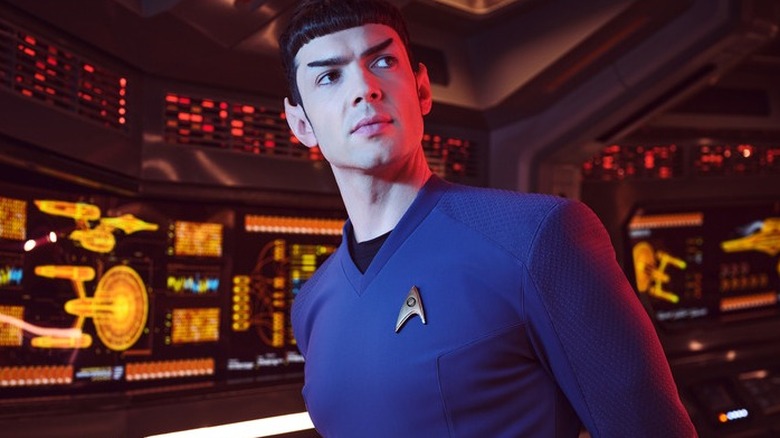
Spoilers ahead for "Star Trek: Strange New Worlds" Season 4, Episode 1, "Valles Marineris."
Early science fiction commonly depicted Mars as flourishing with life. Take "A Princess of Mars" by Edgar Rice Burroughs, where the red planet is filled with human-looking Red Martians, enormous, multi-limbed Green Martians, and more.
This changed when we started to actually explore Mars via probes in the latter half of the 20th century and discovered it can't support human-like life. "Star Trek" lucked out making Spock half-Vulcan instead of half-Martian, so the sterling sci-fi franchise doesn't have to run with the now ludicrous idea of space traveling aliens living just one planet away from Earth.
But the "Star Trek: Strange New Worlds" Season 4 premiere has finally introduced true Martians with a favored "Trek" plot device: time travel. The Enterprise is thrown off course by an "interstellar squall." Its crew initially thinks they're in an uncharted corner of the galaxy, only to learn they're actually in the Sol system... 65 million years ago. Earth is still teeming with dinosaurs, and Mars is home to an alien race that has impulse-propulsed starships (but no warp drive).
The militant Martians are at war with a ravenous insectoid alien race who's attacked their currently lush and green world; the enormous canyon on the Mars equator that gives the episode its title, Valles Marineris? Actually a war wound left on the planet. Captain Pike (Anson Mount) tries to share the Federation's ideals of interspecies cooperation with the Martian Commander (Saffron Burrows), but it all falls apart. Martians steal antimatter from the Enterprise and destroy their enemies' homeworld, but the loss of a planet shifts Mars' orbit and eventually turns it into the wasteland we know today.
Fate dictated the Martians destroy themselves and their home so humanity could exist.
Strange New Worlds' Martians subplot picks up a Next Generation storyline
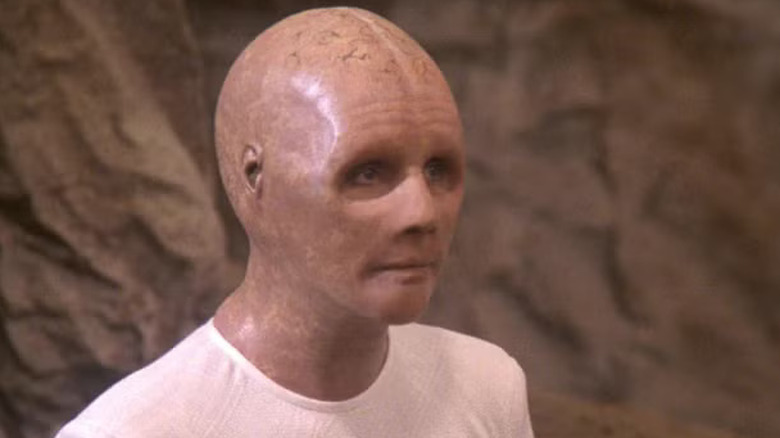
Pop culture has traditionally portrayed Martians as little green men. The "Strange New Worlds" Martians hardly resemble that: They have pointed ears, are slightly taller than humans, and wear blue tattoos (?) on their foreheads. Besides that, they look basically human... around 65 million years before humans evolved. Massive coincidence, huh?
Almost all the major alien races in "Star Trek" look like humans with some makeup. The real reason is budget. That and because it's easy to empathize with the familiar. (Correspondingly, "Strange New Worlds" engages in humanoid cultural chauvinism; the Martians' enemies are big locusts, so you don't feel too bad that their race gets genocided.)
"The Chase," an episode of "Star Trek: The Next Generation," offers a canon explanation for all the human-like aliens in the galaxy. Billions of years ago, ancient aliens seeded their genetic code across many worlds, giving rise to life in their image. ("Star Trek: Discovery" picked up from "The Chase" and delved into these Progenitors.) Ergo, the Martians are just more alien life seeded by the Progenitors. Moreover, the ending of "Valles Marineris" suggests some Martians made it off-world before their race's extinction, offering yet another reason that so many aliens look like them.
Notably, there is a scientific hypothesis that life on Earth could have originally sprung from Mars, but it's far more mundane that the explanation in "Strange New Worlds." (It argues that ancient bacteria from Mars came to Earth via asteroids.) Even Bill Nye the Science Guy, an opponent of humans moving to Mars, has argued the idea that Earth life originated on Mars is worth investigating. Just don't expect to find any fossilized spaceships buried in Valles Marineris.
"Star Trek: Strange New Worlds" is streaming on Paramount+.