

Star Trek: Why Do The USS Voyager's Nacelles Fold?
We may receive a commission on purchases made from links.
Welcome to Trekspertise, a series where we break down the technology, history, details, and decisions that make the Star Trek universe so complex — and so fun.
"Star Trek" creator Gene Roddenberry had four essential rules when it came to designing starships for his show. He liked the idea of ships being somewhat spindly, with engines that were held aloft from the ship's central hull; this wasn't going to be a universe of rocket boosters or phallic shuttles. His starships were to be more elegant than that. By Roddenberry's dictate, starships were to 1) have a pair of warp nacelles, 2) have nacelles that extended up from the central hull so as to have a sight line with one another, 3) have nacelles that were visible from the front, and 4) have a bridge that was located right on the top of the ship.
Most ships in "Star Trek" have abided by these rules, although there are several notable exceptions. The USS Defiant on "Star Trek: Deep Space Nine," for instance, has nacelles that are solidly inside the main hull. That ship, however, was — within the show's canon — an abandoned prototype.
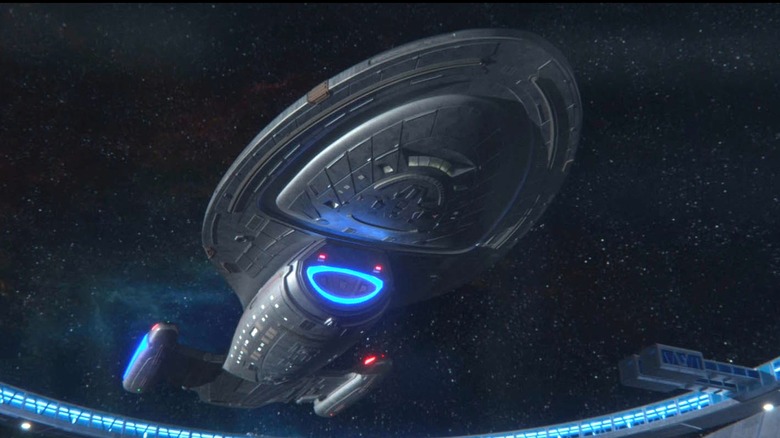
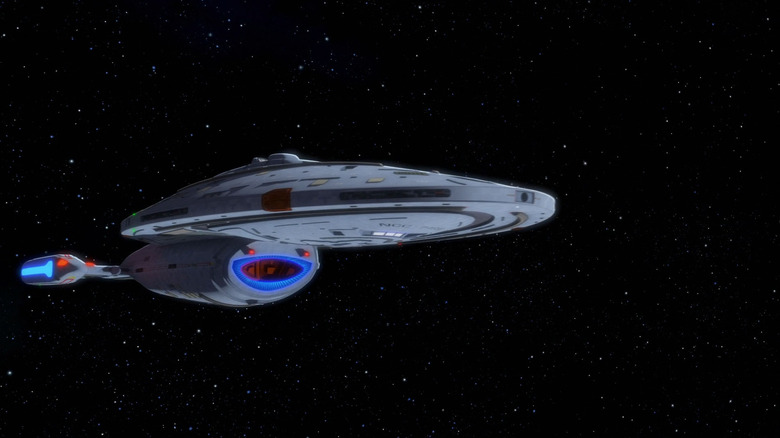
Some will also note that the USS Voyager from "Star Trek: Voyager" also deviates from Roddenberry's rules ... when the ship is traveling at impulse speeds. When the Voyager is traveling slower than that speed of light, its nacelles extend directly outward from its sides, making the back half of the ship totally flat. When it moves to warp, however, the ship reconfigures. The nacelles fold upward at a 45-degree angle, and the Voyager takes off.
Why does the Voyager do this? Because it changes the geometry of the ship's warp field.
The folding nacelles on the USS Voyager are called variable geometry pylons
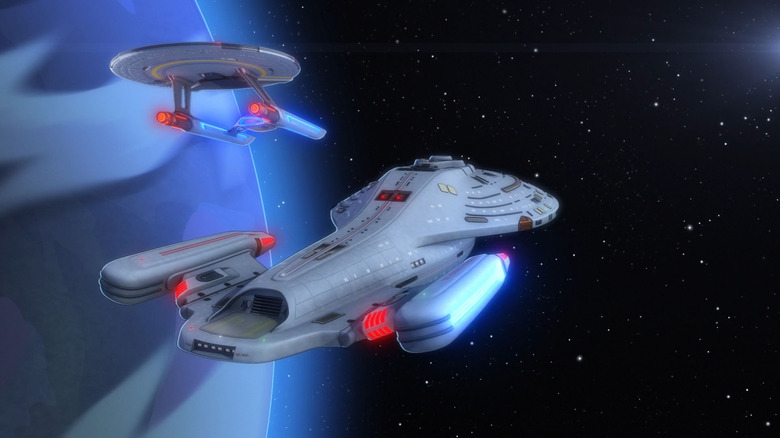
To put a fun term into your brain, the folding nacelles on "Star Trek: Voyager" are named variable-geometry pylons. And what is variable geometry in "Star Trek?" Well, let's delve into some nerdy details for a sec.
In a previous Trekspertise article, we explained what exactly warp nacelles were, and how they worked. In brief, the nacelles project a bubble-shaped warp field around a starship, which effectively warps the fabric of space-time. The ship then moves at sub-light speeds over space that is being rapidly "bunched up" and "re-extended" in front of it. This allows a starship to travel many, many times the speed of light without technically violating the laws of physics.
The handy "Star Trek: The Next Generation Technical Manual," written by Rick Sternbach and Mike Okuda, goes into some detail about the complex geometry of warp fields, and there is mention of geometric correction vectors, and the relative differences of the warp field at various speeds, all measured in millicochrans (naturally). It's all very technical.
According to dialogue in the "Star Trek: Voyager" episode "Learning Curve," the Voyager's warp fields can be activated in an idle state, and that's when the pylons are in their down-folded, flat configuration. When a warp field needs to be projected around the ship, the pylons fold up, changing the shape of the warp field's geometry. Variable-geometry pylons were first mentioned in the "Technical Manual," when the authors were theorizing about future starship designs beyond the construction of the Enterprise-D. They mentioned that a theoretical variable geometry pylon could optimize field stress during extended warp-8+ flight, "resulting in significantly improved energy efficiencies."
So there you have it.
The plans for the USS Voyager's designs were in place years before the series was made
It should be noted that the "Technical Manual" was actually authored before "Star Trek: Voyager" was put into production, and only applies specifically to the Enterprise-D on "Star Trek: The Next Generation." The authors, then, had to present variable-geometry pylons in the context of that vessel. Sternbach and Okuda mention that a ship would have to be much smaller than the USS Enterprise-D for folding pylons to function. Luckily, the USS Voyager is only 344 meters long, while the Enterprise-D is 641 meters long. It's nice to know that the "Voyager" creators were paying attention to their own universe's limitations.
There was also supposed to be a technical manual devoted to "Star Trek: Voyager," authored by Sternbach and Okuda, and while it was never published, some of its lore has leaked its way into the brains of resourceful Trekkies (and online too, for anyone interested). This document suggests that the folding nacelles had such complex geometry that it actually solved some lingering environmental issues left over from "Next Generation."
In the "NextGen" episode "Force of Nature," it was stated that starship warp fields were actually doing environmental damage to certain areas of subspace, and once this was discovered, the top speed limit of all Federation vessels was limited to Warp-5. You'll notice that Captain Picard (Patrick Stewart) stopped saying "set a course, Warp-9" after that, and fell back on "set a course, maximum warp."
But the variable geometry pylons were actually installed as a means to eliminate the negative effect that warp engines were having on the environment. The USS Voyager could, then, travel at immense speeds without harming anything (its max speed was Warp-9.975). It's always nice to be environmentally conscious.