

Why The Terminator Credits Include A Thank You To Sci-Fi Author Harlan Ellison
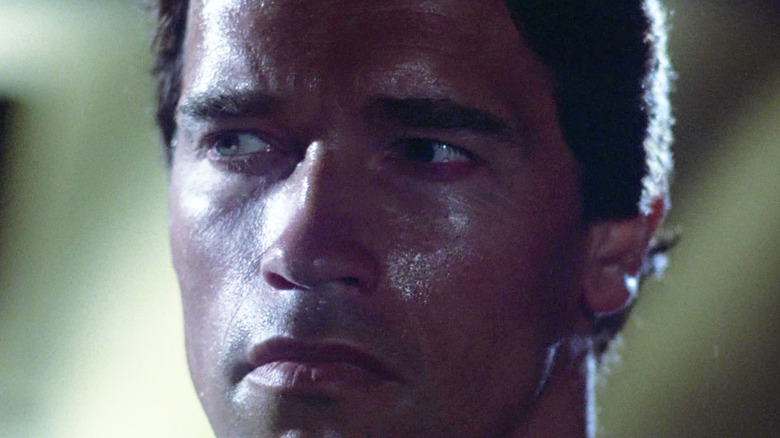
We may receive a commission on purchases made from links.
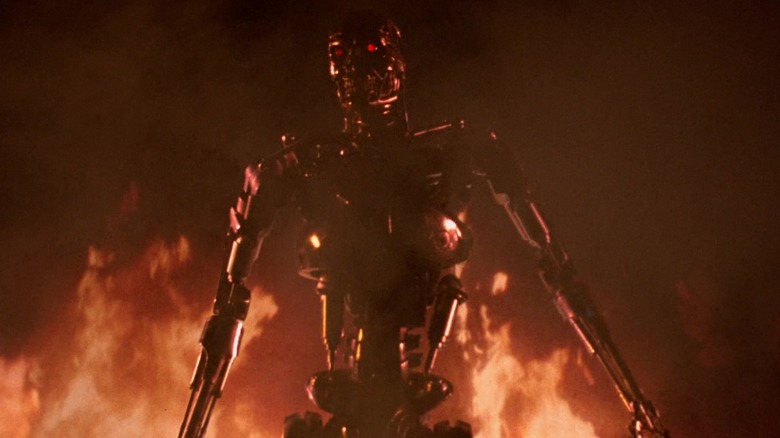
Fans of "The Terminator" will likely know the story of director James Cameron's nightmarish vision that inspired the film. The story goes that he was in Italy enduring the troubled production of his directorial debut, "Piranha II: The Spawning." After falling ill, he had a fever dream in which he saw the image of a chrome skeleton emerging from a fire. Thus, The Terminator was born. Except that's not the full story — at least according to Harlan Ellison, who during one of the many times he lashed out at Hollywood once claimed Cameron had ripped off his episode of "The Outer Limits."
The beloved sci-fi author behind one of the best "Star Trek" episodes hated Hollywood, and that almost certainly played into the multiple times he took legal action against creators, studios, and networks. Ellison had previously sued ABC over their show "Future Cop," and that wouldn't be the first time he was embroiled in a lawsuit over a futuristic sci-fi property.
Those paying close attention might have noticed that the closing credits for "The Terminator" include a thank you to Ellison. According to the writer, Cameron had admitted during an interview with Starlog Magazine that the film's story ripped off "Soldier," an Ellison-scripted episode of "The Outer Limits." But wait, didn't Cameron get his idea from a fever-induced nightmare? Not so, according to Ellison, who in 1957 wrote a short story titled "Soldier from Tomorrow," which he later adapted for his "Outer Limits" episode. In the writer's estimation, it was in this, and not Cameron's nightmare, in which the seeds for "The Terminator" were planted.
Harlan Ellison claimed to have proof that James Cameron stole from The Outer Limits
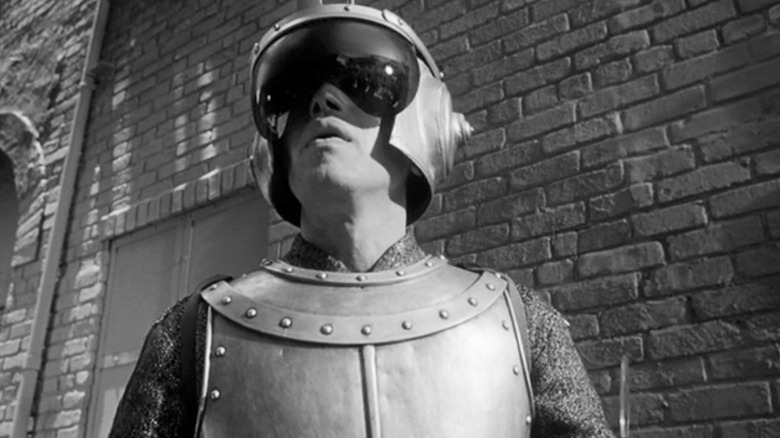
James Cameron is one of the highest-grossing movie directors of all time, and he started with 1984's "The Terminator." Cameron crafted a film that felt ahead of its time, interrogating the consequences of unmitigated technological advancement through an innovative sci-fi slasher unlike anything else. Anything, that is, but "Soldier."
Harlan Ellison recognized Cameron's story about a cyborg sent back from the future to kill the woman who would give birth to the leader of the human resistance as being lifted from his 1964 "Outer Limits" episode. Indeed, "Soldier" begins in a future war wherein two troops, played by Lloyd Nolan and Michael Ansara, do battle only to be transported into a time vortex. Nolan's soldier is deposited in 1964, while Ansara's remains trapped in the portal, only to finally break free, leading to a climactic showdown between the pair.
Ellison wasn't having it. In "The Futurist: The Life and Films of James Cameron," author Rebecca Keegan quotes the writer as saying, "I loved the movie, was just blown away by it. I walked out of the theater, went home, and called my lawyer." More than that, Ellison claimed Cameron had admitted to stealing his material on multiple occasions, one of which came during a 1984 interview with Starlog Magazine.
According to David Brennan of James Cameron Online, Ellison claimed to have received a call from the Starlog editor who told him Cameron originally said he'd taken from "a couple of 'Outer Limits' segments" when creating "The Terminator." For Ellison, this constituted a smoking gun.
Harlan Ellison won his Terminator acknowledgement but James Cameron wasn't happy
After allegedly seeing an original version of James Cameron's 1984 Starlog interview, Harlan Ellison claimed he went to production company Hemdale and distributor Orion Pictures and essentially said, "Do you want to do something about this or do you want us to whip your ass in open court?" The companies settled for an undisclosed sum and agreed to add a credit to the end of all future releases of "The Terminator," including home video releases. Thereafter, the "Terminator" credits included the phrase, "Acknowledgment to the works of Harlan Ellison."
The fact that Orion and Hemdale didn't fight Ellison's claim suggests there might be some truth to the Starlog stuff. That said, Cameron has denied any of it. "It was a nuisance suit that could easily have been fought," he said (via "The Futurist"). "[...] I had no choice but to agree to the settlement. Of course, there was a gag order as well, so I couldn't tell this story, but now I frankly don't care. It's the truth. Harlan Ellison as a parasite who can kiss my a**."
The author certainly didn't stop hounding Hollywood for acknowledgment after "The Terminator." Ellison later sued New Regency for allegedly ripping off one of his short stories with "In Time" and even kept a close eye on Cameron. As a 1991 Los Angeles Times report notes, Ellison once again raised hell when he noticed a laserdisc release of "The Terminator" didn't contain his acknowledgment credit. "The agreement we entered into five years ago has been breached," he said. "The credit is not on the laser disc." Turns out the laser disc was released before the settlement, but Ellison clearly wasn't about to let anything slide.