

Star Trek: Strange New Worlds Season 4 Pays Homage To A Ray Bradbury Sci-Fi Classic
Spoilers for the "Star Trek: Strange New Worlds" Season 4 premiere ahead.
The "Star Trek: Strange New Worlds" Season 4 premiere, "Valles Marineris," has a fun premise. Plot-wise, the episode kicks into gear when the USS Enterprise is caught up in an energy wave and forcefully deposited in an area its crew doesn't immediately recognize. With the vessel having been damaged, an away team beams down to a nearby planet that appears to be populated by unknown fauna.
After some scanning, the Enterprise's crew realizes that they have been transported back in time million of years. This mysterious world is actually Earth during, roughly, the Mesozoic period, and the "unknown" fauna are, in fact, dinosaurs (as teased in the "Strange New Worlds" Season 4 trailer). Naturally, the show's characters are astonished to see a full-grown Tyrannosaurus in their vicinity.
Unexpectedly, however, the Enterprise crew finds that Mars also has a thriving civilization of space-faring humanoids and are locked in a heated, prolonged war with the denizens of the fifth planet in the solar system. Except, that fifth planet isn't Jupiter, it's a heretofore unknown world. Those who love astronomy will be able to tell you that the particular planet is destined to become the asteroid belt.
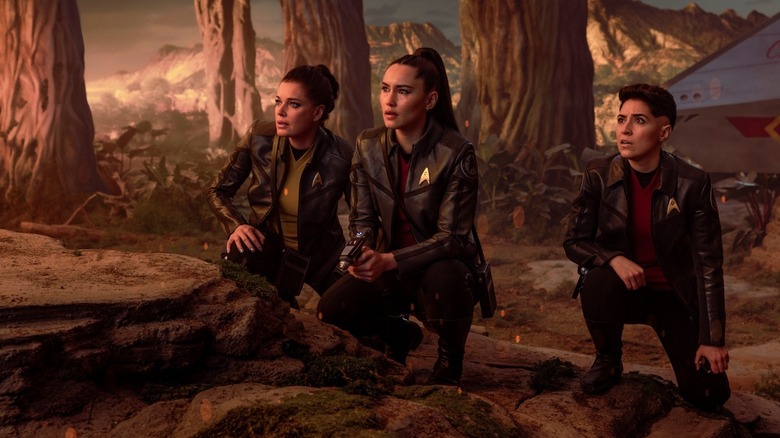
Of course, with the Enterprise's away team — Commander Chin-Riley (Rebecca Romijn), Lieutenant Noonien-Singh (Christina Chong), and Lieutenant Ortegas (Melissa Navia) — tooling around with dinosaurs, questions immediately arise as to how much they should interfere with Earth's natural development. Clearly, the show's characters have read Ray Bradbury's 1952 short story "A Sound of Thunder." That's the tale wherein a time traveler from 2055 treks to the Mesozoic and accidentally steps on a butterfly. As such, when he returns to 2055, everything has changed, and a dictator is ruling the United States.
The Strange New Worlds Season 4 premiere plays with the premise of A Sound of Thunder
"A Sound of Thunder," to elucidate a bit, begins in 2055, when time travel has become a common form of tourism for the rich. A hunter named Eckels wants to shoot a Tyrannosaurus, so he travels to the Mesozoic with explicit instructions. He can only shoot animals destined to die of natural causes, and he has to stay on a very specific path. These rules have been put in place to ensure that tourists don't accidentally change the future.
As far as anyone knows, a single insect from the Mesozoic could come to influence its environment in unexpected ways, leading to a long series of happenings that will eventually lead to the evolution of humans. Hence, when Eckels accidentally steps off the path and crushes a butterfly, it has the unexpected millions-of-year-long consequences of getting a dictator elected president of the United States.
"A Sound of Thunder" has become something of a staple in science fiction and popularized the notion of long-form causality in time travel stories. Everything had to happen the way it did to get us to where we are. If you travel back in time and alter anything, it means, necessarily, that everything would change.
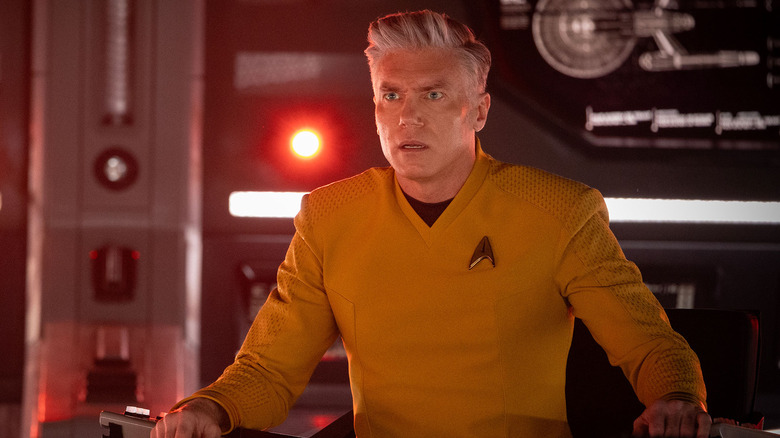
This notion has since been carried over into the "Star Trek" franchise via the Temporal Prime Directive. This particular law dictates that Starfleet officers, should they ever travel into the past (which is a common enough occurrence in "Star Trek"), shouldn't be allowed to tell anyone about the future or interact with anyone in such a way that it will alter the future. Captain Pike (Anson Mount) has to consider this when communicating with the ancient Martians in the "Strange New World" Season 4 premiere.
Strange New Worlds is far from the first show to draw from A Sound of Thunder
Commander Chin-Riley, however, doesn't quite have the leeway to ponder such ethical matters when she's faced with a living Tyrannosaurus. Killing or harming it may alter the timeline. But then, dying and leaving her body on ancient Earth would also alter the timeline. It's quite a conundrum. The fact that the show's characters stop to ponder the issue at all is a fitting tribute to Ray Bradbury's story. It's obvious the writers of "Strange New Worlds" know about "A Sound of Thunder" or, at the least, have been influenced by it.
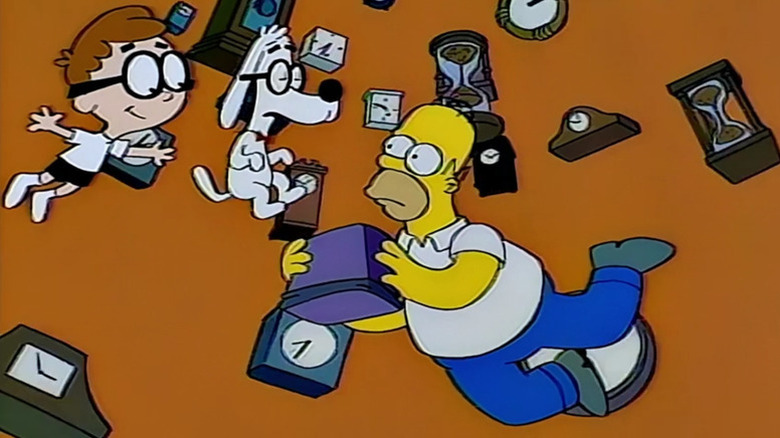
Indeed, Bradbury has often been ripped off, even by Rod Serling (albeit accidentally). More so, the premise of "A Sound of Thunder" has become so common in sci-fi storytelling that it's frequently the subject of parody. For instance, in the 1994 "Simpsons" episode "Treehouse of Horror V," Homer (Dan Castellaneta) invents a time-traveling toaster that throws him back in time millions of years. And while he's initially careful about stepping on any bugs (operating on advice from his father), he ends up squishing a mosquito anyway. Thus, when he returns to the present, his friendly neighbor Ned (Harry Shearer) has become the unquestioned lord and master of the planet. The episode only gets wilder from there, with Homer repeatedly going back in time and altering the universe in even more deliberately comical ways.
The ultimate ending of "Valles Marineris" connects ancient history to the future of "Star Trek" pretty directly and in a fun way. By the same token, "Strange New Worlds" has always been one of the most whimsical "Star Trek" shows, so having its heroes encounter dinosaurs is a good way to start this new season.