

This Underrated 2015 Sci-Fi Miniseries Adapted One Of Arthur C. Clarke's Best Books
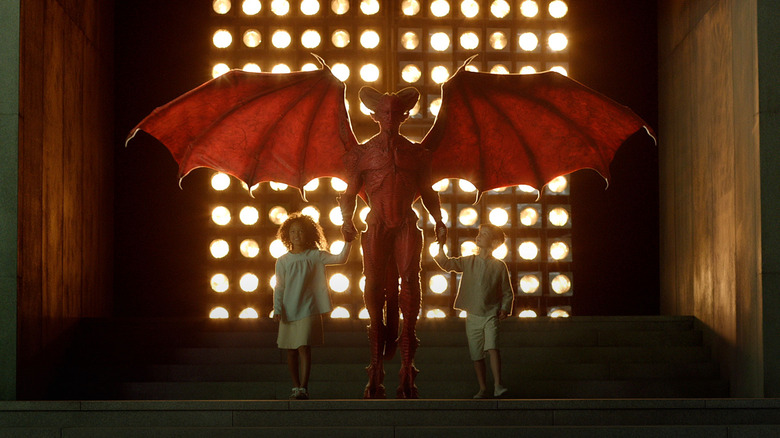
Arthur C. Clarke's 1953 novel "Childhood's End" is one of the best sci-fi novels the genre has ever produced. It posits a future wherein humanity is destined for a larger role in the vastness of the cosmos and will be guided there by a special species of alien caretakers. It begins in the near future, when humanity is beginning to muck around pretty aggressively with rocket technology. A species of aliens — the Overlords — suddenly appear above all of Earth's major cities and announce from their spacecraft that they're going to be taking control of Earth's infrastructure, as we're poised to destroy ourselves. The Overlords won't reveal themselves to humanity until they have been living in peace and unprejudiced harmony for 50 years.
When Clarke reveals the Overlords, one can see why humanity needed 50 years to prep and be nonjudgmental, as they essentially look like winged demons. The Overlords continue their work, pushing humanity into a new golden era of peace and prosperity. They essentially force us to live the utopia seen in "Star Trek."
One might assume that the Overlords are up to something sinister, but it's more complex than that. The Overlords don't want to conquer Earth or eat humans or anything, but they are present to force humans to evolve into a psychic, non-human species. They do spell humanity's end, but only because they serve a vast, overarching cosmic intelligence that humans are now being incorporated into. Our childhood is at an end.
It wasn't a very big hit, so many audiences might have missed its airing, but back in 2015, Syfy put out a three-episode, four-hour miniseries of "Childhood's End" that remains somewhat faithful to the novel. It updates the timeframe of the book's "near future," but otherwise remains largely the same.
Remember the 2015 Childhood's End miniseries?
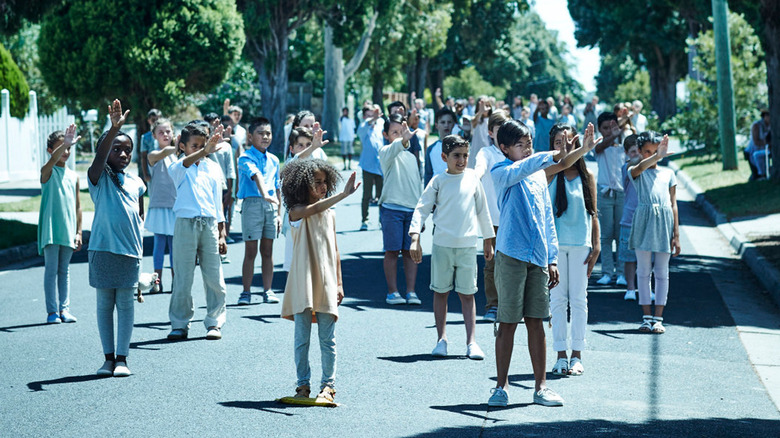
The "Childhood's End" miniseries starred Charles Dance as Karellen, the Overlord who was selected to be Earth's Supervisor. The central human character, Ricky, was played by Mike Vogel, a simple farmer who is selected by the Overlords to serve as humanity's representative. Osy Ikhile plays Milo, a man who is killed and then resurrected by the Overlords, displaying their benevolence. Yael Stone also appears as a woman who is spiritually shaken by the godlike plans of the Overlords; what does it mean for organized Christianity if aliens are essentially becoming the new Messiahs? Colm Meaney from "Star Trek: Deep Space Nine" (and dozens of other films and TV shows) had a cameo in the first episode, and Julian McMahon appears in the second.
Readers of "Childhood's End," though, will be able to tell you that the human characters are largely ciphers who, by dint of the story, cannot affect the plot. They must simply bear witness to the machinations of the Overlords and remain helpless to stop their large-scale, secret plan. The miniseries ends with ... well, I dare not reveal the ending here. But it's an ending that is both very good for humanity and also very bad. As a species, we gain a lot, but our present selves may not be comfortable with giving up the autonomy and status quo that we're used to. Some humans may attempt to escape the Overlords' influence, not trusting or merely fearing the future they promise, but we all have to grow up eventually.
I am usually a proponent of watching TV and film adaptations before reading the books (to see whether the movie holds up without any prior literature-based pretense), but either way, you should definitely read Clarke's novel.
What did critics think of Childhood's End?

Reviews for the miniseries of "Childhood's End" were mixed. John Saavedra, writing for Den of Geek, praised the show's special effects and was impressed that a network like Syfy could pull off something so classy. He also noted that the miniseries omits many of the book's supporting players, focusing on just a few key figures (which is ultimately more feasible for television). Saavedra said, though, that the pacing was a little off, as much of the front half of the miniseries was rushed, and the back half dragged on with all the talkier bits.
Brian Tallerico, writing for RogerEbert.com was unimpressed, however. He wrote that "Syfy's adaptation plays with Clarke's plot and themes but does so in such a leaden, D.O.A. way that it's almost like a grade-school paper from someone who didn't read the assignment." He noted that the miniseries lacked any sense of urgency, which would be vital for roping viewers into its drama, and felt that much of the series was padded to stretch it into the miniseries format.
"Childhood's End" may not have been stellar in the eyes of some critics, and it's certainly not well remembered only 11 years later, but it was definitely a marked improvement over some of the mid-2000s schlock that Syfy had previously produced. This was the network, recall, that broadcast TV movies like "Maneater," "Mammoth," "2-Headed Shark Attack," "3-Headed Shark Attack," and "5-Headed Shark Attack" (none of which are among the best shark movies ever made). Given their reputation for low-budget fantasy flicks and creature features, the fact that Syfy eventually thought to actually tackle real sci-fi was a boon.
Now they just need to get to Clarke's "More Than Human," which inspired the X-Men.