

Hollywood Needs To Adapt This Forgotten '50s Sci-Fi Book That Inspired The X-Men
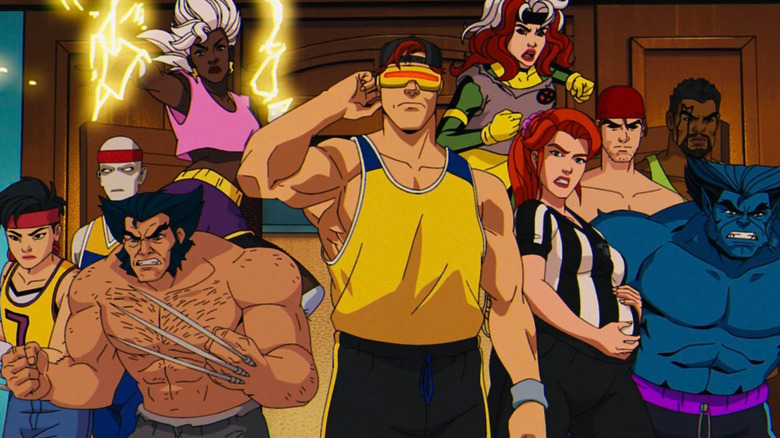
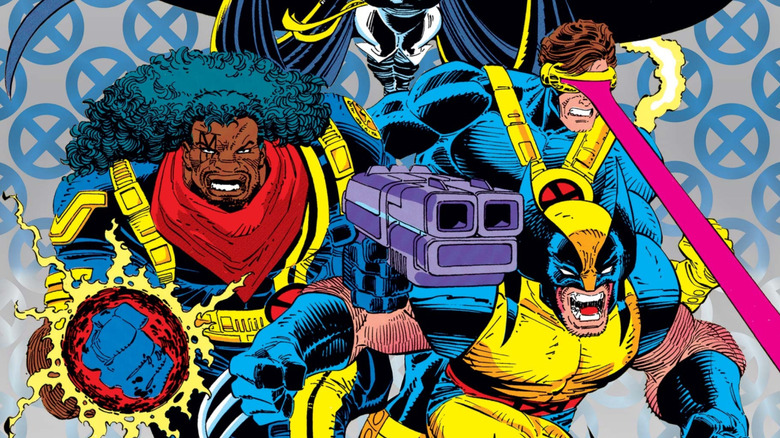
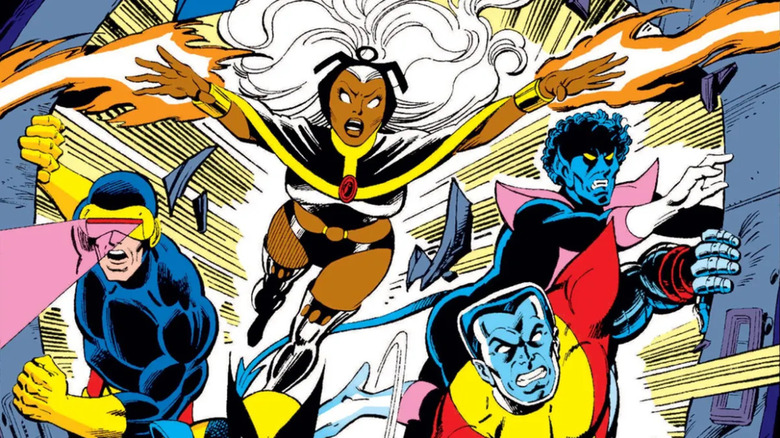
Stan Lee and Jack Kirby first invented the X-Men in 1963 as a team of five teenagers who had simply been born with their superpowers. In the world of the X-Men, mutant powers can manifest as just about anything, from rapid healing to super strength to time travel to powerful eye beams, and one's powers don't appear until adolescence. Stan Lee admitted (via ScreenRant) that the X-Men were born from a bout of creative laziness. By making the X-Men mutants (and almost calling them The Mutants), he wouldn't have to invent an origin for his characters' superpowers anymore. They just had their powers, and that was that. In the world of the X-Men, mutants are sometimes referred to as "homo superior" instead of "homo sapiens."
Lee may not have consciously known it at the time, but the X-Men were part of a larger trend in the era's sci-fi literature. There were several notable sci-fi novels of the preceding decades that were exploring the idea of human evolution, and how humanity may already be evolving into a new, superior species. Olaf Stapledon's 1930 book "First and Last Men," for instance, traces several evolutionary steps that humanity will take after we are homo sapiens. In Arthur C. Clarke's 1953 novel "Childhood's End," human children are born with psychic abilities and telekinesis after a century of alien oversight.
Most closely connected with the X-Men was probably Theodore Sturgeon's 1953 novel "More Than Human," a book about a group of six highly evolved, superpowered strangers. A lot of what one might encounter in "More Than Human" was certainly adopted by superhero comics that followed. It would be fun to see a movie version of "More Than Human" and explore how tales of mutants and psychics began to infiltrate the pop consciousness.
The X-Men were clearly inspired by the 1953 novel More Than Human
If the name Theodore Sturgeon is familiar, it's probably because you're a Trekkie. Sturgeon was a prolific sci-fi writer of the 1950s and 1960s who wrote novels like "The Dreaming Jewels" and "Some of Your Blood," but who also penned the scripts for the "Star Trek" episodes "Shore Leave" (the one with the white rabbit) and "Amok Time" (the one where Spock gets murderously horny). The latter episode also included the first use of the phrase "Live long and prosper." In 1944, he wrote a novella called "Killdozer!" which was adapted into a notorious (and unexpectedly good) TV movie in 1974.
For the 1953 book "More Than Human," Sturgeon cobbled together some of his previous short stories and assembled them into a novel about, essentially, a team of superpowered mutants. There is a homeless man, about 25, who can psychically manipulate others into doing whatever he wants. He has a traumatic relationship with a psychic young woman, whose hyper-religious father kills her when he learns that she's a psychic (and one might see shades of Stephen King's "Carrie" in that).
The main character falls in with an elderly couple, adopts the name Lone, and eventually moves into the woods where he meets up with further psychics who have run away after being ostracized. This is a concept that Stan Lee most certainly subconsciously borrowed — the idea that mutants would be scant in the world, and that they would be looked upon with suspicion and prejudice.
Lone becomes the Professor X of the psychics, who can do things like teleport or construct anti-gravity devices. They call themselves "homo gestalt." By the second part of the novel, there are six of them in all.
A movie adaptation of More Than Human would be an interesting experiment
Like in X-Men comics, one of the psychic characters will be revealed to be something of a villain. The story ends with the "villain," a character named Gerry, being psychically taught the meaning of humility and welcomed into the team. They then manage to psychically reach out and contact a group mind of homo gestalt around the world, and the group mind welcomes them in as a new step in human evolution. The psychic "reaching out" element might evoke the X-Men's computer Cerebro, which can, when used properly by a powerful psychic, locate mutants everywhere on Earth.
If one was to adapt "More Than Human" to the big screen, it would be an interesting sci-fi experiment. In the past, some filmmakers have found the comics or works of literature that inspired things like "Star Wars" and superhero comics, and in turn adapted them to the big screen ... with mixed results. For example, the 1960s French comic book "Valérian and Laureline" inspired a lot of "Star Wars," but when Luc Besson made the film "Valerian and the City of a Thousand Planets" in 2017, it notoriously bombed. Ditto with Disney's 2012 film "John Carter," which was based on the books by Edgar Rice Burroughs, which inspired any number of pop entertainments that followed. The movie is a notorious box office bomb.
"More Than Human" has an advantage over "Valerian" and "John Carter," though, in that it doesn't directly resemble the X-Men. The homo gestalt characters, while superpowered, aren't costumed vigilantes. It would help if a movie were set in the 1950s, placing the action prior to the invention of the X-Men, allowing them to seem like the "origin point" after all. Someone get Spielberg on the horn.