

X-Men '97 Casts Two Star Trek: The Next Generation Actors In Important Marvel Roles
Spoilers for "X-Men '97" Season 2 Episode 3 follow.
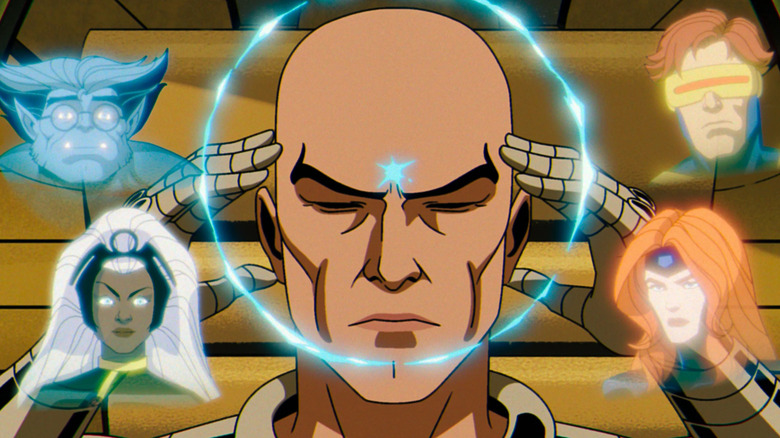
There's a big link between "Star Trek" and "X-Men," and his name is Sir Patrick Stewart. American geeks first met Stewart when he played Captain Jean-Luc Picard on "Star Trek: The Next Generation." As a bald man playing an authority figure, he became every Marvel fan's dream pick to play Professor X in a potential "X-Men" movie. In 2000, that dream was realized. Stewart wasn't sure about playing Professor X at first, but he's stuck with the character through two decades; his next return as Charles Xavier is in 2026's "Avengers: Doomsday."
Animated series "X-Men '97" is upping the ante and has brought in a few of Stewart's old "Star Trek" costars. Mother Askani, psychic leader of the anti-Apocalypse rebellion in the year 3960 AD, is voiced by Gates McFadden, aka Dr. Beverly Crusher. "X-Men '97" Season 2 Episode 3 "Rise of Apocalypse Part I" brings in two "Star Trek" stars, who each have pivotal roles to play in creating the X-Men's most fearsome villain.
"Rise of Apocalypse" picks up from the Season 1 finale; Professor X, Magneto, Rogue, Beast, and Nightcrawler are stranded in ancient Egypt and have met the mutant En Sabah Nur, the future Apocalypse. This past is ruled by Pharaoh Rama-Tut, voiced by John de Lancie, famous to Trekkies as omnipotent trickster Q. En Sabah Nur leads a tribe called the Sandstormers against Rama-Tut's rule, and fighting alongside him is his adopted father Baal. Baal's voice belongs to Michael Dorn, aka Lt. Worf, the first Klingon in Starfleet (and the character who helped define Klingon culture).
There have been literal "X-Men" and "Star Trek" crossover comics before, and these castings intermingle the two sci-fi franchises more and more.
John de Lancie (Q) plays Rama-Tut on X-Men '97
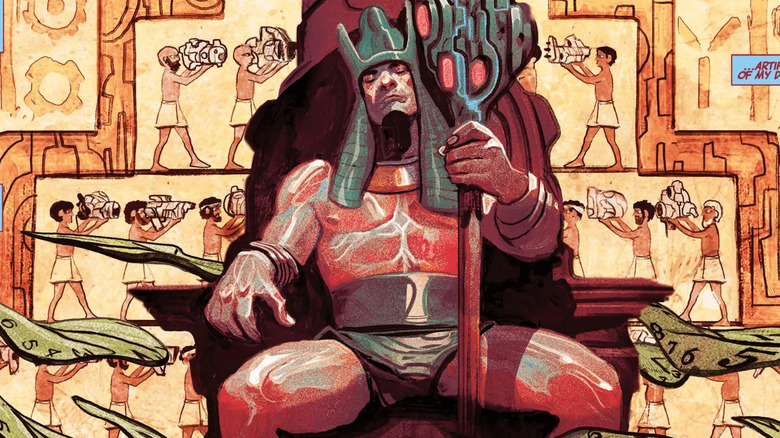
Rama-Tut dresses as a pharaoh, but he's a time traveler from the far future. Marvel fans might know him by another name: Rama-Tut is one of the many, many variants of Kang the Conqueror. Armed with 31st century technology, ancient Egypt was an easy conquest for the self-made pharaoh. The whole thing is more a jaunt for him, the way Q treated his frequent run-ins with the Enterprise-D. Rama-Tut is more reserved than the impish Q, but de Lancie's smooth, soft, and yet sinister voice still fits the villainous pharaoh like a glove.
In Marvel Comics, Rama-Tut actually debuted before Kang, in Stan Lee and Jack Kirby's "Fantastic Four" #19. The FF time travel back to ancient Egypt on a scientific mission, only to cross paths with the pharaoh who recognizes Earth's "ancient" (from his perspective) heroes. Rama-Tut was sent running at the issue's end; he next appeared in "Fantastic Four Annual" #2, crossing paths with Doctor Doom. That gave way to his appearance in "Avengers" #8 as Kang, where he tries to conquer the 20th century as he previously conquered Egypt. Since then, Kang has supplanted Rama-Tut as this time-traveling conqueror's primary persona. Whereas Rama-Tut is tied explicitly to ancient Egypt, Kang functions as a futuristic time-traveling foe.
The 1996 "Rise of Apocalypse" comic miniseries by Terry Kavanagh and Adam Pollina first established that En Sabah Nur came of age in Rama-Tut's Egypt. Tying into the villain's first appearance, the time-traveling Fantastic Four cameo in the book (though never cross paths with Nur). "X-Men '97" is unlikely to feature the FF, but replaces them with the X-Men as the heroes who will end Rama-Tut's reign ... if only for a much greater evil to emerge from that end.
Michael Dorn (Worf) voices Baal, father of En Sabah Nur
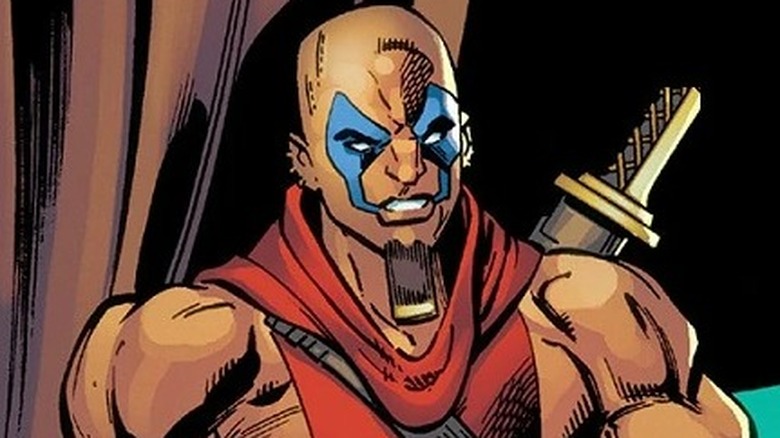
If we go by the comic, then the baby who became En Sabah Nur was abandoned by his mother, left alone to die in the desert due to his unusual appearance. Only a twist of fate saved him. That twist's name was Baal, who took the infant as his own son. Baal is even the one who named him "En Sabah Nur," which supposedly means "The First One" (because Nur is the harbinger of mutantkind).
Baal also taught Nur that survival of the fittest is the way of the world. That makes Dorn fitting casting as Baal, who is the kind of human that Klingons might respect as a warrior. But in this retelling, Baal has competition as Nur's mentor. The X-Men know who Nur (Adetokumboh M'Cormack) is destined to become, and Magneto (Matthew Waterson) tries to use that to their advantage.
Magneto has become a teacher to Nur, trying to teach him the value of mercy, in hopes that Nur can become a leader for men and mutants instead of a force of destruction. Baal does not appreciate or trust the X-Men, and exposes them as time-travelers and supposed collaborators with Rama-Tut.
The episode ends with Rama-Tut destroying the Sandstormers' hideout; not for nothing, in the comic, Baal's murder by the Pharaoh's forces is a key step on Nur's journey to become Apocalypse. The comic spotlights the ostracization Nur faces for his appearance, with that turning him angry at the world much like Frankenstein's Monster. "X-Men '97" is replacing that with a question of fate; can Nur overcome the might makes right brutality both Rama-Tut and Baal taught him in different ways, or is Apocalypse still destined to ascend?
"X-Men '97" is streaming on Disney+.