

Audiences Protested This '60s Western Series Before The First Episode Aired
We may receive a commission on purchases made from links.
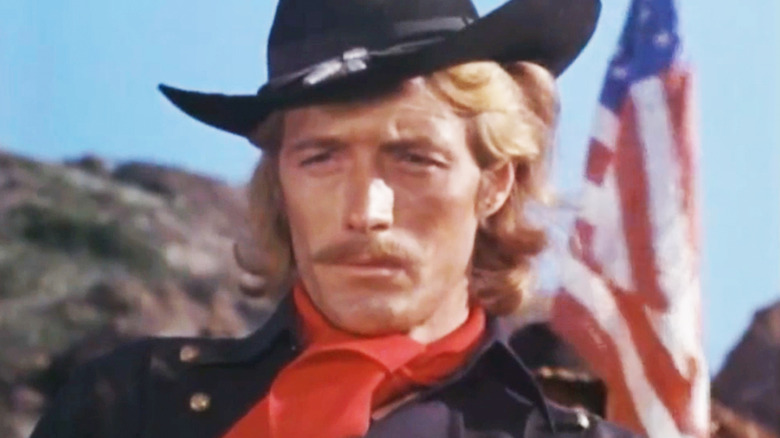
In the 1960s, Western series dominated the airwaves. Classic TV Westerns of the era included "Bonanza," "Gunsmoke," "Maverick," "The Virginian," and many, many more. Among those venerable titles, however, there were multiple short-lived attempts to capitalize on the popularity of the genre. Many of these became underrated Western shows that are still worth a watch today. Many didn't. Take "Custer" (originally titled "The Legend of Custer"), a Western series that aired on ABC from September to December 1967. Although the mid-20th Century wasn't exactly a progressive cultural utopia, a TV show celebrating the legacy of George Armstrong Custer was a little too much to take. Doubly so for the Tribal Indians Land Rights Association, who protested against the show before it even began its meager three-month run.
"Custer" starred Wayne Maunder as Lieutenant Colonel George Armstrong Custer. The series followed the cavalry officer in his post-Civil War years, specifically the period between 1868 and 1875 when he was dispatched as part of the Frontier Wars to take on the Indigenous people of the Great Plains. Not exactly the most honorable section of the man's life, then.
Predictably, not everyone was thrilled at the prospect of a show that, as author Brian W. Dippie put it in "Custer's Last Stand: The Anatomy of an American Myth," portrayed Custer as "a hero with minor blemishes resulting from an excess of zeal." That was evident from the opening credits sequence, which featured a voiceover proudly announcing the eponymous general to triumphant fanfare: "He'd been reduced in rank and sent West to be forgotten. But he was not the kind of man who let the world forget. His name: George Armstrong Custer." Well, not for long it wasn't.
Custer faced pushback before it even aired
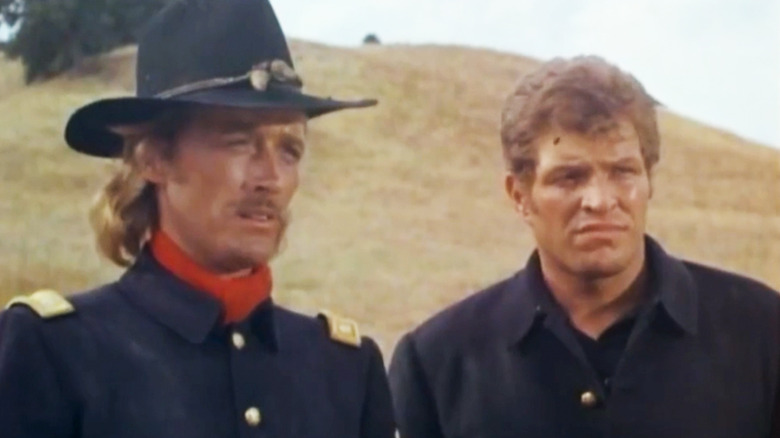
During the Civil War, George Armstrong Custer led his brigade at the Battle of Gettysburg and cut off Robert E. Lee's retreat at Appomattox. When the war ended, he became a lieutenant colonel in the Army and was sent to fight in the Frontier Wars. Custer became best-known, and infamous, for his actions during these post-war years, which ended when he led the Army's 7th Cavalry Regiment at the Battle of the Little Bighorn and was killed alongside his entire battalion. "Custer" never got to depict that battle, however, as a combination of poor ratings and a major backlash cut short its retelling of the controversial general's post-war years.
As a September 5, 1967 issue of Ogdensburg Journal noted, "Custer" courted controversy before it aired "as potential audience members protested the show for celebrating a man many Americans, especially those of Indigenous descent, view as a villain rather than a hero." Indeed, Hollywood had a history of glamorizing the general, as evidenced by the true story based Western "They Died with Their Boots On." This time, though, the Tribal Indians Land Rights Association wasn't having it, and it pushed back before Wayne Maunder's Custer could ride out. Producer Frank Glicksman recalled "getting telephone calls — angry calls — even at home." Things didn't exactly calm down after that.
Glicksman also claimed that pamphlets and letters had been "slipped under [his] door" and delivered to ABC's studio gate. "I suddenly realized there was a big Indian lobby and decidedly antagonistic," he told the Ogdensburg Journal. "They could not have seen the shows since I felt we were portraying Indians with dignity and respect." But the series' portrayal of Indigenous people wasn't the issue. It was the fact that "Custer" was essentially lionizing a highly controversial figure.
Controversy and poor ratings forced Custer to retreat from battle
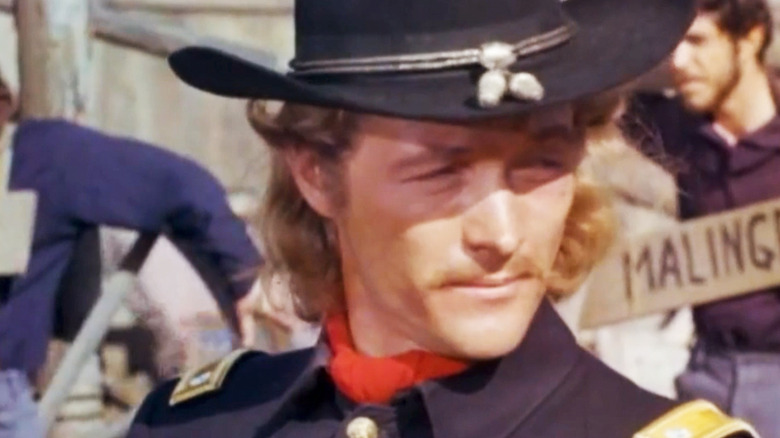
"Custer" was never going to become one of the most successful Western TV shows of all time, but even its producers were probably shocked at how poorly it performed. It didn't help that the Tribal Indians Land Rights Association and several other groups were determined to suppress the show. As author Vine Deloria, Jr. explains in "Custer Died for Your Sins: An Indian Manifesto," multiple organizations ultimately got involved. The National Congress of American Indians (NCAI) dubbed the real-life Custer the "Adolph Eichmann" of the 19th Century and protested the series alongside "other groups." Meanwhile, Frank Glicksman and others involved with the production were getting letters from Civil War students who both abhorred and adored the idea of the show.
As detailed in "Custer Died for Your Sins: An Indian Manifesto," it was Yakima tribal lawyer James Hovis who came up with the tactic of "getting every tribe to file for equal time against ABC's local affiliate," due to the fact ABC was not subject to Federal Communications Commission (FCC) regulations. According to Deloria, Jr., several tribes followed through with filing against local affiliates and were given air time to "present the Indian side of the Custer story during the brief run of the show."
While that no doubt made life hard for ABC, it seems the series was ultimately canceled because of ratings. As Brian W. Dippie explains in "Custer's Last Stand:"
"One beleaguered spokesman for ABC argued that 'the program clearly is identified as a fictionalized series based on a legend.' But semantic distinctions could not save Custer from the Nielsen ratings.'"
After 17 episodes, "Custer" was ordered to retreat from the battlefield. If you're curious, the show is available to stream for free on Tubi.