

Ray Bradbury And A Legendary Hollywood Director Teamed Up For An Adventure Movie Based On A Classic Book
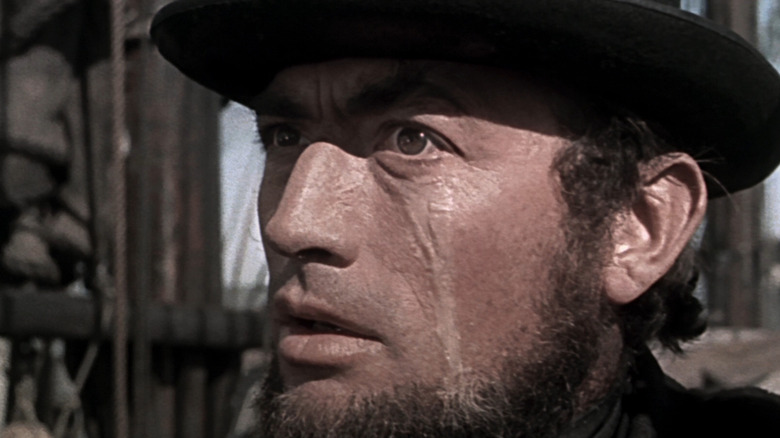
Ray Bradbury had emerged as one of the top science fiction writers on the planet (one whose work would soon become popular fodder for screen adaptations both good and bad, including "The Martian Chronicles") when John Huston approached him to write a screenplay adaptation of Herman Melville's decidedly non-sci-fi novel "Moby-Dick." It still seems like a weird marriage of director and writer, and it only came to pass because the two men shared a friend.
Talent agent Ray Stark was a packager supreme. He had a keen understanding of his clients' strengths and a deft feel for how to pair them. Huston was not officially a Stark client, but the two were good friends. The agent was confident in Bradbury's abilities and was well aware the writer revered Huston's films, particularly "The Treasure of the Sierra Madre" (itself a Stephen King favorite as well, as it were). So, he arranged for the two to meet at a prominent Beverly Hills eatery, where, per Bradbury biographer Sam Weller, Bradbury gave Huston copies of "The Martian Chronicles," "Dark Chronicles," and "The Illustrated Man." "If you love my books half as much as I love you," said Bradbury, "give me a call."
That call arrived several years later, and what started as a dream come true for Bradbury gradually turned into a nightmare. He transplanted his family to Ireland while he wrote the script and endured all manner of psychological abuse as he tried to please his mercurial, hard-drinking director. Eventually, his wife, Marguerite, was so appalled by Huston's behavior and its effect on her husband that she decamped to Italy with their children. It was a hellacious ordeal — and, at that time, par for the course for Huston. But the resulting film remains a stirring adaptation of Melville's dauntingly dense novel.
Ray Bradbury wrote a stellar Moby Dick adaptation
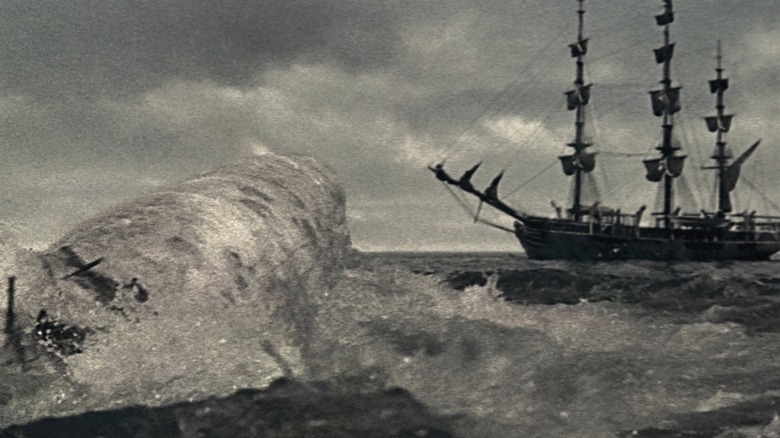
Ray Bradbury might've been eager to write a screenplay for John Huston, but he never envisioned that movie would be "Moby Dick." (The hyphen was removed for the film's title.) Indeed, when Huston rang up Bradbury to ask him if he'd take the assignment, the writer responded, "Gee, Mr. Huston. I've never been able to read the damn thing." Huston gave Bradbury a night to read the book — which, if you've ever read the unabridged "Moby-Dick," is impossible — in the hopes that he'd warm to the material. There really wasn't a chance that Bradbury would turn his filmmaking hero down, but he gamely leafed through the book, absorbed its themes, and decided to give it a go.
The honeymoon ended quickly in Ireland. Huston goaded Bradbury into drinking and excoriated him for not being committed enough to the project. Bradbury only wanted to please Huston, but the filmmaker insisted on playing head games with the then 33-year-old writer. Bradbury finally broke during a dinner in London (which, ironically, was attended by Peter Viertel, who detailed his battles with Huston on "The African Queen" in the book turned Clint Eastwood movie "White Hunter, Black Heart"), where, after much hectoring, the writer told his director, "F*** you." Huston, who enjoyed a good scrap, threatened to punch the peaceful Bradbury. He stayed his hand because the writer he'd hired had to complete the script.
For all the tsuris, "Moby Dick" wound up being a great film. Gregory Peck was perfectly cast as Captain Ahab, while Richard Basehart proved to be a sympathetic Ishmael. Bradbury skillfully condensed Melville's novel, and Huston shot it with his trademark attention to character. Visually, it's not a knockout, but it delivers the whaling goods.