

Star Trek's Starship Designation Formula, Explained
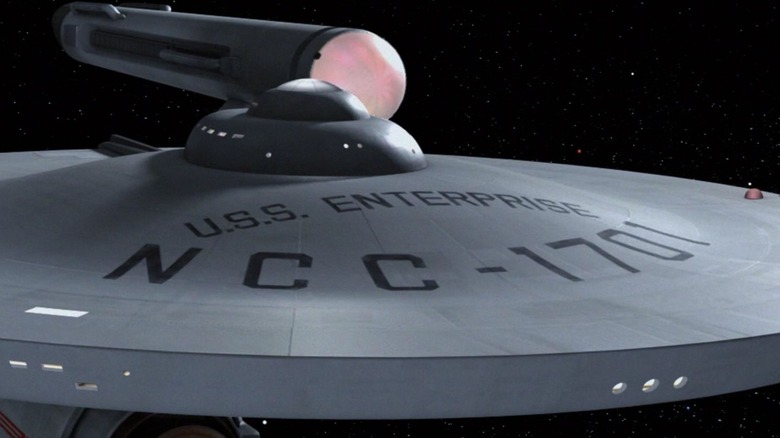
As /Film has previously said, the "USS" in "USS Enterprise" stands for United Starship. It was meant as a riff on real-life naval designations, although show creator Gene Roddenberry fought the idea that it should stand for "United States Ship" like on Earth. The USS Enterprise was not an American vessel. It belonged to a united Earth. /Film also noted that starships that come from Trek's famed Mirror Universe bear the call letters ISS, which stands for Imperial Starship.
We have also gone over what the "NCC" stands for in "NCC-1701," the registry number of the Enterprise. As it so happens, "NCC" doesn't stand for anything, and was merely included to make ships on "Star Trek" a little more realistic; if they had a registry number, then there was a space registrar somewhere in the universe keeping track of everything. The off-screen space bureaucracy made "Star Trek" a hair more believable. Some ancillary, expanded universe material (like starship blueprints) noted that NCC stood for Naval Construction Contract, but that has never been noted in any episodes of any "Star Trek" show.
The letters NCC were chosen by Matt Jeffries, the designer of the original Enterprise model, and he chose the letters based on real-life aircraft registry codes, paired with the "CCCP" seen on Russian vessels.
But there are more numbers to explore, dear nerds. For instance, the number 1701 on the Enterprise indicates that it was the 1,701st vessel commissioned by Starfleet. Given that the USS Voyager on "Star Trek: Voyager" was designated as NCC-74656, it would seem to indicate that 72,955 vessels had been built and commissioned in the century between the original series and "Voyager." Let's look at those designations, ponder their meaning, and postulate the size of Starfleet.
The number on a starship hull appears to indicate when it was built
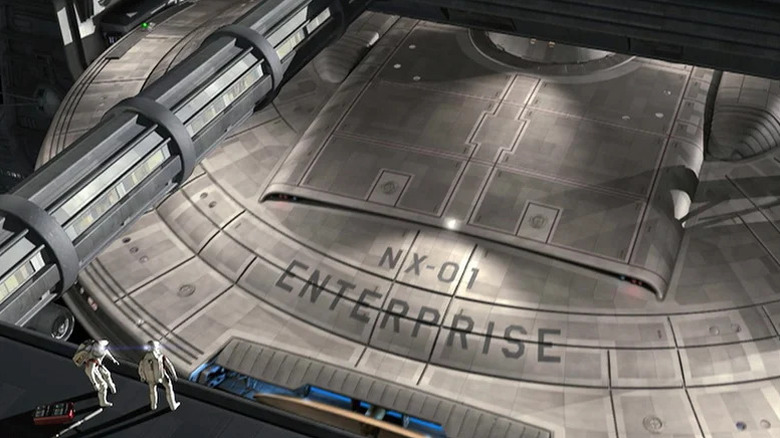
This numbering system — that a starship's call number indicates when it was built — holds true when one recalls the Enterprise as it appeared in "Star Trek: Enterprise." That series was set a century prior to the original "Star Trek," and followed the adventures of the very first Starfleet vessel to be built for long-term missions of exploration. Its call number was NX-01. The very first. The "NX" indicated that it was an experimental vessel.
Fast-forward through "Star Trek" chronology, and 1700 vessels were constructed from the 2151 timeframe of "Enterprise" to 2245, when the NCC-1701 Enterprise was launched. That means that Starfleet was only able to construct, on average, about 18 ships a year. This makes sense, given that starships are massively complicated machines that require advanced computers, warp engines, food replicators, transporters, and all kinds of other miracle technologies.
But it seems there are production cycles. In "Star Trek III: The Search for Spock," set in 2285, Trekkies were introduced to the USS Excelsior, the NX-2000. That means, while Kirk's Enterprise was galavanting about the galaxy, Starfleet was churning out starships to the tune of 299 of them in 40 years. That's only about seven and a half ships a year.
The nerdy website Ex-Astris-Scientia pointed out that ship production increased immensely in the days of "Star Trek: The Next Generation" and "Star Trek: Deep Space Nine" which both began in the 2360s. The USS Saratoga, for instance, which Benjamin Sisko (Avery Brooks) served on, was designated NCC-31911. The Voyager, as mentioned, was NCC-74656, and that show began in 2371. In the 86 years since "Star Trek III," Starfleet built 72,656 vessels. That's almost 845 ships a year!
Wait. That can't be right. Right?
But are those numbers merely chronological?
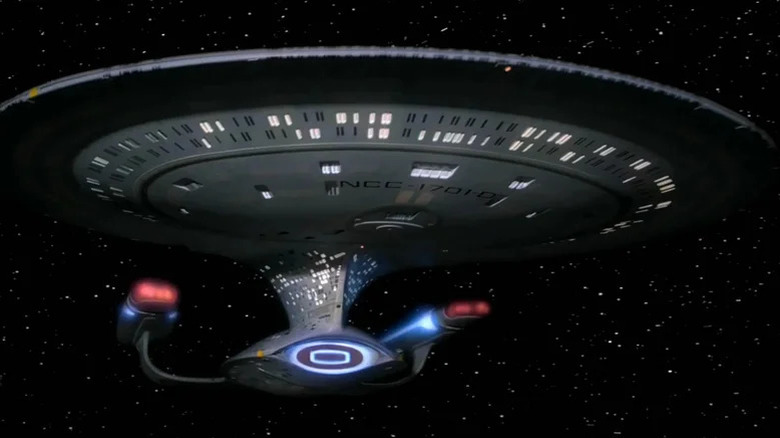
Now there have been a few passing references, as pointed out by the Ex-Astris-Scientia website, that Starfleet can indeed build ships quickly, but not as quickly as the numbers above indicate. The Battle of Wolf-359 — a skirmish with the Borg that took place in 2367 — destroyed 39 vessels and took about 11,000 lives. There is a line of dialogue about how it would take a year for Starfleet to rebuild its coffers. 39 vessels in a year is well below the 845 indicated above.
The theory goes, though (also posited by Ex-Astris-Scientia, as well as many idly conjecturing Trekkies), that the first two numbers in a starship's designation are actually an indicator of the "model number." For instance, the Enterprise as it was seen on the original "Star Trek" series was a Constitution-class vessel, and the "17" in NCC-1701 would indicate that Constitution-class vessels were the 17th class invented. This makes sense, when we consider that the USS Defiant (from the episode "The Tholian Web") was NCC-1764.
This theory falls apart, though, when we consider that the USS Constellation from the episode "The Doomsday Machine" was designated NCC-1017. It stand up, however, looking over a list of all the starships on "Star Trek." All the Reliant-class vessels, for instance, begin with a "90."
It's also theorized that, in an as-yet-undefined way, the first two numbers in a designation indicate the use of the vessel and not its class. Is it for research? Exploration? Survey? Is it for battle? Is it a shuttlecraft? A two-number designation system would be a good way to indicate, within a fleet, what ship can be contacted for specific jobs.
But this is all still theory. None of these nerdy details have yet been canonically confirmed.