

Antony Starr's Early Career Includes An Acclaimed Drama With A Perfect Rating On Rotten Tomatoes

Given all the horrible things that Antony Starr's Homelander does on "The Boys," it's no wonder that the character has become a modern pop culture icon. Bringing complexity to such an irredeemable antagonist is no walk in the park, but Starr manages to do so across the show's five seasons. At the same time, the role has become so synonymous with the actor that it tends to overshadow his other work. Consider his Homelander-inspired turn in the horror flick "Cobweb" or when he played a Biblical hero in "Xena: Warrior Princess." Indeed, Starr's early career triumphs include Brad McGann's 2004 drama "In My Father's Den," which has a perfect critical score on Rotten Tomatoes.
"In My Father's Den" opens with war photographer Paul (Matthew Macfadyen) visiting his hometown in New Zealand to grieve the death of his late father, Jeff (Matthew Chamberlain). Paul's brother Andrew (Colin Moy) and his wife Penny (Miranda Otto) convince him to stay longer, though, leading to Paul reminiscing about his father's makeshift shed and becoming a temporary teacher at his former high school. There, he forges a friendship with Celia (Emily Barclay), a student who bonds with him over her love of writing. However, given that Celia is also the daughter of Paul's ex-lover Jackie (Jodie Rimmer), it's possible that Paul is actually her father. Hence, the closer Paul and Celia grow, the more their relationship seems to bother Jackie and her boyfriend Gareth (Starr).
Gareth, as it were, is both infuriating and obnoxious, as he tries to harass and control Celia while at the same time unfairly casting doubts on Paul. He represents the judgmental attitudes that people harbor to mask their own cruelty, and Starr makes a meal of the role. But how does "In My Father's Den" fare as a whole?
In My Father's Den is a gut-wrenching drama about human connection
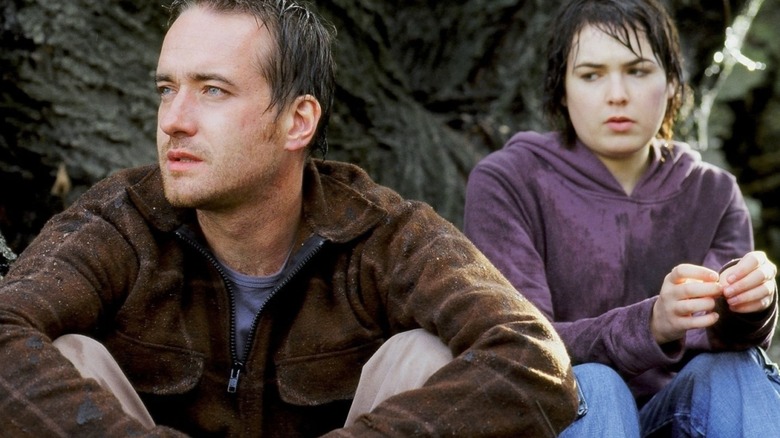
Brad McGann's film tells a bittersweet story about memory, trauma, and loss. The titular den is Paul's safe space, but it's also a figurative portal to the past that makes him deeply nostalgic. These feelings aren't misguided, as Jeff's den was secretly an act of rebellion against his wife's orthodox worldview. Jeff then shared this space with a young Paul, exposing him to progressive literature and philosophy as he grew up. The den is a metaphor for a simpler time before things took a dark turn, contributing to Paul's decision to leave home as soon as he turned 17.
Eventually, in the movie's present, Celia inexplicably disappears, and Paul is left to wrestle with social scrutiny and judgement. From there, "In My Father's Den" jumps between the past and present to map the full extent of Paul's world-weary journey.
The beauty of the film stems from Paul and Celia's bond, which proves that showing up for another person is a choice one needs to make every day. Of course, the simplicity of their trust-filled dynamic is marred by feelings like jealousy and narrow-mindedness, as certain individuals, like Gareth, cannot fathom the idea of a platonic relationship built on mutual respect. And while "In My Father's Den" doesn't make any in-your-face statements about the dangers of dogmatic faith, it criticizes the very foundations of such a worldview through a horrific tragedy.
The den, once a source of comfort, gradually comes to feel like a lair of dark family secrets best left uncovered. This unmooring is handled with great skill, even when the movie veers into melodrama. Antony Starr's role might be enough to evoke curiosity, but this film has a lot more to offer than that.