

Roger Ebert Hated This 90s Flop That Was Essentially An Alien Rip-Off

Stephen Sommers' 1998 film "Deep Rising" came during a now-forgotten mini-wave of late-'90s original monster movies that produced no true classics but provided a few fun distractions. The trend also encapsulated titles like Steve Miner's "Lake Placid" (i.e. the film that revitalized Betty White's career), Renny Harlin's "Deep Blue Sea," Ron Underwood's "The Relic," Luis Llosa's "Anaconda," Louis Morneau's "Bats," and Guillermo del Toro's "Mimic." Taken together, it was proof that monsters were very much in vogue in the late 1990s, perhaps motivated by shifting visual effects technology that allowed such beasties to be more vividly realized.
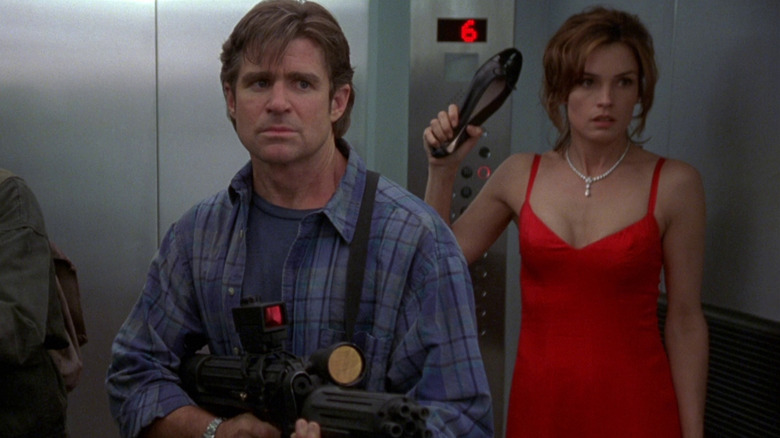
"Deep Rising" was, on paper, a combination of "Jaws" and "The Poseidon Adventure," pitting a group of ship-bound mercenaries against a giant octopus-like monster. The cast featured an impressive who's-who of steadfast character actors, including Kevin J. O'Connor, Wes Studi, Cliff Curtis, Jason Flemyng, and Djimon Honsou. They were led by handsome leading man Treat Williams, and Famke Janssen as a Catwoman-like catburglar named Trillian.
There is more plot than that, of course. The mercenaries have infiltrated a seemingly damanged ship, the Argonautica, hoping to loot its vaults and sink it with torpedoes. They become trapped, however, when the squid monster attacks. It's theorized that the monster is actually a highly evolved Ottoia, a species of prehistoric worm.
Critics hated "Deep Rising," and Roger Ebert gave it only one-and-a-half stars. Although he had rated plenty of other movies more harshly, "Deep Rising," for Ebert, was a stellar example of a truly awful monster flick. (He wasn't anti-monster movie in general, either; quite the opposite, Ebert had given "Mimic" a near-perfect score the year prior.) He even included "Deep Rising" on a notorious 2012 list of his most hated movies. 14 years after its release, Ebert was still angry.
Roger Ebert really, really hated Deep Rising
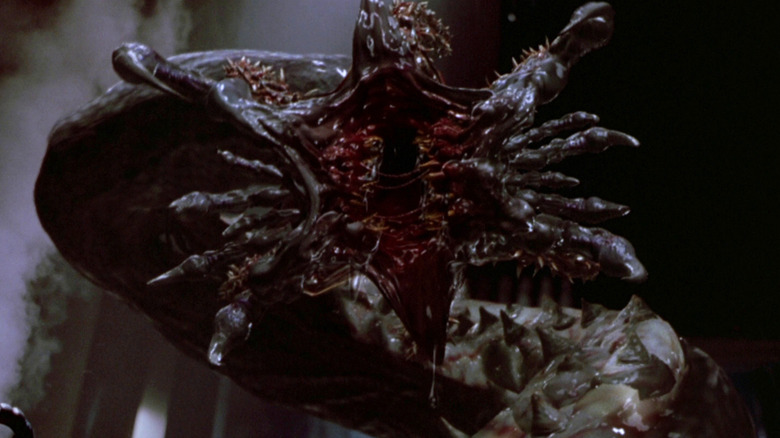
Roger Ebert opened his review by noting that "Deep Rising" repeats the formula of Ridley Scott's "Alien," which was 19 years old at the time. He added that the film's monster has very good timing, always popping out at the right moment and scaring the movie's dwindling survivors, all of them trapped in a confined vessel. Ebert also observed that "Deep Rising" was so derivative of other then recent films that he began questioning if Hollywood execs should talk more to avoid rehashing one another's movies:
"No sooner does the snake in 'Anaconda' release a slimy survivor from its innards than the squid in 'Deep Rising' does the same thing. No sooner is there an indoor jetski chase in 'Hard Rain' than there's one in 'Deep Rising.' [...] And last week I saw 'Phantoms,' which was sort of 'Deep Rising Meets Alien and Goes West.' In that one, the creature emerged from the depths of the Earth rather than the sea, but had the same nasty practice of living behind piles of undigested remains."
Continuing, Ebert argued that the film's humor didn't quite work, either, though he pointed out that Kevin J. O'Connor gets all of the movie's laughs and Djimon Honsou is very good as one of the more fanatical mercs. In the end, Ebert described "Deep Rising" as being "essentially an 'Alien' clone with a fresh paint job." His primary issue was that it was merely derivative, and that bored him. "You know something's wrong," he wrote, "when a fearsome tentacle rears up out of the water and opens its mouth, and there are lots of little tentacles inside with their own ugly mouths, all filled with nasty teeth, and all you can think is, 'Been there, seen that.'"
Deep Rising does have a fun twist ending
NOTE: I'll be getting into spoilers from this point on since it may be fair to spoil a largely forgotten, nearly 30-year-old mid-budget monster movie.
I, too, have seen "Deep Rising," and found it to be, at best, above average. The action is slick, its monster is fun, and I like the cast. Still, it wears its "Alien" influence on its sleeve, offering no new narrative twists, character beats, or plot developments not seen in dozens of movies before. The most exciting thing about "Deep Rising" is its twist ending, which I will spoil here since it's a great selling point.
At the end of the movie, there are only a few survivors (I shan't say who) who manage to flee the squid monster before the Argonautica finally sinks. They wash up on the beach of a distant, uncharted isle, relieved and relaxing after having escaped. They even begin to giggle and joke, happy to be out of danger. Then, unexpectedly, there's an unholy roar from the nearby jungle. The camera pulls back, and something giant — large enough to shake the trees — lurks toward our heroes. Cut to black. What a fun punchline. The heroes escape one unknown monster only to be suddenly beset by something equally unknown and terrifying. Unfortunately, the twist ending is only a clever little wink. It's not an earth-shattering revelation.
As mentioned, most critics hated "Deep Rising," and it was a sizable bomb, grossing but a fraction of its $45 million budget in theaters. Director Stephen Sommers managed to bounce back immediately, however, with his remake of "The Mummy" becoming a proper box office smash the following year. As for "Deep Rising," it was hastily forgotten.