

This Disastrous Western Flop Prompted Its Original Writer To Unleash Hell On The Weinsteins
We may receive a commission on purchases made from links.
The Texas Rangers have a complicated history involving acts of great heroism and brutality. Parsing such a complex legacy might make for an interesting movie, but Hollywood instead decided to give the Texas Rangers a Millennial-cool makeover. It made for a historic bomb in 2001's "Texas Rangers" which also prompted one of the film's original writers, John Milius, to publicly chastise Miramax founders Harvey and Bob Weinstein. When I say chastise, I mean suggest handing the pair to a terrorist regime.
In the early 2000s, Brad Pitt delivered a Western flop that also happened to be one of the best movies of the era. Otherwise, however, Hollywood studios appeared to tacitly agree that rejuvenating the long-suffering Western required giving Old West figures a cool rockstar makeover. In 2001, this yielded the awful "American Outlaws," which unsuccessfully reimagined the story of Jesse James, made less than half its budget, and led Roger Ebert to ask, "When did cowboys become teen pop idols?" "Texas Rangers" was worse.
Released the same year as "American Outlaws," "Texas Rangers" follows a group of the titular lawman in the post-Civil War era. The film had been in development long before it made its ignominious debut, with the Los Angeles Times reporting in 1992 that Milius was set to direct for Savoy Pictures. At the same time, Columbia executive vice president Marvin Antonowsky told Film Comment that "Westerns with a young cast can work because you create a younger audience." Milius, who had also written a version of the "Texas Rangers" script, disagreed, telling the magazine, "We're the only culture in history that builds a shrine and prostrates before the 14-year-old." You can imagine, then, that when "Texas Rangers" was ultimately turned into a studio executive's idea of a 14-year-old's fantasy, he was not best pleased.
The longer it remained unmade, the more Texas Rangers regressed
"Texas Rangers" was loosely based on George Durham's book "Taming the Nueces Strip: The Story of McNelly's Rangers," which recounted the author's experiences as a Ranger under the command of Captain Leander McNelly. John Milius seemed determined to preserve the book's authenticity, but in 1998, Reel World reported that then 26-year-old screenwriter Ehren Kruger had been brought in to rework the script. It seems Milius had left the project after having tried to sign up Tommy Lee Jones only to have the studio deny his request. But there was almost certainly more to it than that as every executive seemed intent upon making a Western for younger audiences. That irked Milius.
At some point during development, Bob and Harvey Weinstein's Miramax bought the project. By this point Milius was long gone, but Bob Weinstein tried to tempt him back. In an interview with Erik Bauer published in "Creative Screenwriting" Milius said he was not prepared to "dismantle" his previous screenplay. "[The Weinsteins] were really arrogant," he continued. "They called me up and acted as if I should feel privileged to come back and ruin my own work. I told that a**hole Bob Weinstein he was lucky to have it the way it was."
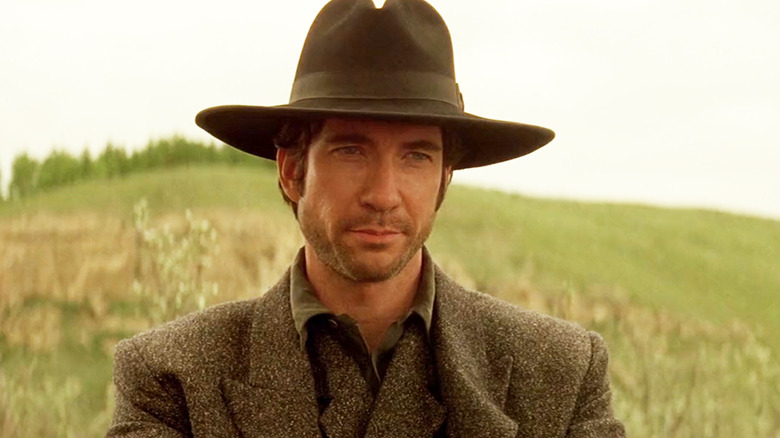
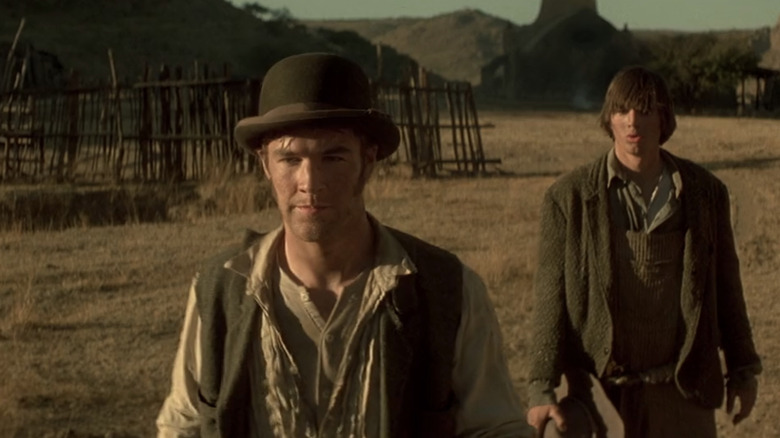
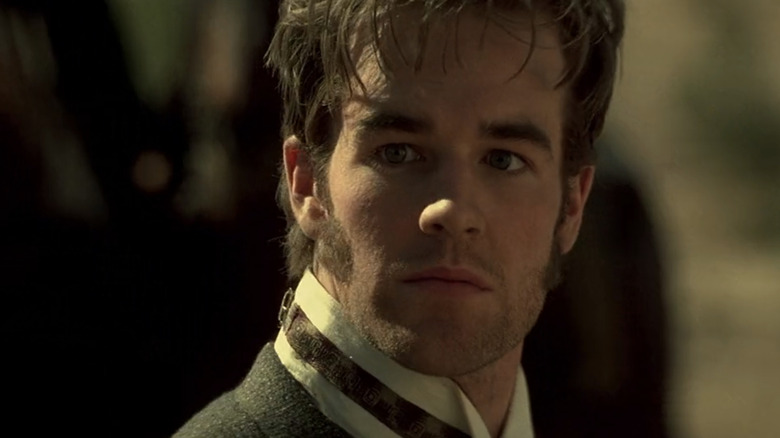
Eventually, "Texas Rangers" debuted with Steve Miner directing from a script by Scott Busby and Martin Copeland. The execs got their way by casting an assortment of hot young stars including James Van Der Beek as Lincoln Rogers Dunnison, Ashton Kutcher as George Durham, and Dylan McDermott as Captain Leander McNelly. The film made an astonishing $737,740 on a $38 million budget and Milius, who once dubbed a Chris Hemsworth-led remake of his 1980s film "Red Dawn" "terrible," was similarly vocal about what happened to "Texas Rangers."
John Milius was ready to hand the Weinsteins to the Taliban
John Milius was never afraid to say what he thought when it came to Hollywood contorting his screenplays. He found the final version of Clint Eastwood's "Magnum Force" distasteful precisely because it deviated from his original script. But even his criticism of Eastwood's "Dirty Harry" sequel was nothing compared to how he torched the Weinsteins for "Texas Rangers." You can hardly blame him given the film's box office returns and its abject 2% Rotten Tomatoes score.
Needless to say, "Texas Rangers" was not one of the best Westerns to ever flop at the box office. In fact it had to be one of the biggest Western flops ever and Milius made no secret of his feelings on the matter. In 2001, the writer told The Guardian that Bob and Harvey had "mutilated" his script, ultimately prompting this fiery condemnation of the cretinous producers in which Milius suggests handing Harvey Weinstein to terrorists:
"They don't have any sense of responsibility. They'd make a film about anything if they thought it would make some money for them. I think they should give Harvey Weinstein [president of Miramax] to the Taliban. I'd like to see him on the other side. I'd like to hunt him down in a cave"
At the very least, "Texas Rangers" proved Milius right about the film industry prostrating itself at at the altar of the proverbial 14-year-old. Stephen Hunter of the Washington Post even yearned for "an adult sensibility" in his review, and he was one of the film's kindest critics. Lou Lumenick of the New York Post, for instance, unfavorably compared it to Clint Eastwood's classic "Unforgiven," writing, "it's more like unforgivable." Still, every critic stopped short of suggesting we extradite the Weinsteins to ruthless militants.