

Battlestar Galactica's Budget Dramatically Changed The Reboot's Season 1 Plans
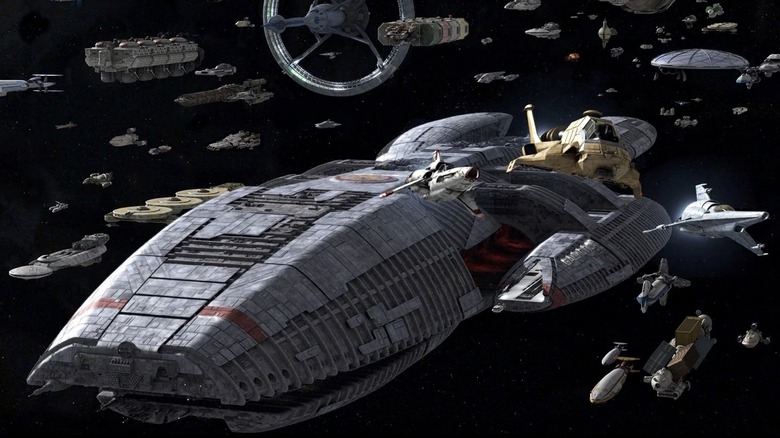
The reimagined "Battlestar Galactica" was a flagship program of the Sci-Fi Channel, but by being a 2000s network TV show, it still had to work with a much smaller budget than modern streaming sci-fi series get. Katee Sackhoff, who starred on "Galactica" as Kara Thrace/Starbuck, has said half-seriously (via Syfy) that the catering budget on "The Mandalorian" is the same size as the entire "Battlestar" budget. The budget hardly held back the show's quality, but during "Battlestar Galactica" Season 1, its makers got a quick lesson in the kind of show it could afford to be.
For reference, the series' premise is that humanity is wiped out in a nuclear attack by their robotic creations, the Cylons. So, about 50,000 survivors set aboard a fleet of starships, shepherded by the last remaining Battlestar warship Galactica, to find a new home.
Speaking with Empire in 2016, "Battlestar Galactica" co-creator Ronald D. Moore said the show's creatives initially envisioned that Season 1 would explore the different ships in the fleet, spotlighting the niches of this makeshift community:
"The initial approach was that the show would bring the characters to a variety of ships in the fleet, among them vessels that served as hospitals, prisons, schools, and even malls. We had the idea of the ragtag fleet as our world and our community and we could tell lots of different stories."
The third episode of Season 1, "Bastille Day," followed this mold. Some of the series' main characters visit a prison ship, the Astral Queen, trying to recruit the prisoners as laborers for a mining operation. The prisoners, led by Tom Zarek (Richard Hatch, star of the original "Battlestar Galactica"), want conditions attached — like clean records for themselves.
This episode, per Moore, "almost broke our budget."
Cutting corners on Battlestar Galactica
The "Battlestar Galactica" Season 1 that Ronald D. Moore described would've necessitated repeated new sets and new guest stars across episodes. So, it's easy to see why that was impractical. Once the series' crew realized that, "suddenly all those stories and ideas were wiped off the board, and we concentrated much more up front [on] what was happening aboard Galactica," per Moore.
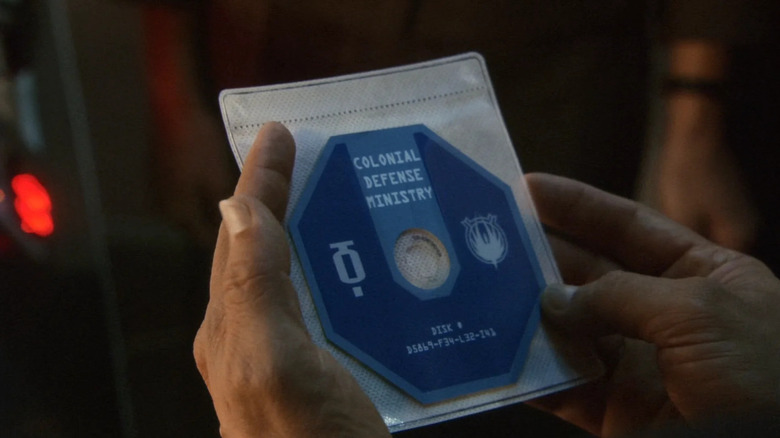
The show didn't completely give up exploring the nooks and crannies of the fleet (see the Season 3 episode "Dirty Hands," one of the truly essential "Galactica" episodes), but it was hardly a "new episode, new ship" kind of series. That said, "Battlestar Galactica" proved to be television that spun compelling stories out of limitations. (There's an inside joke about this — all the paper in "Battlestar Galactica" has an octagonal shape, because the show was literally cutting corners.)
Why, for instance, did the Cylons look like humans? Because the show didn't have the money for either extensive CGI or to build legions of convincing Cylon suits. But far from being "lame," like Moore first feared it would, their human-like appearance made the Cylons more multi-dimensional villains. They weren't simplistic killer robots like in the original series, they were basically wayward children trying to displace their parents.
This also led to a storyline about the humans (correctly) believing there were Cylon spies hidden among them. That complemented the series' larger post-9/11 themes about the paranoia of a society under attack. (Not that the show's writers planned out which characters were Cylons at first.)
"Battlestar Galactica" recently returned to streaming and while it may not have had the budget modern sci-fi series had, it still holds up alongside them.