

Should You Watch Spider-Noir In Black-And-White Or Color?
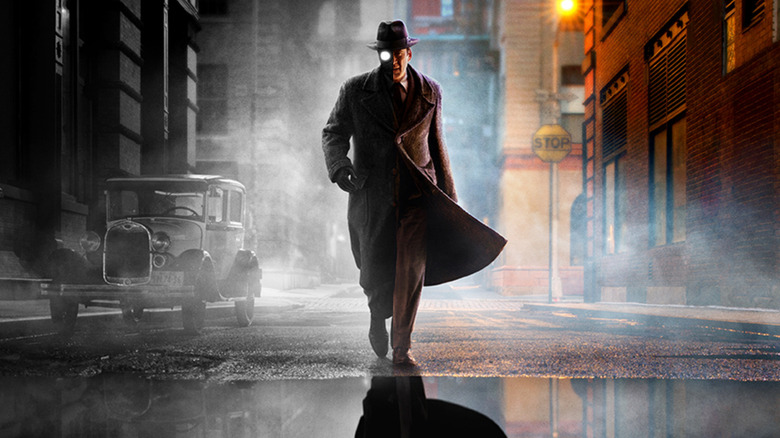
Quick: what's the first thing you think of when you hear the term film noir? Whether your mind went to a specific example like "The Maltese Falcon" or "Kiss Me Deadly," or simply conjured up an image of a rough-hewn fella in a trench coat and a sultry lady in a glamorous dress, chances are that you were imagining in black and white. Noir, of course, is like any other artistic genre. It has its own archetypes, tones, tropes, and aesthetic. There's a classical version, a deconstructionist/modernist movement (usually referred to as neo-noir), and versions of both that still exist today. Yet unlike broader genres such as horror or comedy, noir had a more definable origin point and heyday, and it's this version that we all still harbor in our collective cultural memory.
As such, one would assume that a noir version of the superhero Spider-Man would actively seek to indulge in the classical trappings of film noir. Indeed, most versions of Spider-Man Noir, in print and in the animated "Spider-Verse" movies, do just that. This week, Prime Video's "Spider-Noir" TV series premieres, with Nicolas Cage in the starring role, and it unsurprisingly is offered in what the service calls "Authentic Black and White." However, the entire series is simultaneously being released in a color version, referred to as "True-Hue." This presents a conundrum: which one should you watch?
It might seem, given the murky reasons behind the dual offering, that the color version is a cowardly choice to placate viewers who still exist in the dark ages of Fullscreen and pan-and-scan viewing, people who scoff at anything that looks old. Yet the answer isn't that simple. While the black and white version is my recommendation, both renditions have their merits and serve the show well.
Spider-Noir brings a cinematic split decision trend to TV
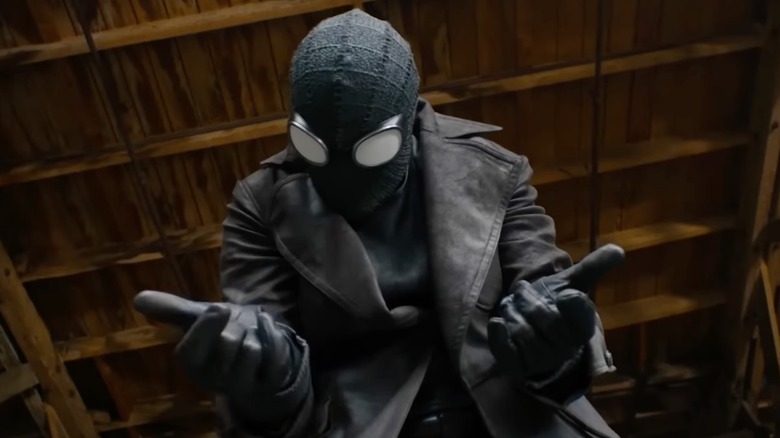
As my previous piece about "Spider-Noir" being released in two versions mentioned, the entire idea seemed suspicious from the jump. In the quoted Esquire interview, both showrunner Oren Uziel and star Nicolas Cage gave, well, cagey and diplomatic answers as to why this was being done. What's very clear from that interview is that this was a decision made prior to shooting the series, as the filming was arranged so that the digital footage was split into two versions immediately, rather than in post-production. Given Uziel and Cage's comments, it can be inferred that the choice was made primarily to appease someone perhaps worried at the prospect of a superhero series in black and white. Maybe someone was simply copying Marvel Studios' similar throwback experiment from 2023, the "Werewolf by Night" special, which also released both black and white and color versions.
However, the care and effort put into both the black and white and True-Hue versions of "Spider-Noir" seem to indicate that this was more than a mere mandate. It recalls a number of films released in dual formats over the last decade and change, a trend which began in earnest with 2015's "Mad Max: Fury Road." Other films, from "Logan" to "Parasite," have seen value in alternate versions in this manner. The splitting being done during filming means there is no "actual" version of "Spider-Noir," and that both are valid. It seems less like Uziel and co. wanted to make one and were mandated to make the other, and more like they wanted to make both at once. This is borne out by watching both versions of the series, as neither one appears lazier or more like an afterthought than the other. Each is visually compelling on their own!
1990's Dick Tracy is a huge influence on Spider-Noir
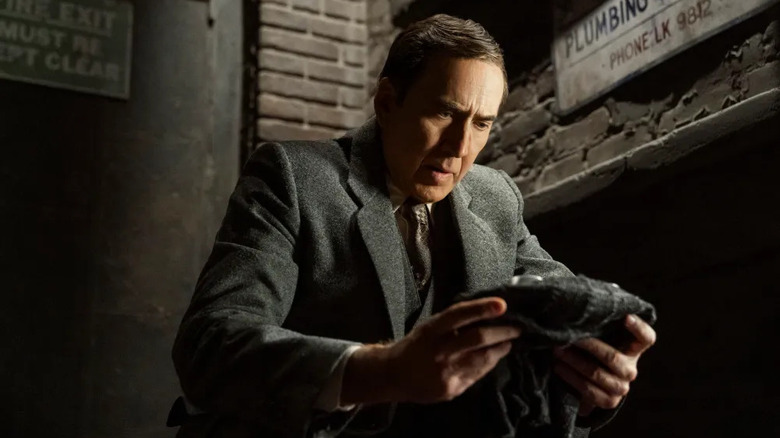
The proof in the pudding of why the dual versions of "Spider-Noir" are more of an artistic choice than a lazy offering can be seen, ironically, in the True-Hue version. If the color iteration of the series merely looked like any generic streaming series made today, then the entire enterprise would feel pretty cowardly. However, in the same way that the black and white version recalls numerous classics of the '30s and '40s (there's even an homage to Orson Welles' "The Lady From Shanghai" that the series nails), the True-Hue version most explicitly feels like a tribute to Warren Beatty's "Dick Tracy." That movie was based on the popular 1930s comic strip about a gumshoe and an unusual rogues gallery of criminals he faces. Beatty's film version uses classic film noir as a major reference point throughout, all while he and cinematographer Vittorio Storaro shoot the film in bright, saturated primary colors, the better to emulate the character's four-color origins.
The True-Hue version of "Spider-Noir" feels highly akin to Beatty's film. The various locations and costumes are pushed beyond naturalism to an eye-popping, sometimes even garish looking place. Skin tones look just a little bit unnaturally peachy, and everything seems arranged to contrast as much as possible while still being pleasant to look at. All of this makes the True-Hue version of "Spider-Noir" an interesting watch. If you only have time to watch the series once, by all means I'd lean toward the black and white, but choosing the True-Hue doesn't diminish "Spider-Noir" at all. Hopefully, the bifurcation of the series doesn't set an anti-black and white precedent, and instead demonstrates that streaming series can be as creatively adventurous as their cinematic brethren.
"Spider-Noir" is now available on MGM+, and is on Prime Video on May 27th.