

Paramount Hated When Star Trek: The Next Generation Writers Used One Storytelling Technique
We may receive a commission on purchases made from links.
The writers of "Star Trek: The Next Generation" will all happily regale you with tales of the show's exciting two-part cliffhanger episodes. It's generally accepted that "The Best of Both Worlds" — the one where Captain Picard (Patrick Stewart) was assimilated by the Borg — is the best episode of the series. The first half of "Worlds" served as the grand finale of the show's third season, while its conclusion opened the fourth, meaning that Trekkies had to wait a long, tense summer to learn how Picard would escape the Borg's clutches.
But that episode is extraordinary because "Next Generation" typically didn't have cliffhangers, except as season finales. Indeed, the series only boasts a small handful of two-part episodes altogether. For the most part, TNG abided by the traditional episodic TV structure: Weekly miniature dramas would conclude at the end of the hour. Most primetime shows did at the time. Only soap operas tended to feature long-running serialized stories. TV studios loved the episodic structure because it was incredibly friendly in syndication, and if a casual TV viewer caught a random rerun of "TNG" one afternoon, they wouldn't need to know where they stood in the show's timeline to understand it. They would be able to understand the story and the characters right away.
Of course, sticking to an episodic structure was frustrating for the writers of "Next Generation." Several scribes have gone on record with their desire to tell longer-form stories that spanned many episodes, but Paramount — and their executive producer — discouraged them from doing so. Some of those writers talked about those frustrations in the oral history book "The Fifty-Year Mission: The Next 25 Years: From The Next Generation to J.J. Abrams" edited by Mark A. Altman and Edward Gross.
Paramount hated when the Star Trek: The Next Generation writers wanted to do more serialized stories
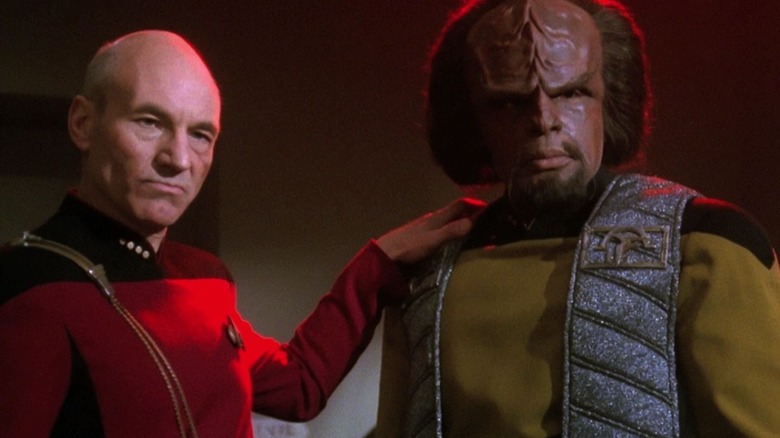
Ronald D. Moore, a writer and producer on "Star Trek: The Next Generation," co-penned an episode in the show's third season called "Sins of the Father." The episode involved the fate of Worf (Michael Dorn) and his status in the Klingon Empire. In Klingon culture, if a father commits a crime, it brings shame on their sons even after his death, and Worf's father had been accused of being a traitor. "Sins of the Father" is about Worf investigating his dead father's crimes and discovering that his father was innocent. But thanks to some political machinations, Worf was encouraged to take the blame anyway. The episode ended with Worf being excommunicated from the Klingon Empire.
Of course, that meant that Worf's status would have to be addressed in future episodes. Indeed, there are several more episodes about Worf, his father, and achieving justice. At the time, though, Moore recalls some trepidation from the show's executive producer Rick Berman, as well as being alerted to the fact that Paramount hated that kind of open-ended storytelling. In Moore's words:
"The episode that did break the mold before 'Family' was 'Sins of the Father.' I deliberately left it open. Worf has lost his honor and leaves. It was pretty clear that eventually you're going to have to follow that story up. There was a moment in Rick's office when we're working on the script when he said 'Do, we're going to have to do a follow-up to this, right?' and I was like, 'Yeah.' 'Paramount doesn't like that.' I was ready for him to say you can't end this way, but he didn't. He just kind of grumbled and moved on."
The ending, it seems, was too good to throw out.
The aftermath for The Best of Both Worlds was necessary
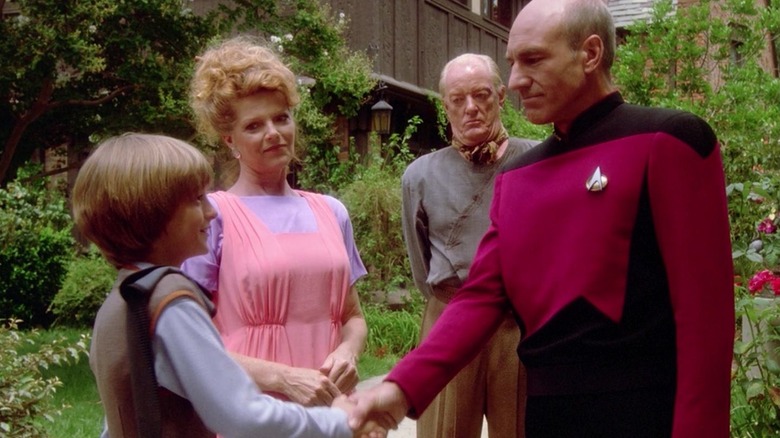
Michael Piller, a longtime writer and producer on "Star Trek: The Next Generation," also noted that interconnected stories were necessary. In particular, he cited Ronald D. Moore's script for the episode "Family," which immediately followed the events of "The Best of Both Worlds." "Family" is set several weeks after Picard had been abducted by the Borg, and he was already ostensibly on the road to recovery. "Family" allowed him to visit his estranged brother on Earth, where he revealed that he still hadn't fully processed his trauma.
Piller mentioned that most of the TNG writers didn't like avoiding serialized stories, but that the team had fallen into an effective pattern of writing great episodic TV. But for the episode "Family," Piller really had to plea a case for a story that connected directly to the events of a previous episode. Piller said:
"When I got to the end of ['The Best of Both Worlds, Part II'), we made the decision not to extend it. And I called up Rick and said 'Hey, listen, next week Picard can be fine, but for a who that prides itself on a realistic approach to storytelling, how can how have a guy who's basically been [assaulted] be fine the next week? There's a story in a man like Picard who's lost control.' Finally, I was persuasive enough to talk Gene [Roddenberry] and Rick into taking the chance."
The only compromise on "Family" was that Moore had to write a sci-fi B-plot to balance Picard's sojourn to Earth. Luckily, "Family" works well enough as a standalone story anyway. Even if you didn't know what happened with the Borg, you'd understand that Picard suffered some sort of awful trauma. All of that tracks.