

Landman's Ali Larter Starred In A Western That Roger Ebert Said Proved The Genre Was Dead

In 2001, a Western debuted that has since gone down as one of the 21st century's most disappointing examples of the genre. "American Outlaws" starred Colin Farrell, Scott Caan, and "Landman" actor Ali Larter, who was then several decades away from portraying the fiery Norris matriarch on Taylor Sheridan's oil drama. The movie even boasted the likes of Kathy Bates and Timothy Dalton, yet was not only critically derided, but according to Roger Ebert, proof positive that the Western was truly dead.
When did the Western actually die? Some say it started in the 1960s when Sergio Leone's Oaters rewrote the rules of filmmaking and Sam Peckinpah's "The Wild Bunch" upset John Wayne so much he spoke out about how the director had gone too far. But 1969 had some of the finest Westerns ever made, from Wayne's own "True Grit" to Leone's "Once Upon a Time in the West." With that in mind, the 1970s was really when the genre died out, as sci-fi fully usurped its standing as the most popular movie genre of the time. Even then, however, the Western never actually died.
Today, Hollywood still cranks out the odd Oater, and in a post-Sheridan age, we're seeing more Western and Western-adjacent media than ever. But if you ask Roger Ebert, the final nail in this long-suffering genre's coffin came in 2001 with "American Outlaws." As the critic put it in his one-star review, "For years there have been reports of the death of the Western. Now comes 'American Outlaws,' proof that even the B Western is dead."
American Outlaws was a misguided attempt to reinvigorate the Jesse James legend
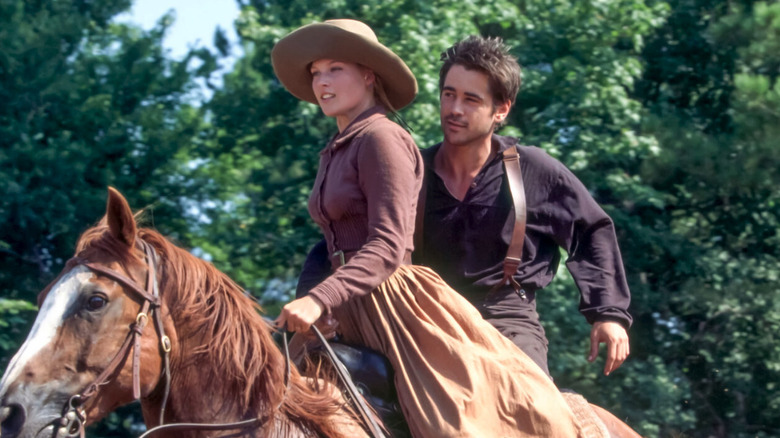
Plenty of great Westerns have bombed at the box office, like Brad Pitt's Western flop which also happens to be one of the best movies of the 2000s, "The Assassination of Jesse James by the Coward Robert Ford." Fellow financial fiasco "American Outlaws," however, might be one of the worst. Warner Bros., which also ensured Pitt's revisionist flick failed at the box office, oversaw the release of "American Outlaws" which grossed just $13.7 million on a $35 million budget. This was a historic bomb that might have been destined for "Assassination of Jesse James"-levels of cult status if it hadn't also been terrible.
The film focuses on that same legendary outlaw, this time played by Colin Farrell. Rather than the hauntingly beautiful elegy for the myth of the Old West that was Pitt's film, however, "American Outlaws" sees Farrell's gang leader in a confused mess of a film that tried to reinvent the legend as some sort of early 2000s action hero. "American Outlaws" follows Jesse, his brothers, and their cousins, the Youngers, as they return to their Missouri town to find it occupied by Union troops. The Yanks are forcing locals to sell their land to the railroad company, but the James and Younger boys are having none of it. After their dear old mother Zerelda James (Kathy Bates) is killed, the gang set out for revenge joined by Ali Larter's Zee Mimms.
According to Roger Ebert, this all made for a film that "only wants to be a bad movie, and fails." That wasn't even the worst thing Ebert had to say about the movie, either.
American Outlaws made Roger Ebert despair of modern Western filmmaking
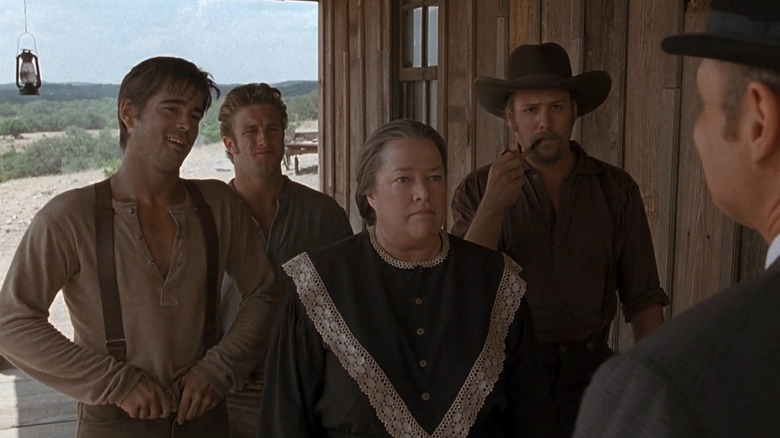
Not everybody hated "American Outlaws." Kevin Thomas of the Los Angeles Times found it to be "a handsome and skillful retelling of a legend that imaginatively draws on conventions of both the Western and the gangster movie." Roger Ebert, on the other hand, found it to be "the Nickelodeon version" of Philip Kaufman's much more highly acclaimed 1972 Western "The Great Northfield, Minnesota, Raid." "Imagine the cast of 'American Pie' given a camera, lots of money, costumes and horses," he wrote, "and told to act serious and pretend to be cowboys, and this is what you might get."
Whereas "The Assassination of Jesse James" deconstructed the myth of James, "American Outlaws" irked Ebert with its suggestion that the legendary outlaw was "motivated not by money but by righteous anger (and publicity–all the boys liked being famous)." The film itself borrowed from the real James' life but embellished and elaborated with abandon, killing off the James matriarch whereas in reality she was only maimed. This sort of thing not only rankled Ebert, but upset him, prompting the critic to reflect on the state of filmmaking. "What happened to the rough-hewn American intelligence that gave us the Westerns of Ford, Hawks and Peckinpah?" he asks at the end of his review. "When did cowboys become teen pop idols?"
Along with the critically-derided "Texas Rangers," "American Outlaws" helped bury the Western even deeper, making 2001 a real nadir for Oaters. But even then it wasn't truly dead, as evidenced by the spate of standout Westerns that came in its wake. That included the movie that was voted the best Western of the 21st century "No Country for Old Men" and Brad Pitt's far superior Jesse James movie.