

5 Best Captain America Villains Of All Time, Ranked
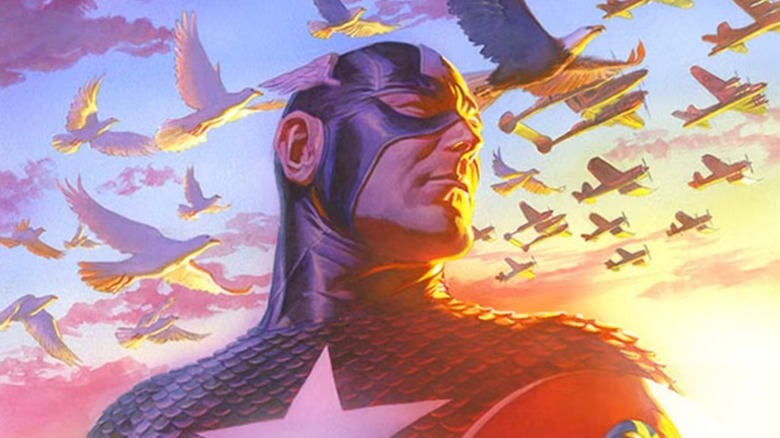
In the 80+ years of "Captain America" comics, there have been plenty of bad guys who have been willing to challenge the Sentinel of Liberty and his mighty shield.
Captain America is a breathing symbol of the U.S.' most just ideals, so his villains tend to be political subversives. Cap has battled foes at complete opposite ends of the political spectrum, be they greedy capitalists, white supremacists, terrorists, the radical anarchist Flag-Smasher, or the Nationalsozialistische übermensch Master Man. Remember, Captain America was created (by Jack Kirby and Joe Simon) during World War II, and the character's legacy — including the evils he fights — are connected to that war. No surprise, then, that many Cap villains have ties to the German Third Reich and Axis Powers.
But "Captain America" is a book that evolves with the times, using Cap to grapple with the issues of the day. (In a couple of Marvel comics, Captain America has even run for political office.) Oftentimes, that means having villains who either represent inner rot in the U.S. or are dark mirrors of Captain America himself. Take William Burnside; the 1950s "commie smasher" Captain America was resurrected as the evil "Grand Director," leader of a cross-burning Ku Klux Klan-like group at complete odds with Cap's belief in a pluralistic United States.
But across the many challenges and foes Captain America has faced, these five villains stand out as either the most consistent, the one who left the deepest scars, or both.
5. Aleksander Lukin
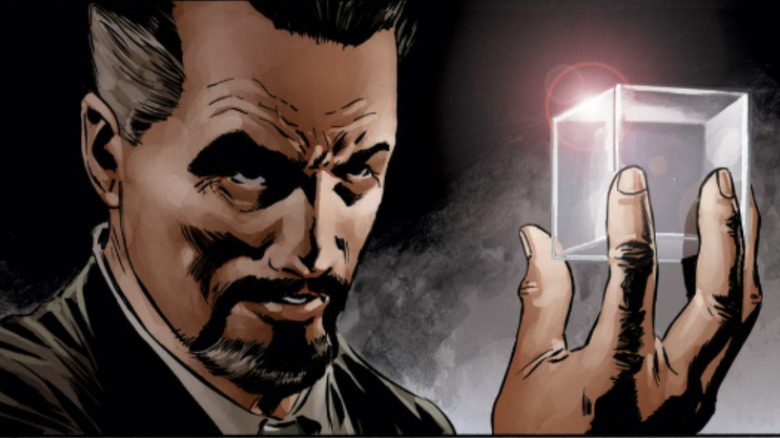
"Winter Soldier" by Ed Brubaker and Steve Epting is one of the most acclaimed Captain America stories ever. It's a perfect "Captain America" gateway comic even though it builds on (and upends) the title's whole history.
In 1964's "Avengers" #4, Stan Lee and Jack Kirby killed off Cap's kid sidekick Bucky. He stayed that way for 40 years, too, with Cap remaining haunted by his inability to save his best friend. Then, Brubaker threw all that in the air. Bucky was found by the Red Army and brainwashed into Russia's Winter Soldier, with no memory of his true self. (Hence his famous line, pointed at Cap: "Who the hell is 'Bucky'?")
"Winter Soldier" is a canonical story. It changed Bucky forever and, of course, was adapted in 2014 as a film. But truly, the Winter Soldier was only an adversary of Cap for about a dozen issues before Bucky's true self returned. Even as a bad guy, he was a tool of the true villain: former KGB officer turned energy oligarch Aleksander Lukin, the protege of the Winter Soldier's creator, Vasily Karpov.
In his first appearance, "Captain America" #1, Lukin executes the Red Guardian, symbolizing the death of the old Soviet Russia for a new capitalist one. At the end of that issue, he then has the Winter Soldier assassinate the Red Skull — not to rid the world of evil, but to take the Skull's reality-warping Cosmic Cube. Lukin ultimately kills hundreds of people in Philadelphia to power the Cube and delights in tormenting Cap with all his past failures (Bucky most of all).
Lacking the flair or dual identity of a typical Marvel villain, Lukin feels all the more real for it. He's a cautionary tale of how you invite evil inside yourself by reaching for power.
4. The Secret Empire
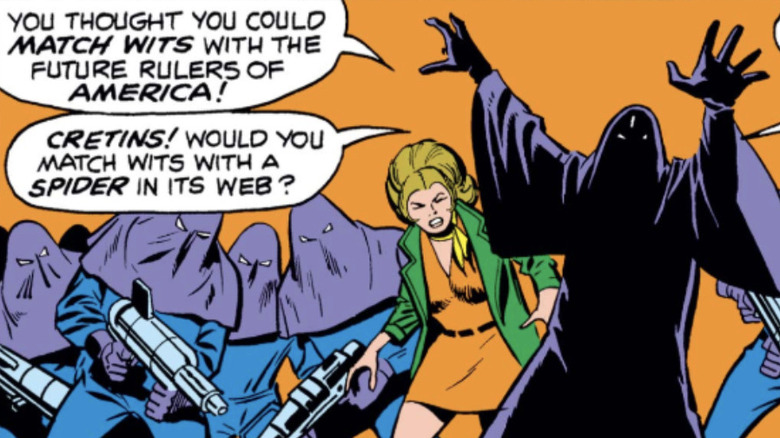
Captain America has fought many evil/terrorist organizations filled with legions of masked members. Thanks to the Marvel Cinematic Universe movies, the most famous one is HYDRA. Originally created as villains in "Nick Fury: Agent of S.H.I.E.L.D.", HYDRA was soon folded into Cap's rogues gallery, and it's stayed there since. In Marvel movies and cartoons that can't or don't want to get into the political realities of World War II, HYDRA makes a convenient stand-in for the Nazis.
But of the evil conspiracies, I've got to give the edge to the Secret Empire, thanks entirely to a 1970s "Captain America" storyline written by Steve Englehart. The story follows Cap and the Falcon disrupting the Secret Empire's attempts to take over the U.S. It's all in a day's work for Captain America ... until the ending, when Cap unmasks the conspiracy's leader Number One.
The villain's face is not seen, and then he takes his own life, but between Cap's aghast reaction and Number One saying public office wasn't enough power for him, it's heavily implied to be U.S. President Richard Nixon. ("Secret Empire" was written during the then-ongoing Watergate scandal.) Steve Rogers is so dispirited by the leader of his country being a crook that he discards the title "Captain America," trading in his red, white, and blue costume for a new one as Nomad, a man without a country.
"Secret Empire" redefined Captain America; if he's the American paragon, then his stories can and should engage with the flawed reality of what the U.S. really is. Richard Nixon's corrupt administration, and the public exposure of that corruption, left its scars on (Captain) America.
3. Crossbones
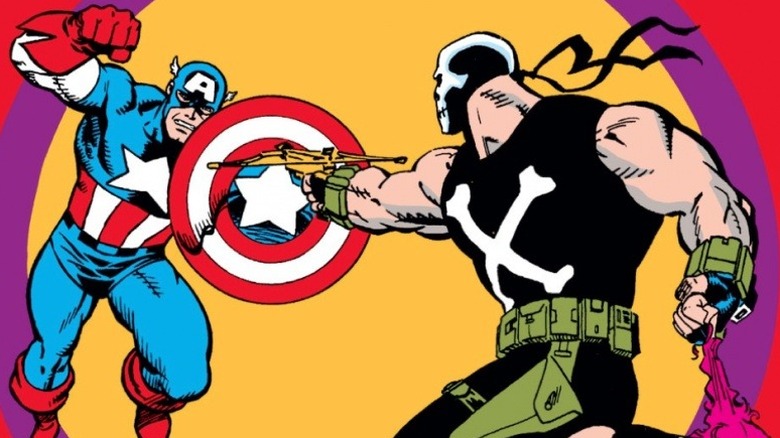
Mark Gruenwald wrote "Captain America" for over 100 issues, and he left his mark by expanding the book's supporting cast. One of his most enduring co-creations (with artist Kieron Dwyer) is the villain Brock Rumlow/Crossbones, a white supremacist mercenary who dresses in black-and-white skeleton-themed tactical gear. If Rumlow seems like a cruel man based on that description, rest assured, he's even worse than he sounds!
Rumlow is a loyal servant of the Red Skull, and within that devotion lies the origin of his name: Skull and Crossbones, i.e. the symbol for death (whether by pirate or poison). Crossbones lives up to that symbolism, and as much he loves guns and knives, he doesn't need them to deal out death. Tall and burly like a bodybuilder, Crossbones can give Cap a one-on-one bare knuckle challenge not many other villains can.
Though he only debuted in 1989, Crossbones has stuck around like a cockroach and is now one of the most prominent Captain America villains. He has a major part in the Ed Brubaker "Captain America" run, which pairs him up with the Red Skull's sadistic daughter Sin; they rampage across the U.S. together like a fascist Bonnie & Clyde. Rumlow even helps assassinate Captain America during this run, firing sniper rounds that hit Steve Rogers.
Frank Grillo played Crossbones in the MCU films "Captain America: The Winter Soldier" and "Civil War." Even if I'd contend this version (reimagined as a HYDRA sleeper agent inside S.H.I.E.L.D.) didn't match the brutal skinhead characterization of the comic Crossbones, Grillo's Rumlow still left his mark by kicking off the titular superhero civil war.
2. Baron Zemo
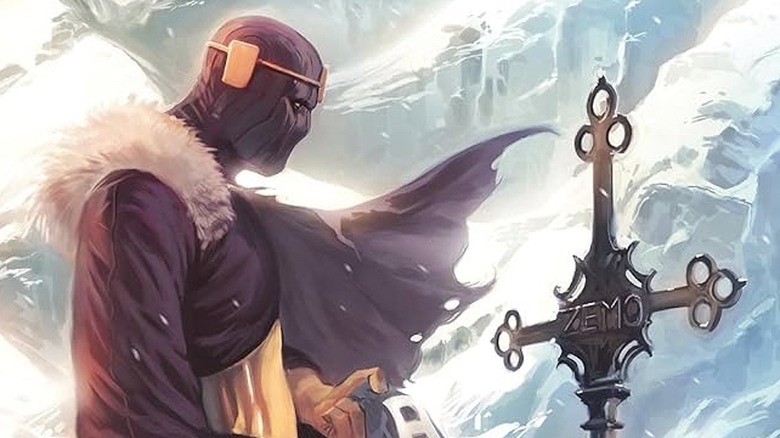
During both Captain America's original adventures in World War II and his ongoing ones in the modern day, one name has caused him more pain than almost any other: Zemo.
First, there was Baron Heinrich Zemo, 12th of his name. A Nazi scientist, Zemo was the proudly self-described "most hated man in Europe" and the Führer's chief doomsday weapon architect. One of Zemo's creations, Adhesive X, backfired during his first fight with Cap; the glue sealed his purple hood to his face. Stan Lee and Jack Kirby debuted Zemo in "The Avengers" #4, where he was retroactively depicted as a major enemy of Cap during the 1940s. (It was on a mission to stop Zemo that Bucky seemingly perished, and Cap wound up frozen for decades.)
After that tease, it was inevitable the reawakened Cap would face Zemo again in the present day. Come "Avengers" #6, Zemo formed the Masters of Evil to counter Earth's Mightiest Heroes. You can't write about Captain America without mentioning how he leads the Avengers. Zemo, as the original and most famous boss of the Masters, mirrors Cap's fearless leadership.
Heinrich met his end in "Avengers" #15, but his evil legacy lives on through his son Helmut, the 13th Baron Zemo. Initially seeking revenge on Cap for his father's death, Zemo Jr. got even more reason to hate the Star-Spangled Avenger when he was scarred just like his father was.
Given Heinrich worked for the Nazis, it's no surprise the Zemos are eugenicists; they're not just racist, they're classist. Father and son both deem themselves "born better" due to their noble lineage. Aristocracy is a European tradition that the United States threw off during its War for Independence, making Captain America a perfect foe for the evil German Barons.
1. The Red Skull
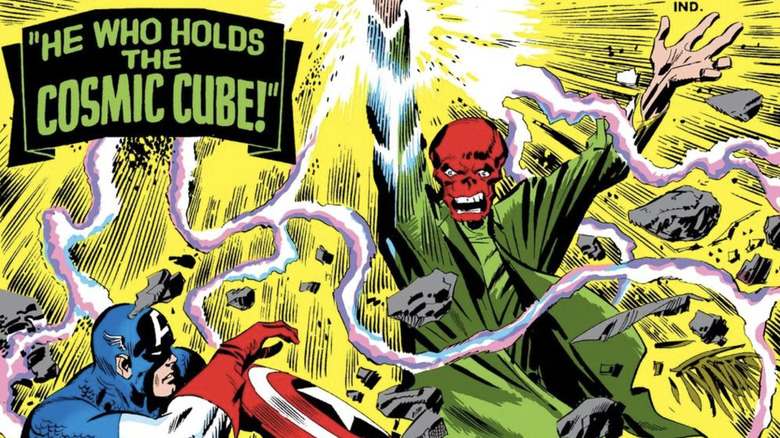
The original "Captain America" villain, Red Skull debuted in "Captain America Comics" #1 alongside his heroic nemesis. In those early stories, the Red Skull was George Maxon, an Axis-sympathizing industrialist and saboteur. When Captain America was revived for publication in the 1960s, the Red Skull was retconned with him.
Maxon was a mere imposter for the true Red Skull, Johann Shmidt. Once a mere hotel bellhop in Germany, the future Red Skull initially served Adolf Hitler. Recognizing a capacity for evil in the boy's eyes, Hitler remade Shmidt into the ultimate Nazi. (The Skull's real name is the German equivalent of "John Smith," perfect for a nobody made into a monster.)
His red skull is (usually) a mask, but it shows the true face of both Nazism and Shmidt's rotten soul. "Captain America: The First Avenger" made this literal; the MCU Red Skull (Hugo Weaving) took the same Super Soldier Serum that remade Steve Rogers and it revealed his true self, i.e. the Red Skull.
Other "Captain America" villains, like twisted scientist Arnim Zola, evil hypnotist Dr. Faustus, the aforementioned Crossbones, and sometimes even Zemo, have often worked in subservience to the Red Skull. One of the Skull's most nefarious acts was, with the help of his favored weapon the Cosmic Cube, rewriting history to make Captain America submit to fascism's vision, too.
During the earlier Ed Brubaker "Captain America" run, the Skull was the mastermind behind Steve Rogers' assassination; Cap returning doesn't mitigate the damage. The Skull himself has been able to dodge death before. Once, he even resurrected himself into a clone of Steve Rogers. That's arguably his most insidious attack on Cap of all, taking his blond, blue-eyed face and using it to fight for not the American Dream but the Thousand Year Reich.