

One Of The Best Horror Novels In Recent Memory Is Begging For A Movie Adaptation
We may receive a commission on purchases made from links.
Two genres that do not intersect often enough are horror and medieval-set fantasy. The Dark Ages, a time of superstition where violence and danger prowled through villages and woods every day, is a perfect setting for spooky stories. Some of the best cooked pudding with proof of this is Christopher Buehlman's novel "Between Two Fires," an odyssey through medieval France beset by the Black Plague and demons alike. And it needs to be adapted to film.
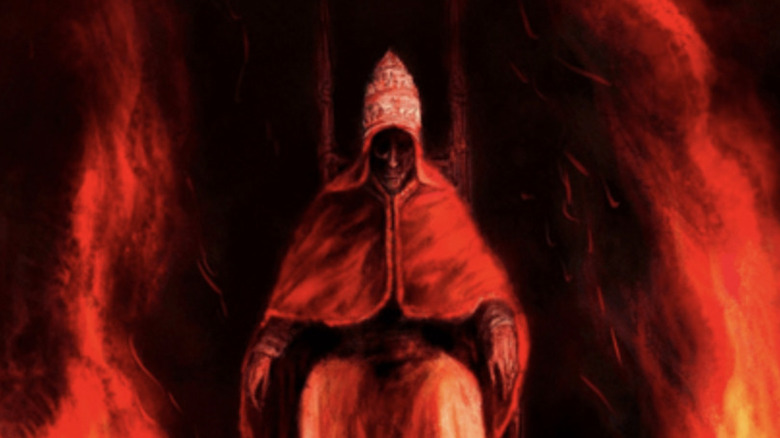
Set in 1348 AD, "Between Two Fires" follows disgraced knight turned brigand Thomas. He has a chance meeting with a little girl named Delphine (when he stops the band's less honorable members from raping her), who claims she can see holy visions. A bemused Thomas, unsure if she's a witch or a prophet, sets out on a quest to bring Delphine to the holy city Avignon, seat of the Pope. ("The Pope held audiences between two fires to burn off pestilential air.")
First published in 2012, "Between Two Fires" spent over a decade slowly rising from obscurity into a best-seller and modern classic; a new hardcover edition, with fresh cover art, was released in 2026. In a foreword for the 2026 edition, author Joe Hill speculated a key reason for the novel's new popularity is that, after the COVID-19 pandemic, readers can now relate to living in a plague-filled world. As Hill also notes, though, there's more to the novel's endurance than that.
Buehlman's prose in "Between Two Fires" is witty (though without any snark or self-deprecation) and vivid with detail; it's both a joy and a terror to watch him paint his world and its characters with his words. Readers have certainly taken notice of "Between Two Fires," and the book's epic quest of redemption — and infernal monsters — should call out to Hollywood, as well.
Between Two Fires mixes the Black Death and religious horror
In Christopher Buehlman's debut novel "Those Across The River," he mixed the Southern Gothic with werewolves; the book's text put historical evils of chattel slavery alongside very literal monsters. "Between Two Fires" does something similar. We know that the Bubonic Plague was brought by germ-spreading rats, but to uneducated peasants in 14th century France, the plague might as well be a curse cast upon humanity.
"Between Two Fires" runs with that, because in the novel, the plague is literally the work of demons. The novel includes interludes of a war between Heaven and Hell, with ramifications felt across the mortal plane. Compare the 2010 horror film "Black Death," set in the same era, which also shows how the plague's inescapable touch of death drove people to blame a vengeful God. In "Black Death," any magic is only superstition, in "Between Two Fires," the supernatural is all-too real.
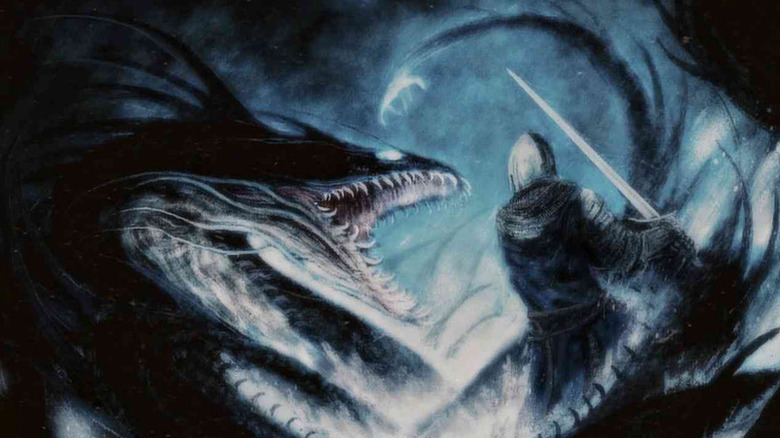
Thomas and Delphine encounter a variety of demons on their quest, such as an eel-like monster hiding in a village's river. Closer to Avignon, the demons become even stranger and often more ethereal. There's an increasingly nightmarish sequence wherein Thomas stops at a castle, apparently untouched by the plague... until the castle's people shift into monsters and, eventually, vanish altogether.
I'm one of the many who holds up the manga "Berserk" as the peak of dark fantasy, and "Between Two Fires" is the Western work I've read which comes closest to nailing the same vibe. Thomas, as a cynical demon slayer who learns to value love again, is similar to "Berserk" antihero Guts. Thomas' eventually revealed backstory isn't quite as horrifying as having your former best friend sacrifice you and everyone you love to demons, but it's close!
Why fantasy fans will love Between Two Fires
The narrative engine of "Between Two Fires" isn't far off from classical fantasy, a la "The Lord of the Rings" — a band of travelers on a heroic quest. But Christopher Buehlman uses that to structure his story almost like a collection of medieval monster tales; there's a wide variety of demons in, some that could sustain a novel all their own.
One of the creepiest chapters in the book, "Of the Ones Who Knock by Night," features Thomas and Delphine staying overnight in Paris. They learn, the hard way, that demons descend on the city at night, using holy statues as corporeal forms to kill any person unwise enough to answer their door:
"The door had opened on a six foot statue of the Holy Virgin with a high crown holding a scepter in one hand, but where the Holy Infant should have been cradled in the other, her stone hand held the ankle of an infant who dangled upside down with the purplish skin of a plague victim."
Reading "Between Two Fires," the one director who I feel could slip easiest into Buehlman's world is absolutely Robert Eggers, known for his horror period piece films. His films pull the same trick the novel does, telling horror stories of centuries past rooted in fears felt by people living in those eras.
Eggers' "The Witch" is about the dissolution of a Puritan New England family in the 1600s; those kinds of people believed witches were real, and in the movie, they are. It's the same way "Between Two Fires" takes the fears of 14th century France, that devils walked among them or that God had abandoned them to a plague, and makes a story out of those superstitions being proven real.