

Project Hail Mary Author Andy Weir Didn't Mince Words About This Oscar-Winning Sci-Fi Movie
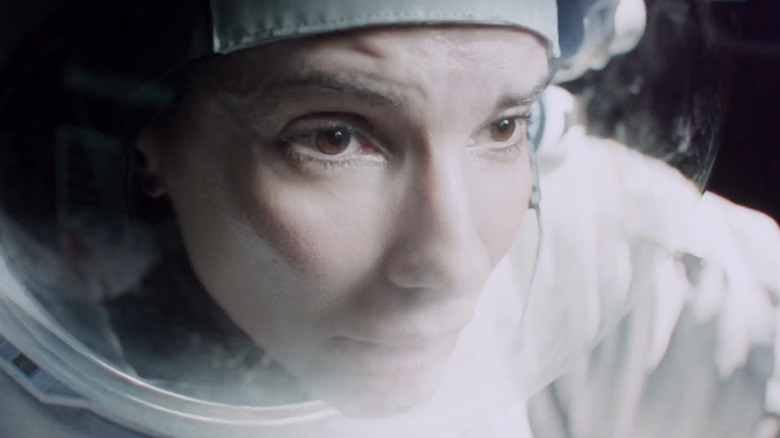
Andy Weir has plenty of opinions and isn't shy about sharing them. The "Project Hail Mary" author has some strong thoughts about "Avatar: The Last Airbender," and previously let it be known that he wasn't a fan of "Black Mirror" because he saw the sci-fi anthology series as being too anti-tech. Oh, and Weir also has a major issue with the "Star Trek" franchise. So you can bet if a new sci-fi movie debuts and gains any sort of attention, the author is going to have something to say. That was certainly the case with Alfonso Cuarón's 2013 effort "Gravity," which, according to Weir, was one big mislead from the very beginning.
The film itself was actually excellent from the very start. The opening oner in "Gravity" is one of the best action scenes ever, and things only got better from there. The film sees Sandra Bullock and George Clooney's astronauts stranded in space after their shuttle is destroyed by space debris. With no way to contact Earth and rescue an impossibility, the pair embark on a perilous journey through orbit to reach the International Space Station in what is one of the most tense and riveting space adventures ever put on screen.
"Gravity" earned widespread praise upon its 2013 debut, and not only from critics. The great James Cameron called it "the best space film ever done" (via Variety), and it earned 10 nominations at the 86th Academy Awards, winning seven, including Best Director for Cuarón, and Best Cinematography for Emmanuel Lubezki. All in all, then, it was nothing short of a triumph. Except it wasn't scientifically accurate and, surprise, surprise, Andy Weir didn't like that.
Andy Weir's didn't like Gravity's scientific inaccuracies
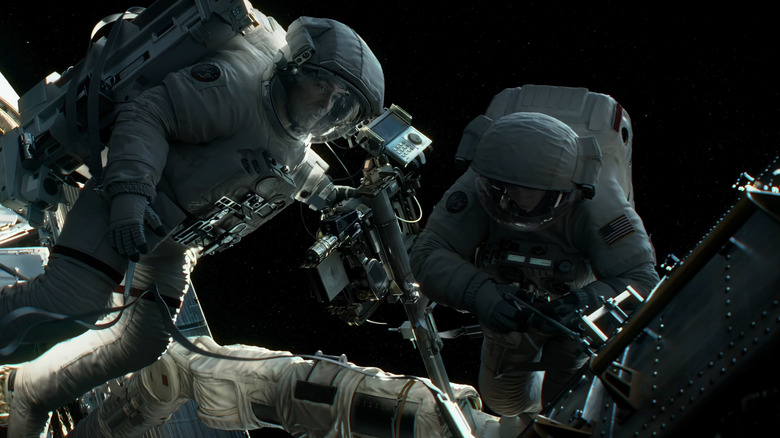
"Gravity" did have plenty of scientific inaccuracies, but anyone who saw it in theaters, especially IMAX, surely couldn't have cared less, given how thrilling an experience it was. Andy Weir, however, decided to call out Alfonso Cuarón for taking liberties with the science in his space thriller.
In a 2017 interview with The Verge, Weir was asked to give an example of a story that made him cringe and pointed to "Gravity." But it wasn't just that Curarón's film was inaccurate. The author took issue with the movie's purported realism. "'Gravity' was presented as an accurate portrayal of the International Space Station, shuttle flight, and all these other things," he said. "The inaccuracies in that stand out because it presented itself as a realistic film."
Weir pointed to other sci-fi films that don't "pretend to be realistic," citing "Star Wars: The Force Awakens" as one example. As he put it, "Few people look at 'The Force Awakens' and say, 'Let's analyze the science of this and make sure it's accurate,' because that's not the kind of story it was." Asked why scientific accuracy is important to him, Weir went on to say:
"The shocking revelation is that I actually don't think it's important. It's just that it is my approach to making plausible stories. My strength is scientific knowledge — that's what I'm good at. So that is the avenue by which I tell plausible stories. There are a million ways to make a good story, and this is just the one I've chosen."
If it isn't important to you, why bring it up? Well, it's one of those Weir mysteries that arises every time the man delivers one of his hot takes.
Andy Weir's nitpicking of Gravity kinda just sucks
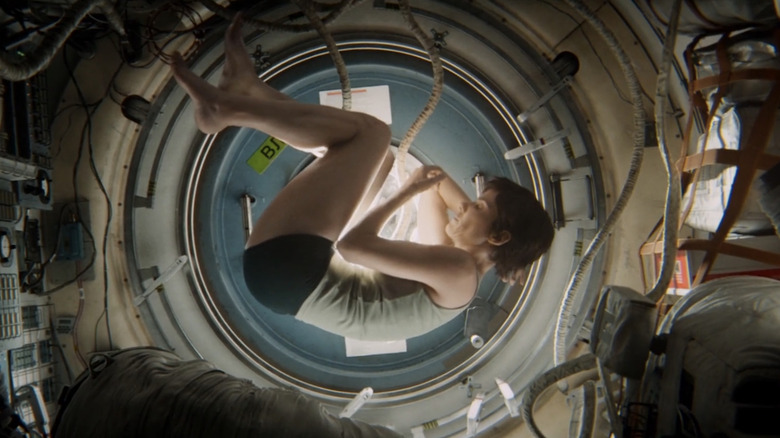
Andy Weir's issue with "Gravity" hinges on the idea that the movie was touted as a film so accurate it might as well have been a documentary. It is true that Alfonso Cuarón went to great lengths to ensure parts of the film were, and told CollectSpace "For me that whole idea of doing the setting in space and honor what is in there, not trying to invent, that was the thing." But the director also went on to state, "This is not a documentary, it's a piece of fiction and in the frame of the fiction we have we wanted to be a respectful and accurate as possible. But obviously, you know, we have to take big, big leaps and big, big freedoms to tell the story." Fair enough. Except it wasn't for Weir.
Weir previously called out "Interstellar" for being inaccurate, even though Nobel Prize-winning physicist Kip Thorne consulted on the movie and ensured that everything, down to the smallest plot detail, had a justifiable, scientifically sound explanation. With his "Gravity" comments, he once again just seemed to come off as needlessly critical, and he wasn't the only one.
Professional buzzkill Neil DeGrasse Tyson also fact-checked "Gravity" in a series of tweets collected by Wired, taking Cuarón to task for everything from Sandra Bullock's hair to the way the space debris orbited Earth from East to West. This is a guy who started his tweet marathon with "Mysteries of 'Gravity': Why anyone is impressed with a zero-G film 45 years after being impressed with '2001: A Space Odyssey" — a tweet so impeccably designed to ensure everybody reading immediately tuned out that it should be studied for generations to come. I'm sure Andy Weir liked it, though.