

The Devil Wears Prada 2 Review: A Chic, Charming Sequel, But Nothing Groundbreaking
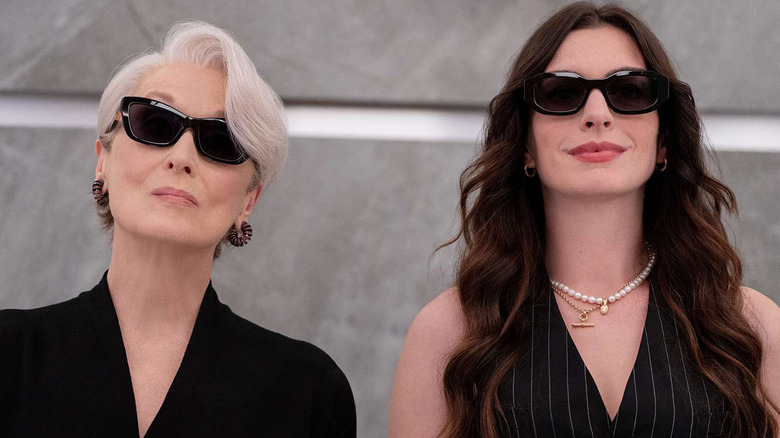
When "The Devil Wears Prada" debuted in 2006, it reshaped Meryl Streep's career and cemented Miranda Priestly as an iconic, icy antagonist. Alongside Emily Blunt's biting Emily, Anne Hathaway's overwhelmed Andy Sachs, and Stanley Tucci's scene-stealing Nigel, the film became a pop culture touchstone, immortalized by quotable lines still widely recognized today. Based on Lauren Weisberger's novel of the same name, "The Devil Wears Prada" only happened because of Streep's star power, but it's the continued cultural relevance in an industry desperate to mine through existing IP that has brought us a sequel 20 years later.
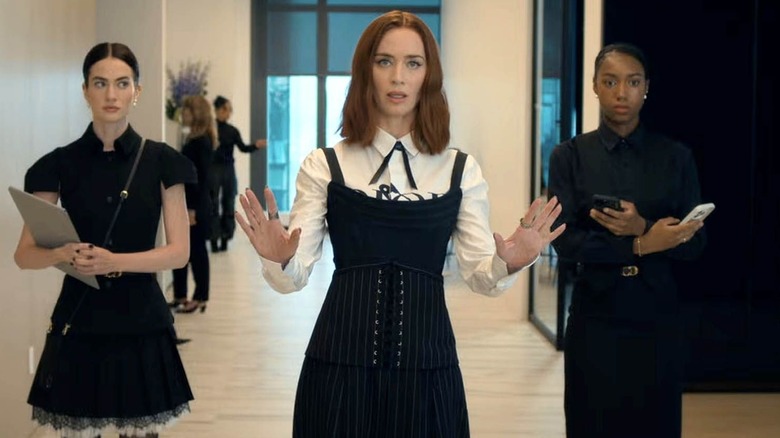
While working at a magazine was one of the go-to workplaces for women-led comedies in the 2000s, the print media landscape is nearly unrecognizable in 2026. Not even prestigious awards for her work as a journalist can shield Andy from the cruel hammer of corporate restructuring and the bleak reality that people would rather scroll than read, because she finds herself jobless within the first 10 minutes. Fortunately, she is immediately scooped up by "Runway" magazine, tasked with rehabilitating "Runway" after a PR disaster. This allows her to reunite with all of our favorites from the original film, including Emily — who now works for Dior — and meet the "new Emilys," Amari (Simone Ashley) and Charlie (Caleb Hearon), as well as her own assistant, Jin (Helen J. Shen).
Despite Andy's growth, Miranda, unsurprisingly, has no faith in her. But even the baddest boss of them all is no match for the unforgiving grip of late-stage capitalism and the shifts in modern media. Faced with existential threats to the publication, these former adversaries must collaborate to save "Runway," or risk this pillar of fashion publication joining the graveyard of legacy media.
The Devil Wears Prada 2 reveals a new side of Miranda Priestly
"The Devil Wears Prada 2" has some serious Jimmy Choos to fill and often feels restrained by the weight of the original's legacy. Everyone rightfully hated Andy's original boyfriend, Nate (Adrian Grenier), but at least he mattered. By contrast, her new love interest, Peter (Patrick Brammall), while effortlessly charming, is ornamental at best. I love that Andy has grown to a point where she can "have it all," but their relationship is wholly inconsequential to the rest of the plot. Nate might have sucked, but at least he provided conflict that helped motivate the story. Peter feels like a checkbox "romance subplot" inclusion.
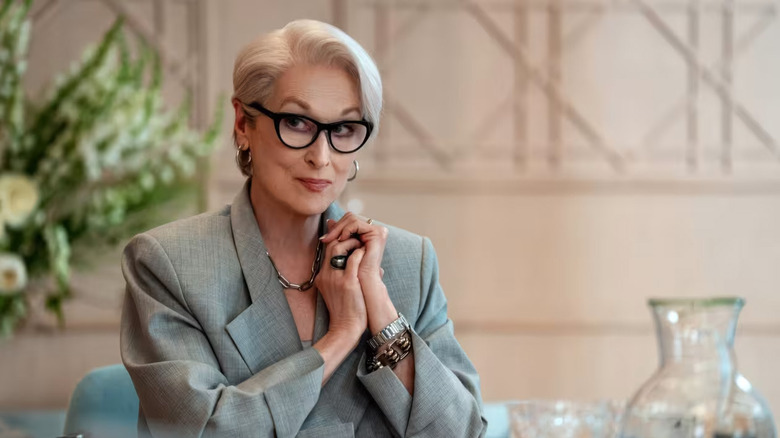
Miranda is remarkably restrained this time around, but it's a fascinating change reflecting the evolution of acceptable workplace behavior and the harsh reality that even Miranda Priestly is not immune to the prioritization of digitization. Meryl Streep imbues Miranda with a vulnerability previously left unseen, but the script is frequently plagued by the "tell, don't show" methodology that is currently destroying American streaming TV. Fortunately, the performances are so delightful, and Molly Rogers' stunning, sequin-forward costume design is such a feast that it's easy to look past the script's handheld shortcomings, like a baby with jangling keys. It helps that brands that were terrified of upsetting Anna Wintour — who Miranda is allegedly based on — the first time around, are happy to sign on now that she's embraced the character.
Tragically, nothing in the script comes close to the memorability of the cerulean monologue or the exchange of "Are you wearing the—" "The Chanel boots? Yeah, I am" or Nigel's heartfelt confession of why "Runway" means so much to him, but hearing Anne Hathaway cry about the importance of journalism brought me to tears.
The image politics of The Devil Wears Prada 2 are still stuck in 2006
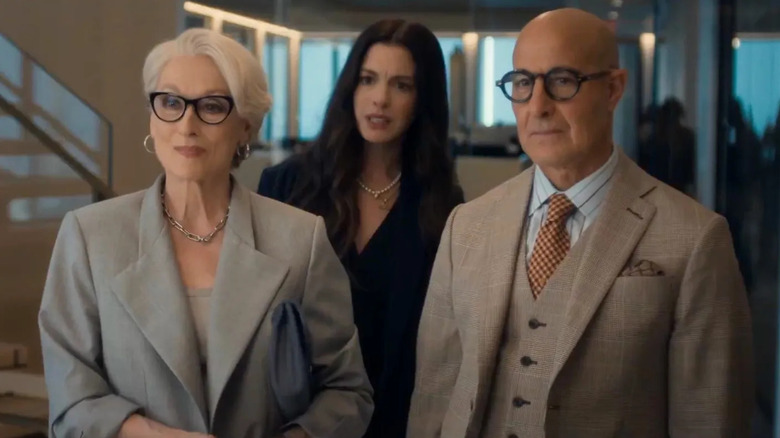
There's a noticeable uptick in body diversity compared to the first film, but don't mistake that for progress because the messaging underneath is still pretty rancid. Justin Theroux's Benji Barnes is a cartoonishly obvious mashup of every cringe tech oligarch archetype, while his ex-wife, Sasha (Lucy Liu), is a "good billionaire" counterpart like MacKenzie Scott. Theroux makes a meal out of his character and earned the biggest laugh when he genuinely thought, during a discussion of Kendall (presumably Jenner), that a model was named "Candle." But the introduction of his character via a pre-divorce magazine spread opts for a grotesque prosthetic double chin, evoking the one Ryan Reynolds wears in "Just Friends" but worse.
I recognize that this is a movie about the notoriously image-obsessed fashion industry, but that doesn't excuse the scattershot jokes where fatness itself is treated as inherently funny. At one point, Miranda flies economy in a middle seat (I get times are tough, but she's already rich, so this would never happen, but I digress), and her nightmare scenario is sitting next to a fat man wearing a neck pillow eating a sandwich, minding his business. There's a line where Miranda struggles to refer to plus-size models as "body positive" and reflexively calls it "body negative." YAWN. It's doubly disappointing when you take into consideration that the film was wise enough to cast Caleb Hearon, one of the funniest comedians working today, as one of Miranda's assistants, and completely wastes him.
The film unintentionally (at least, I hope it was) equates size to worth, where if you're an embarrassing loser billionaire, you'll be depicted as a bloated, balding jagoff who can somehow nab Emily Blunt, but if you're an altruistic billionaire, you get to be Lucy Liu. Casual fatphobia? In 2026? How passé.
The Devil Wears Prada 2 struggles to practice what it preaches
I'm deeply appreciative of the criticism "The Devil Wears Prada 2" puts forth in calling out the calculated decline of the media landscape and the deterioration of culture thanks to late-stage capitalism sucking the soul out of everything to pursue the Icarian endgame of a terminal growth rate, but there's a cruel irony considering the film itself does exactly that. It screams "journalists are vital" while flooding crowd scenes with online personalities and influencers — the very people pushing out journalists — and fails to acknowledge how bad things actually are for journalists by giving Andy an immediate new job and the ability to upgrade into a luxury apartment a few weeks later.
It insists that destroying cultural institutions and stripping them down to parts erodes our quality of life, while making constant references to the memorable parts we love from the original film and offering nothing new of comparable caliber, despite a significantly higher production budget. Visually, the film doubles down on this contradiction. Every frame is polished to a high-gloss sheen, lit so aggressively that it flattens texture and drains personality. What once felt cinematic now resembles an expensive commercial, and it's hard not to be cynical when it constantly proves that individual wealth is the only lifeboat for struggling people and industries.
The characters remain inherently watchable so there's a baseline pleasure in returning to them, but that's ultimately the problem — affection does the heavy lifting that the storytelling won't. For a movie that insists on the value of artistry, it certainly plays like an expensive knock-off. I liked it fine, because I love these characters in this world, but ultimately... that's all.
/Film Rating: 6 out of 10
"The Devil Wears Prada 2" hits theaters on May 1, 2026.