

Bugonia Ending Explained: What Yorgos Lanthimos Was Saying With That Conclusion
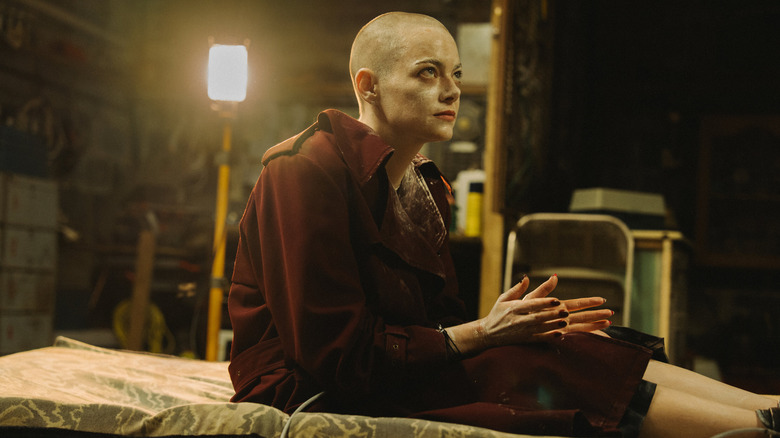
Since 2018, Emma Stone and Greek director Yorgos Lanthimos have produced a number of wonderfully weird and unsettling collaborations. and in 2025, they created "Bugonia," a remake of South Korean director Jang Joon-hwan's 2003 film "Save the Green Planet!" So what does the ending of this darkly funny, deeply disturbing, and utterly bizarre film really mean?
Before we get into specifics regarding the story and ending of "Bugonia," let's talk about Stone and Lanthimos and their excellent, bonkers body of work thus far. "The Favourite," a strange retelling of the story of Queen Anne of England (Olivia Colman), is probably their most "normal" movie, all things considered. Then, in 2023, Stone and Lanthimos reunited to make "Poor Things," which adapts Alasdair Gray's 1992 novel and casts Stone as Bella Baxter, a woman who dies and then has her unborn infant's brain transplanted into her head, forcing her to rediscover life all over again. This won Stone her second Oscar after winning in 2017 for "La La Land." Then, in 2024, Stone and Lanthimos brought Jesse Plemons on board for the anthology film "Kinds of Kindness."
With "Bugonia," Lanthimos chose to work with both Stone and Plemons again and also enlisted the truly wonderful newcomer Aidan Delbis, comedian Stavros Halkias, and "Clueless" veteran Alicia Silverstone for supporting roles. The result is a truly jarring, strangely hilarious, and ultimately shocking movie that argues against rampant capitalism, the destruction of the Earth and its resources, and highlights a conspiracy theorist whose conspiracy might actually be right. Here's everything you need to know about the ending of "Bugonia," including Lanthimos's interesting take on what it says about humanity as a whole. Oh, and obviously: spoilers for "Bugonia" ahead!
What you need to remember about the plot of Bugonia
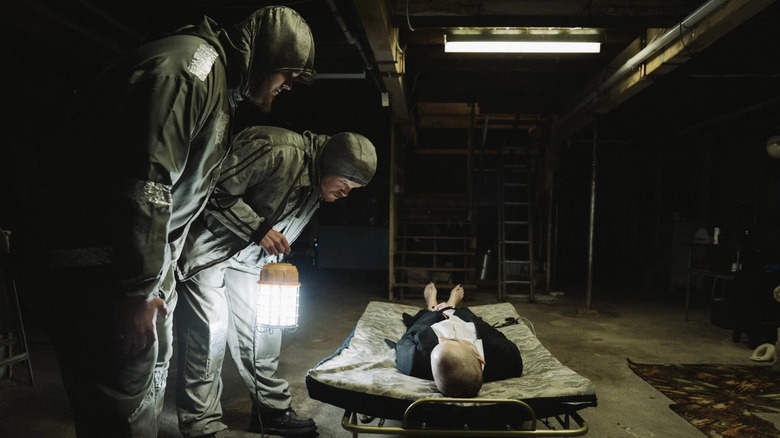
"Bugonia" introduces us to Teddy Ganz (Jesse Plemons), a hardcore conspiracy theorist who lives in a tiny, rundown house with his cousin and only friend, Don (Aidan Delbis, who, like his character, is neurodivergent and on the autism spectrum). Teddy spends his days working at a warehouse for the massive pharmaceutical company Auxolith, and by night, he fills Don's head with increasingly wild theories and beliefs, including that Teddy's mother and Don's aunt Sandy (Alicia Silverstone) was given a drug during a clinical trial with Auxolith meant to render her comatose. Teddy firmly believes that Auxolith's CEO, Michelle Fuller (Emma Stone), is an alien who hails from the planet Andromeda and is on Earth to kill honeybees and turn human beings into their indentured servants.
To try and combat this, Teddy and Don kidnap Michelle from her palatial house, shave her head — Teddy insists that Andromedons use their hair to communicate — and hold her hostage in their basement as Teddy tries increasingly desperate measures to force Michelle to admit that she's an alien. (The worst, by far, is when he electrocutes her — while blasting a Green Day bop — to the point that she nearly dies, which only convinces Teddy that she actually is an alien.) Unfortunately for Teddy, his desperation to learn "the truth" leads to other tragedies, including Don's death by suicide (as he believes he'll be transported to another planet if he dies) and the murder of local sheriff Casey Boyd (Stavros Halkias) at Teddy's own hands (it's also strongly implied that Casey abused Teddy as a child). So how does this all wrap up?
What happens at the end of Bugonia?
Here's the thing about Teddy Ganz in "Bugonia": He's right about everything. Before we get to that big reveal, though, let's talk about how Michelle, desperate to save herself, deftly manipulates Teddy into killing his own comatose mother by putting antifreeze into her IV drip. Michelle tells Teddy that the antifreeze is an alien antidote to his mother's condition, and in his absence, Michelle explores Teddy's basement. There, she finds a secret room with preserved body parts, at which point Michelle and the audience both realize that Teddy has murdered quite a lot of people to try and figure out if they're Andromedons.
After an overwrought explanation involving the lost city of Atlantis, Michelle finally convinces Teddy that they need to go to the Auxolith offices for a meeting with her alien cohorts. When they get there, she tells him that he needs to go into her closet in order to be transported to the ship. Teddy is wearing a suicide vest, and when it detonates by complete accident, his decapitated head hits Michelle square in the head. Though she's rescued by emergency responders, Michelle evades them and heads back to the closet, where she's ... transported to her ship.
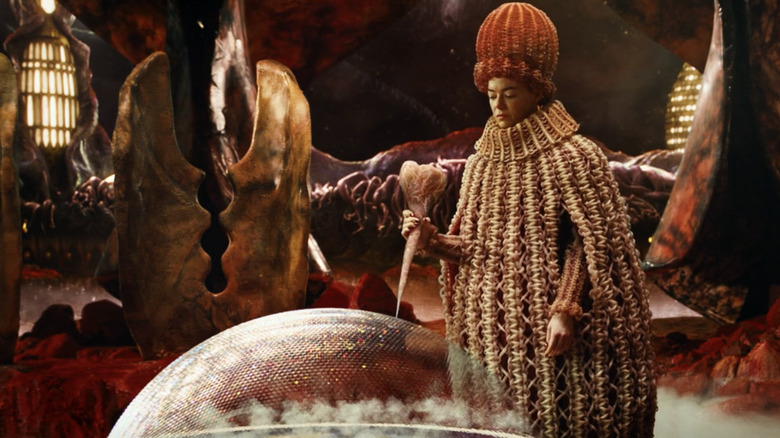
Michelle is an alien, and she is, as Teddy correctly realized, a royal member of the Andromedon race. (Teddy was even right about her hair being a communication device, a stunning little detail we learn when Michelle reunites with the Andromedons.) As it turns out, Andromedons have been trying to guide humans to avoid their violent and harmful impulses and failing miserably, so Michelle, along with her Andromedon council, pops a dome that encases the planet and kills all humans on earth. She does not kill animals or plants, which then thrive on Earth.
What the end of Bugonia means
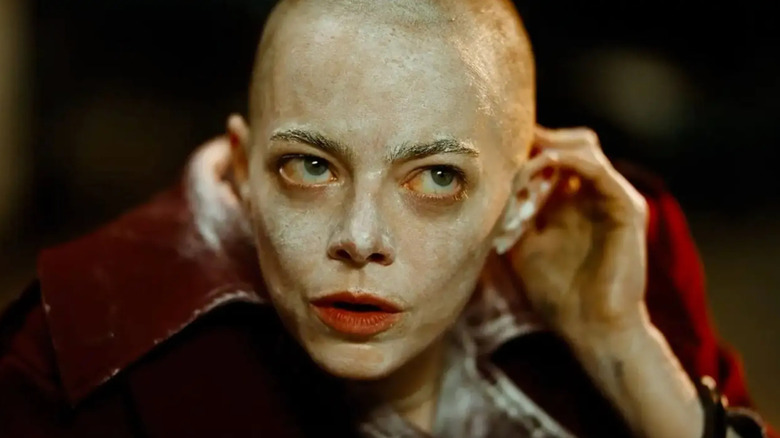
Teddy was right that Michelle was an Andromedon sent to meddle with things on Earth, but he was wrong about one thing: He thought the Andromedons were intent on harming Earth's humans. Though Michelle quite literally does harm humans by killing all of them — and Yorgos Lanthimos concludes the film with a striking, stunning montage of dead humans in an array of places, like schools and weddings set to Marlene Dietrich's rendition of "Where Have All the Flowers Gone?" But Michelle only does it because, after seeing what Teddy did to a bunch of humans who presumably weren't aliens in disguise, she and her fellow Andromedons determine that the present state of humanity is hopeless and decide to restart the human experiment.
Because Lanthimos ensures that we see honeybees and plants basically thriving after all humans die, the message certainly seems to be that humans create ruin, and we've done so for centuries by damaging the very planet we call home. Screenwriter Will Tracy all but confirmed that in an interview with Inverse about the movie's ending. As he put it:
"The ending of Bugonia is reckoning a little bit more with a very specific kind of political turn and hopelessness that we're feeling at the moment. And maybe probably as time has gone on and the climate catastrophe has felt increasingly urgent, and for some people hopeless, that that feeling of our relation to the planet and our trying to prefigure what the planet might look like without us and what our role is on this planet, I think all those questions feel much more top of mind ... The ending feels a bit more reactive around that."
Emma Stone and Jesse Plemons have a theory about one part of Bugonia's ending
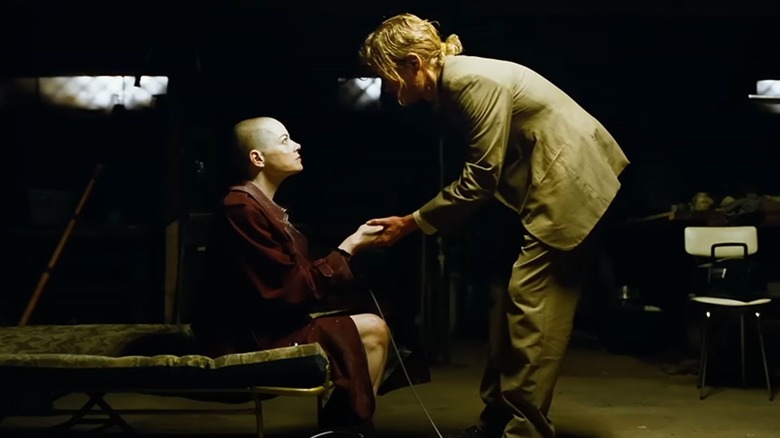
The ending of "Bugonia" is pretty definitive for humanity, but there's one element that might be debated for years to come: Why did Teddy's suicide vest go off as soon as he entered Michelle's closet? (The funniest touch of the entire movie is that Michelle uses what appears to be a totally useless calculator to "control" Teddy's ascent to the ship, and while that calculator turns out to actually be the way to make her transportive closet work, it looks really silly ... and makes the audience jump when she presses a button and Teddy explodes.) As Emma Stone and Jesse Plemons told Entertainment Weekly, they both think Teddy's vest was affected by his body heat and friction — plus, you have to consider that the bomb on his vest was homemade, making it incredibly unstable.
"Yeah, I mean, I always assumed it was Teddy, really," Stone said as they discussed this gruesome scene. "There was a friction situation, and he got stuck, and that thing was a homemade [bomb]." Then she made it a point to praise the film's prosthetics department, which is fair; they did such a great job on Teddy's head that I felt viscerally disgusted just watching the movie, and I can't imagine how Stone felt getting bonked by it.
"I'm going to be honest with you. I think [Teddy's decapitated] head was one of the most incredible pieces of prosthetic work I've ever seen," Stone said. "I'm being really serious. It was unbelievable. But stepping into that closet was really disgusting."
As for Plemons, he liked that Teddy's final moments indicated a mistake. "But I like the [kill switch] beaming thing," he said, embracing the possibility that Michelle somehow triggered the explosion remotely. "That's the one thing he didn't think about."
Yorgos Lanthimos says the ending of Bugonia is 'optimistic'
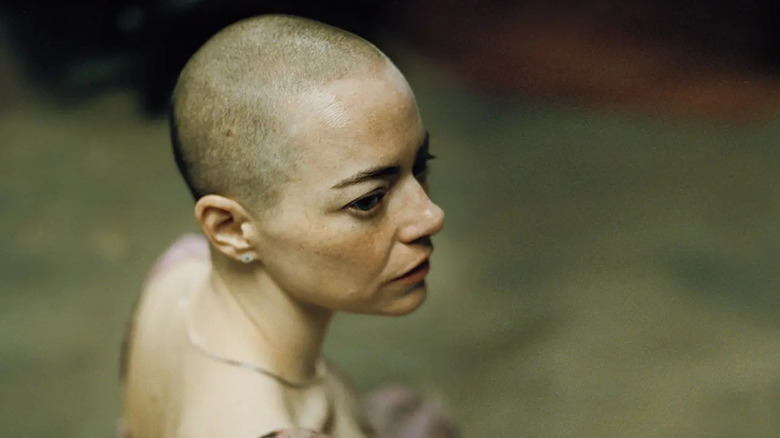
It might be hard to see the ending of "Bugonia" as "optimistic," but apparently, some people do — including Yorgos Lanthimos himself. In an interview with British GQ, Lanthimos, speaking to the outlet alongside Will Tracy, was asked if he feels "pessimistic about the direction the world is heading" and if he used the movie to express that. "Well, that's an interesting thing, because what I've experienced so far is people like you saying it's bleak and pessimistic," Lanthimos noted. "And then there's people that go, like, 'Oh, it's an optimistic film.'"
As far as Lanthimos is concerned, "Bugonia" has a bleak ending, yes ... but it also centers on rebirth and the rejuvenation of a damaged Earth. That's why Lanthimos thinks you can see it in a variety of ways. "The ending is, in a way, optimistic. But I think it says a lot of things about you, about how you see things," the director said. "The ending of the film allows you to have hope, if you can see that. It's deliberately constructed in order to allow anyone who watches the film to have that mindset." He went on:
"But of course, a big chunk of the film is definitely... not [necessarily] pessimistic, but really shining a light on the dark side of humanity. A very important aspect of the film, I think, is how we view other people, or how we view the world. And the bias that we have about things and people and how this is challenged as the film progresses. Within that context, I think when you reach the end of the film, you do have your own sense of if we're doomed or not."
Decide for yourself — you can stream "Bugonia" on Peacock now.