

The Pitt's Director Of Photography Reveals The Secrets Of Shooting The Addictive Medical Drama [Exclusive Interview]
This article contains spoilers for "The Pitt" season 2 finale.
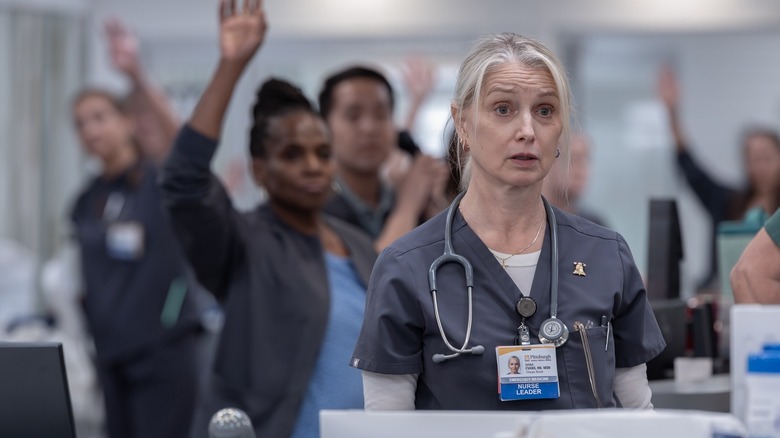
"The Pitt" is the definition of a "put your phone away while watching" show. The believable aesthetic, hyper-realistic surgery sequences, and terrific performances plunge viewers into the story, and its breathless pacing keeps us locked in for practically every second of screen time (even if some people are watching the show incorrectly). Look away at your own risk — you might miss an unspoken glance between Dr. Robby (Noah Wyle) and Dr. Langdon (Patrick Ball) that speaks volumes about the current status of their relationship, or a mysterious moment where Dr. Al-Hashimi (Sepideh Moafi) seems to lose control of her faculties that will become crucial later.
While the mundane hospital set might not draw attention to itself, its everyday look belies the staggering amount of work that goes into capturing each scene. Each time "action" is called, an elaborate dance breaks out behind the scenes in which camera operators, lighting programmers, and sound professionals play off the actors to orchestrate that addictive, immersive feeling.
"We're trying to be as invisible as we can, as natural as we can, but there is a lot going on in every single shot," says Johanna Coelho, the director of photography for every episode of the series thus far. I caught up with Coelho ahead of "The Pitt" season 2 finale, and after you read our in-depth conversation about what goes into shooting this show, you'll realize what an understatement that truly is. Below, she shares the secrets of filming "The Pitt," including the complex lighting, how she and her team maintain a documentary style (with the assistance of a few little cheat moves here and there), what Wyle brings to the table as a director, and much more.
This interview has been lightly edited for clarity and brevity.
How blocking works on The Pitt
/Film: My understanding is that most TV shows shoot way more material in a day than most films do. So given that faster pace, how does the blocking work for "The Pitt?"
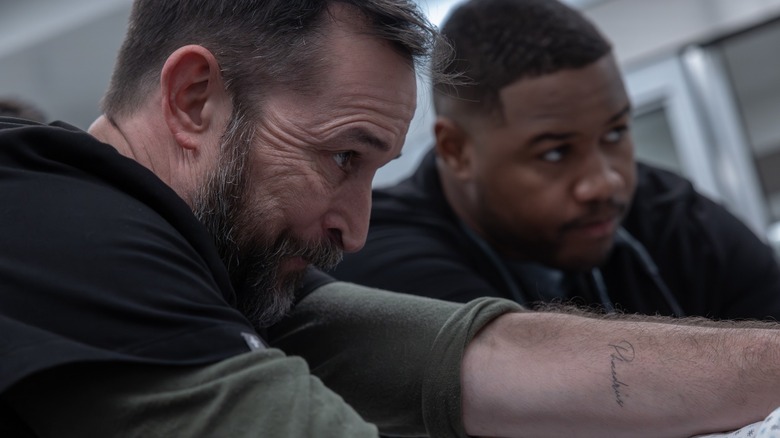
Johanna Coelho: Yes. The way we shoot "The Pitt" is actually different even from other TV shows. I feel you often start in TV shows with a shot that's the master shot where you have a wider shot and you can see all the blocking of all the actors, and then go in and do coverage. On "The Pitt," actually, a master shot is something very different. The master shot is a shot that follows the perspective of the character of the scene. Whose scene is this, and who are we going to follow in the scene? [It] really is designed from the beginning of the scene to the end of the scene. How much of the storytelling can we tell in that shot in the perspective of that character continuously? So then you have this feeling of continuity in the edit, and that's a master shot. So it's something very immersed, following the character, and really getting as much of the story as possible in that shot.
Now, obviously when we design that shot, we also understand we might not be able to get everything. So we often get the reverse master of that shot, and then we do a cleanup, eventually pickups if we have two other shots on other people's reactions we need to have, or the piece elements that we couldn't get into these long shots. But the idea is really to keep as much of the scene as we can so when they edit it, you're really feel that continuity one more time, really feeling like the shot keeps going and you barely realize there's any cuts, actually.
So shooting at that pace in that manner, it's really helping, because you really get as much as you can in long shots. And that helps us, keeping that flow and getting more pages a day. We have two cameras. So our main camera [captures] that long shot, and the other camera is able to grab some little elements we may need that we cannot get in that long shot, during that long shot. So it can come in during the shot and get out as the camera keeps moving, et cetera. So that's how we get as much as we can in the day with that many scenes.
That's amazing.
Emotions drive The Pitt's imagery
Sometimes I'll see videos that analyze the camera moves in a Steven Spielberg movie or a Kurosawa movie, and the person narrating the video will say something like, "Because this character steps closer to the camera at this moment, that makes them larger than the other person on screen, which represents how they're more powerful than the opponent." How intentional are you when it comes to that level of symbolism and meaning in the images that you create?
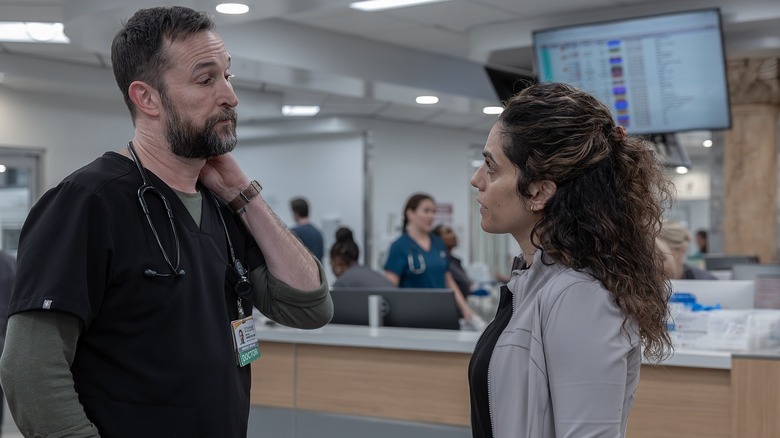
I feel like "The Pitt" is a lot about emotions, actually — the emotions that the characters are experiencing during their shift. We really try to find a way to transmit this emotion, feeling you're immersed and you're almost in the perspective of that character with the video storytelling. So for us, the rules, it's not like, "Okay, this character is bigger in frame [and therefore] is more powerful."
It's more like, how close are we to that character to feel what they feel? And then if we're on their back, we see the rest [of] what they're seeing, what they're experiencing. Our rules and our visual language is how much can we immerse the audience so they can feel that perspective in some ways? We're actually using the same lens through [most of] the show, which is a 50 millimeter on large format, which really gives us that sense of almost eye view, like normal perspective view from someone in the audience.
So sometimes we'll have a longer lens, like a 75 millimeter, which makes the world disappear even more around them, which sometimes helps emphasize that moment of isolation or hyper-focus on the person they're talking to and the world is disappearing around them. So little elements like that help us give a signification throughout the framing and the shots.
How and when The Pitt's DP communicates with her camera operators
Do you ever operate the camera yourself on "The Pitt," or are you more concerned with big picture and managing how the images are created?
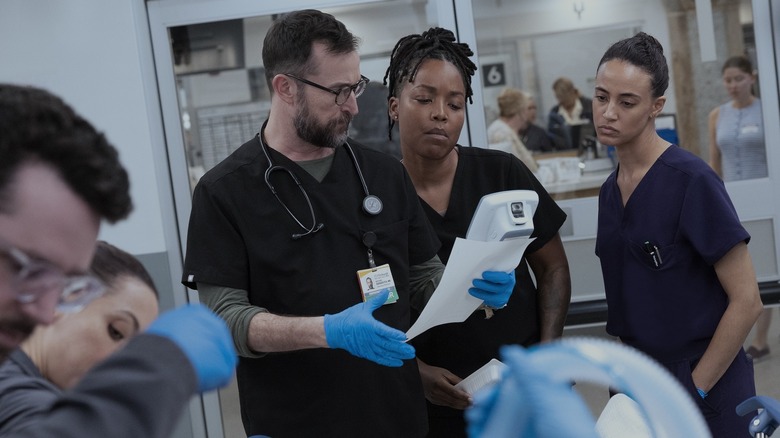
I love operating, but unfortunately on this show, I cannot. We have two cameras running almost at the same time all the time. And it's so important, there are so many elements in each shot to grab, that I have to be by the director and really watching everything that's happening to get notes and then transmit that to the operators. So the operators are doing an outstanding job on this show. And the A camera operator is actually a Steadicam operator. Even though we don't use Steadicam, it's a similar rig. It's like a Steadicam vest with a Steadicam arm and another tool called the ZeeGee on it, which gives us that handheld feeling, even though it's controlled as Steadicam, but it's all looking handheld.
I am not experienced enough to use that tool, so that's why I have an amazing camera operator doing that. And my B camera operator, she's amazing as well, and she's all handheld. They're really good at taking notes and then collaborating on ideas as well to make all this storytelling happen visually. But it's so important I stay by the director, because there's too much going on and I have to see both frames at the same time.
Well, in terms of communicating with the camera operators, are you able to do that during a take? Are they wearing an earwig and you can whisper to them while something is going on and say, "Hey, can you tip the camera up and get a reaction shot of this person's face while they're performing a procedure?" or something like that?
Yeah, absolutely. Actually, it's very important to be able in these long takes to be able to communicate to them if there's anything we know is about to happen and we didn't give that note before. Or if we notice something, it's like, "Go grab this." So we are on comms or on walkie-talkie. We've switched our system a few times. But it's really important to communicate during the shot.
Now, I'm trying not to as much as I can, because I also think they have so many notes to hit during the shots that if you keep adding to them during the shot, it might distract them from the other thing they're also trying to grab. So I think it's important to let them do as much as they can, but in those key moments that we know we are not going to have many more takes to get, we'll communicate. Or if the director has an idea and says, "Can you let them know that?" then I'll communicate as well.
I'm sure you probably trust their instincts at this point as well, too. They probably have a little bit of freedom to move around, I would guess, in a situation like that.
Absolutely. We really design the shot with the director and really talk about all the points we're trying to hit, and then the operators are really good at finding maybe a better way to circle around to do that move and to hit that point. So it's such a nice collaboration all together, and it's important because it's what is best for the shot, and that really is what matters.
Lighting on The Pitt sounds extremely complicated
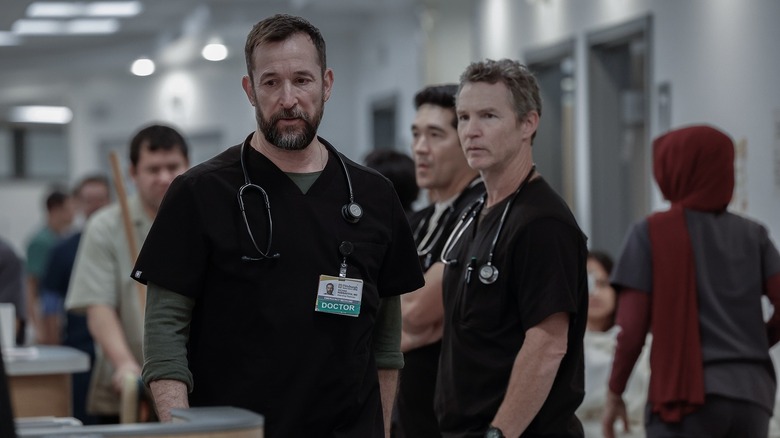
One of the biggest aspects of a DP's job is lighting, and I wanted to ask you about lighting, because I know the production for "The Pitt" has built this immersive hospital set where you can shoot things 360 degrees if you need to. That approach requires the lighting to be placed ahead of time so you can have that freedom of movement, and that makes me think if the lighting is all done beforehand, maybe it's not that complicated. But I would love to hear directly from you about what actually goes into the lighting on this show.
Oh, absolutely. A big part of the show, you're right, was when we prepped the stage when it was getting built, and making all the decisions of how we're going to integrate all the lighting in it so we have freedom on set. There's no C-stands, we really try to avoid to put any light there except outside the windows. So it's very important to find a way that it looks good on everyone. It looks natural and good, and also it works with every single skin tone.
So when the set was getting designed and we integrated the lighting in it, there was a lot of testing happening with my chief lighting technician, Keelan Carothers, my key grip, Max Thorpe, and then the production designer, Nina Ruscio, because it's such a collaboration with [the art department] since all the lights are seen in the frame. So it has to be something that works for art and it works for lighting.
But what was important is to find the intensity of lights we wanted, the spacing, what do they look like? We didn't want it to look like a spaceship, so you don't want to put lights all over on the side walls. The only really side wall lights are the headlamps inside rooms, which we are using a lot when we're lighting a scene. If you don't see it, we bring the brightness up and that really helps us [light] the faces when we face the other way. So yes, finding the right setup to create this immersive lighting on this 360 set was really key for the success of working so fast on the show.
Now, the challenge now when we shooting, even though that's done, is we have an amazing lighting programmer and it's really programming the lighting as people walk through the set, because it doesn't stay the same levels. If someone walks forward, we have a tendency to have the lights brighter ahead so it's not so toppy. So then it's brighter ahead and as they walk, we'll dim the lighting in the shot, et cetera, et cetera. So there is a full lighting choreography also happening during the shot, and that's one of the elements.
Wow.
We also have moving lights. Sometimes we actually miss a bit on the faces sometimes because it is another head lighting environment. So we'll have a [small LED light] on a boom pole, it's an electrician that's moving with a light next to the camera, so we can fill in these faces as well.
We also created custom onboard lights on the camera, on the left and right side of the matte box, fully controllable as well by lighting programmers. So during the shot, they'll come on and then they'll come off if there's a reflection. So all of this is choreographed during the shot.
Another element that was really important for the 360 lighting is actually the walls. In a way, it's scary for a cinematographer to have white walls everywhere. At the same time, it really is a key element in this set because it bounces back all the light. And this is where we had so much testing happening also with the production designer, because the type of white, the type of shine on the wall, all of this affects lighting. So that's something we really collaborated together on.
We tested so many shades of white, I think around 50 or more, to find the right white that looks good again on every single skin tone, because once the light's bouncing it, that really reflects the color of the wall on people. So that was all very important. I love that people don't really see all these elements and don't imagine them. We're trying to be as invisible as we can, as natural as we can, but there is a lot going on in every single shot.
How The Pitt team accomplishes so much in a day
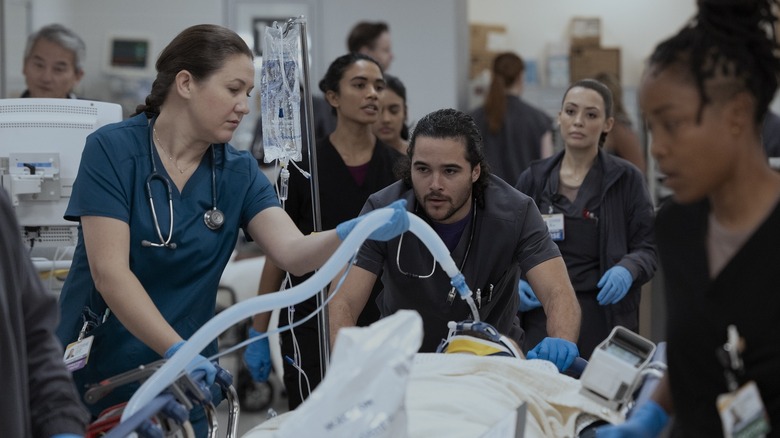
I was already impressed, Johanna, by what I thought was going on in the show, and hearing that really blows my mind. I've seen some of the behind the scenes stuff, and in the footage I've seen of your camera operators right in there with the actors, it seems like there's so little space in those rooms and everyone's body is contorted a little bit just to make room for all the equipment and stuff that has to be in there. But hearing what you're talking about with all that lighting, it kind of makes my head hurt thinking about how you go through any given scene figuring out, "Okay, what are the lighting cues in this moment? Where is the camera moving in this moment?" On a TV schedule, how do you all make your days with all of those factors to consider for all of those scenes?
I mean, honestly, we have a really amazing team. This team is so good at knowing exactly what they have to do once we show the blocking to everyone. Everyone is setting up at the same time. So I talk through the move with the camera operators. My chief lighting technician and key grip are following us, making notes for the programmer as well.
I forgot to mention, actually, we also created 3D tools to soften the lights, because that was something else. People were stopping under the overhead lights. My key grip and his team, they created these diffusion frames that just magnet to the ceiling. So if you don't see them in the shot, you put magnets like this [imitates applying them to the ceiling with diffusion], like frame magnets, so when people step under it, it's not as harsh on them and all that. So there's a lot of elements we started to develop to work into that 360 set.
But in general, I think everyone is working at the same time to make it happen. Once we start setting it up, [after] 15 or 20 minutes, we start doing a rehearsal after that. And that really works because everyone is doing their job so well and loves collaborating together and understand it's not about each department individually, it has to be a group.
Then we'll do rehearsal, we'll make adjustment of what worked, what didn't work. And you're right, you have to think about the space. You have the actors, you have background, you have camera, lighting, you have all these elements at the same time, and they are tight. So sometimes in the choreography when you have a long move throughout the ER, we'll have different electricians that have to switch because they can't pass through the hallway with everyone. So you have someone else waiting, and then they'll take the move after to continue with the camera.
Another element that is important is that we had some of the rules ... we wanted to have this documentary feeling a little bit for the show. So it feels real, you feel immersed, you feel like almost living the documentary. And one of the rules was, you shouldn't put the camera in a place that you would not be able to put it in a real ER. That helps us to give that sense of reality all the time.
So the furniture doesn't move, and that's the reason why you see everyone cramped on counters and all that [laughs], is because the only way to make that ability to keep that rule as much as we can — there are always exceptions — is to not have things moving. So then you always have a camera in the space that you would really be able to be in a real ER. So the only things that move are things on wheels. So, gurneys. We have done tricks where the camera has to get into a corner where there's a gurney. So the set dressing during the shot will move the gurney out, the camera passes, and then they put the gurney back in because the camera rotates and is going to see the gurney again. So we have some "Hollywood switches" during the shot happening like that.
But any walls or furniture that is stuck to the ground do not move, and that's to help us keep that visual language. Sometimes people can think it's a little strange, but it really helps you stick to that rule. And I think that's also what makes the show so real.
What Noah Wyle brings to The Pitt as a director
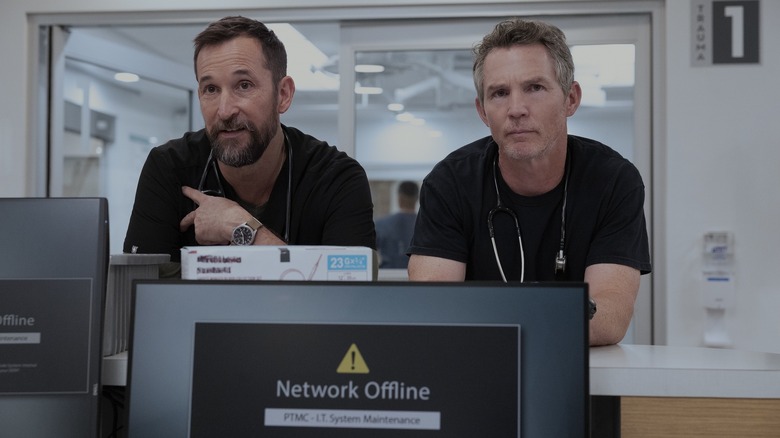
Can you tell me a little bit about your collaboration with Noah Wyle? Obviously, he's the star of the show, so you're shooting him in every episode, but he's also a producer and a writer and a director on this series.
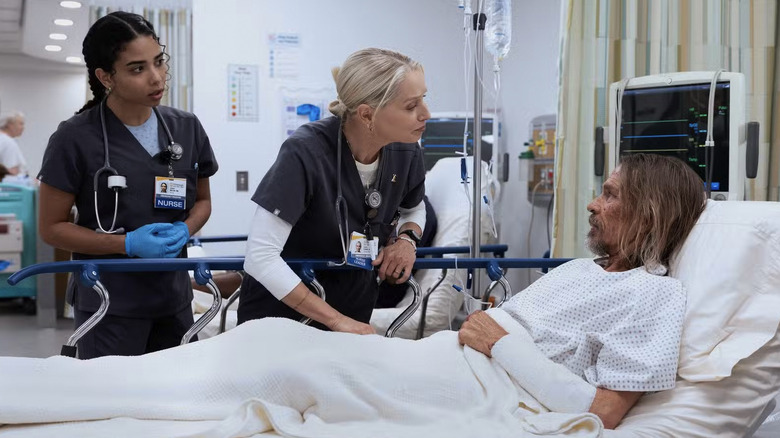
Noah is truly an amazing person. And I'm not saying that because he's Noah Wyle. [laughs] He's so creative, so collaborative, and obviously he knows the show so well. And I love how we got to do episode 206 together because he was directing that episode. Having him create the shots together and really think about the blocking and how to tell these stories — and that episode specifically is told from the nurses' point of view — was really amazing. He thought so much about transition, how to feel, to really emphasize this continuity of the shift going from one scene to the other. And you really feel that, I feel, in this episode, how the camera moves from one character, gets into the hallway, for example when Perlah steps out after Louie just died, she goes into the hallway, she looks at Princess across and boom! We are in Princess' room. She has a scene, she gets out, meets Perlah again. And that just gives you this feeling that it just never stops, right?
And Noah was so good at this. I think, again, he understands the show so well. It was such a nice collaboration, because we were on the same page all the time. The visual language is something that he fully understands as well, so it was really easy in a way. It was a really smooth collaboration and episode, and I'm really hoping we get to do that again.
Do you notice when he's directing an episode that he focuses on things that are slightly different than some of the other episodic directors because of that unique perspective that he has?
I think Noah's amazing quality is he's such a multitasker. So yes, in a way, but he's also focusing on the other thing he should focus on. He'll be reading a scene with the actors while he's blocking it and is in it. And he's listening, he gives a note, boom, he says his line like he's acting, and then he [gives another note], then says his line. I don't know how he does that.
And then he thinks about the shot at the same time. 'Well, but the camera might pass here,' and all of that. So yes, he's able to do, I think, what other directors are able to do, while he's able to still act, while he's able to think about the script, all of these things. So he is an amazing multitasker, and it's very impressive to watch.
Sometimes, real doctors will serve as doubles for The Pitt actors during surgeries
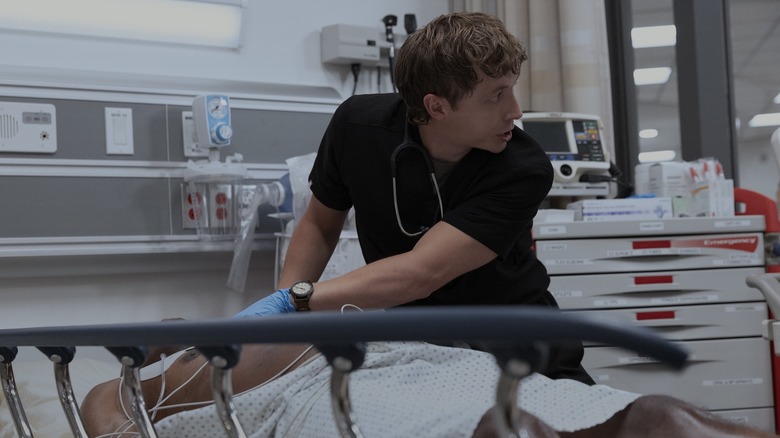
You mentioned the transitions. I love the transitions in the show. I assume a lot of those are written into the scripts, but have there been any times where you've had to basically come up with them on the fly for whatever reason?
So, you're right. Most of the time they are written in the script. There has been cases where it felt important to continue the move even though it was not written. And often then, we'll bring the writer in and talk about that as well to make sure it's approved. But otherwise, if it's not about adding any dialogue or it doesn't really change the scenes, then it's something that visually we can also integrate.
So maybe we are like, 'Okay, this was not written, but instead of jumping from that room to that room, we'll have Dr. Robby walking through it, stay on his face to feel the tension growing, and we land in that room,' even though that might not have been in the script originally. But they're really good in general at trying to put the transition in the script. And if not, then again, either the writer will be involved in prep to make that happen, or on set it feels like it doesn't change anything story-wise and we can make that transition happen visually.
Gotcha. Do you ever find yourself having to design the coverage in such a way that you frame things out if you're shooting an actor who maybe isn't quite as skilled as some of their colleagues at mimicking a specific aspect of a procedure?
I think they all train, in general, they have medical rehearsal for that. So if an actor is not nailing it in the scene, we might start with something else just to give them more time to get up to speed. But also sometimes, it's just so hard and precise that we just realize on set, it's not something that can be done by an actor. It actually might be the hand of our consultant doctor on set. And that happened a few times, where it's like it's too physically hard for an actor. We've got [a doctor with] many years of experience to do that move. So then we'll have a tighter shot, and we'll get the doctor in, and we'll do that with the actual doctor. So the actors are so good at doing everything, it's just sometimes if it's really too demanding for the experience, just because they're not doctors, then we get the doctor in for that.
Do you remember if there was a moment like that in season 2? An instance where that happened?
I know there's the sewing scene where I think it's when ... I can't remember exactly which episode it was. But I think it's when they're doing stitches on ... I think it's on ... I can't remember. It's on the arm of someone. I think it's maybe on the one who was in jail? No, I don't think so. I can't remember. I'm so sorry. [laughs]
[laughs] That's fine!
There's a stitching scene that is supposed to be with, I think it's Whitaker. There's so many stitching scenes, so this is why I'm mixing them up.
There are.
Anyway, there's a great scene like that where I think it's two med students that are sewing, so we had to get two doctors doing the sewing in the tighter shot, because it was very precise sewing, so that's why.
I wonder if it's the one where they kind of had to use a different material to go under the skin...
That! I think that's right. That was the prison guy, right?
I think it was, yeah.
Yes. So then it kept not working out. So I think we had to do that with two doctors, if I remember correctly.
Season 2's most challenging scene to shoot took The Pitt DP by surprise
Last question for you. This interview is going to be published after season 2 ends, so you have the freedom to talk about any moment in the season that you like. Was there a specific scene or shot that required maybe an unexpected solution or some extra creativity to achieve in season 2?
I'm trying to think. Well, there's a few different things for me in this answer. Different creativity? There's a scene, it's very small, but there's a scene that's at the end of episode 15 for the credits. It's a karaoke scene and it's outside of our hospital environment, and it's really fun and different in a way. So that just was different. I don't know if it was challenging. I think it was just fun, honestly. It was very different.
Now, a challenging scene, we had one also in episode 15 where Digby is walking in the park away with the mannequin. And weirdly, it was a little hard to light this one, because the mannequin is so clean and pure, it takes so much light. And then Digby is a little dirtier and darker skin at that moment and all of that. So that was really hard to light in a natural way that we could just follow this move like this. I didn't expect this to be so challenging, and it ended up being challenging.
I thought the rooftop scene where they're watching fireworks was going to be more challenging, and that turned out to actually be a little easier to shoot. [laughs] So sometimes you never know what happens. It might be a specific situation and you haven't been in that specific situation. And for me, that was that mannequin that took so much light, whereas the character didn't and I felt we kept being distracted from the mannequin to just looking at Digby as well.
But otherwise, more like when there's a lot of people in a small room. The scene where Louie dies, there's a lot going on here, and trying to really keep the perspective of Perlah at that moment was interesting, because you still wanted to feel the tension with Robby and with Langdon, but also you wanted to keep that from the perspective of Perlah, how she's experiencing that scene. So I think that scene was a little challenging on choosing the shots and how we were showing everything with the intensity in the small room, and then also in transitioning to stay in the nurse perspective throughout.
But yeah, any big move is always challenging, because it's so precise on the choreography. But we do so many of those, so they're all challenging, and they're all super fun as well. It's kind of one of our favorite things to do. And any room where in they're in a trauma scene and they're all around and they all have to do things with their hands in and we're trying to stick the camera in is always very challenging as well. But again, we work so well with the actors, and they help the camera so much. And they would [move] so the camera can get in for that moment, and then they'd have to go back in so the camera backs out. They're really good at dancing together.
"The Pitt" season 2 is now streaming in its entirety on HBO Max.