

Roger Ebert And Other Critics Thought Robert Redford Was Miscast As This Iconic Literary Character
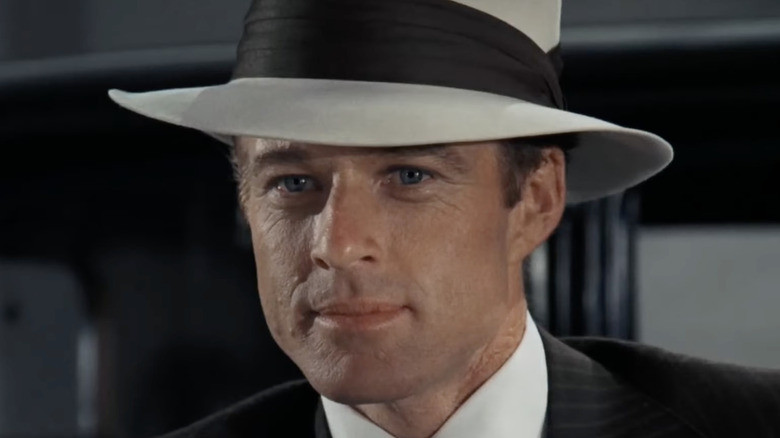
The problem with Robert Redford was that there was no problem. He was blonde, beautiful, and a consummate professional of an actor whose biggest career challenge arrived in the latter half of the 1960s when he had to decide where he wanted to be a star (of either the Broadway or Hollywood variety). Redford went west, and after scoring massive box office hits with "Barefoot in the Park" and "Butch Cassidy and the Sundance Kid," there was no looking back.
Redford was renowned for his ability to identify top-tier material that played to his strengths. He was, however, keenly aware that his preternatural assurance could curdle into casualness. He could get too comfortable, make it look too easy. So, early in his career, he flirted with roles that ran counter to his Casanova type, which, in one notable case, forced a filmmaker friend to save him from a miscasting disaster.
Redford probably could've talked his way into playing Benjamin Braddock had anyone other than Mike Nichols been attached to direct "The Graduate." Nichols, fortunately, knew Redford well, and, to his credit, let the golden boy down easy. As the director told an audience at a 2003 Directors Guild of America screening of the film, "I said [to Redford], 'You can't play it. You can never play a loser.' And Redford said, 'What do you mean? Of course I can play a loser.' And I said, 'Okay, have you ever struck out with a girl?' and he said, 'What do you mean?' And he wasn't joking."
Redford would've been all wrong for the role that made Dustin Hoffman a star, but, several years later, he seemed like spot-on casting for the title role in the 1974 F. Scott Fitzgerald novel adaptation "The Great Gatsby." Roger Ebert, and other critics, disagreed.
It's hard not to see Redford in Fitzgerald's Gatsby
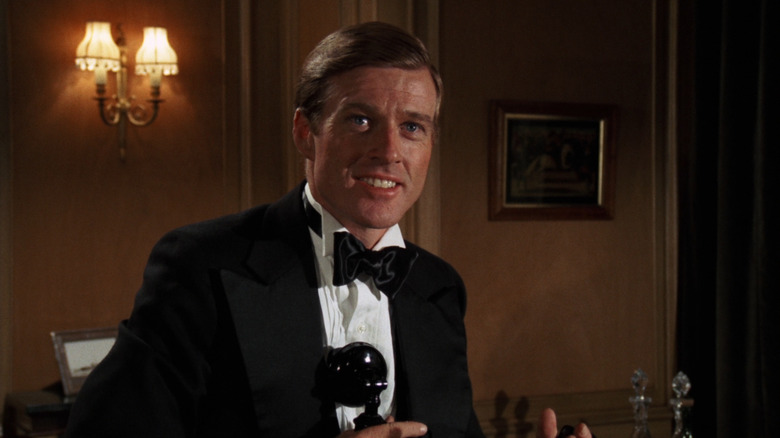
"The Great Gatsby" is hardly unadaptable. Its narrative is cleanly structured, while its dim view of the American Dream has remained tragically relevant since its publication in 1925. Where the two film adaptations that I've seen (from 1974 and 2013) go wrong is in their odd belief that if you get the surface details right and let that Jazz Age energy crackle, the despair at the book's core will bleed out and ultimately suffuse the entire undertaking.
Many critics entered the 1974 adaptation expecting a failure based on its casting alone, and they saw what they wanted to see. In his two-and-a-half star review, Roger Ebert admitted that he deemed Robert Redford miscast sight-unseen as Jay Gatsby. The star was "too substantial, too assured, even too handsome." It's an odd hang-up because when I read "The Great Gatsby" in high school, F. Scott Fitzgerald's description of Gatsby's smile instantly evoked Redford in my head:
"He smiled understandingly – much more than understandingly. It was one of those rare smiles with a quality of eternal reassurance in it, that you may come across four or five times in life. [...] It understood you just as far as you wanted to be understood, believed in you as you would like to believe in yourself, and assured you that it had precisely the impression of you that, at your best, you hoped to convey."
This is how Redford made me feel virtually every time he graced the screen. Even when his character was up against it or at a loss, he'd flash that sun-kissed smile, and I knew he had the world licked. Jay Gatsby wants you to believe this, too, which is why watching him lose should make you feel so empty.
Redford was misused, not miscast, in The Great Gatsby
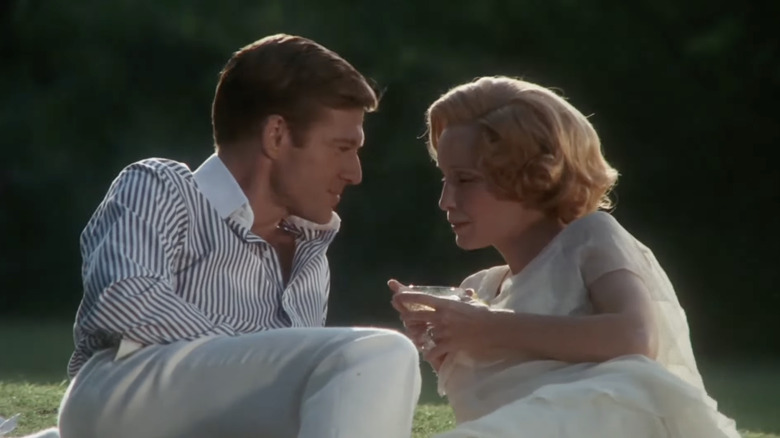
Roger Ebert did allow that Robert Redford "could have played Gatsby," but he argued that director Jack Clayton's film trips up by envisioning its protagonist as Charles Foster Kane. I didn't get that feeling, but that's only because I didn't feel anything while watching 1974's "The Great Gatsby" other than boredom. Hampered by an excessively faithful adapted script by Francis Ford Coppola, and exacting period detail that's lingered on to a numbing degree, Clayton and his stellar cast (which also includes Mia Farrow, Sam Waterston, Bruce Dern, and Karen Black) can't bring the damn thing to life.
Some of Ebert's most notable colleagues were even more down on the film, and Redford, than he was. The New York Times' Vincent Canby found Clayton's movie "ponderous" and crushed by an "intolerable burden of pretentiousness." As for his thoughts on the star: "Redford, handsome, open-faced, all Ivy League in manner, is miscast as Gatsby, but I can't see that he hurts a film that is otherwise so heavy‐handed in design and execution."
I'm not sure what Canby's on about here, because Gatsby's "Ivy League" affectation is intentionally laid on thick. The problem isn't Redford's demeanor, it's that he has nothing to play. Like every other actor in the film, he's walking through F. Scott Fitzgerald's book page by slowly-turned page. Meanwhile, Clayton and Coppola err tremendously by visualizing the novel's painfully deliberate symbolism (which is the thing I like least about Fitzgerald's classic novel).
That we don't talk about this take on "The Great Gatsby" much nowadays has nothing to do with Redford's performance and everything to do with the film that wasted his talent. As for Baz Luhrmann's bombastic 2013 "Great Gatsby" adaptation, at least it's got a pulse.