

Sam Elliott's Most Difficult Production Was A War Movie That Left Him In Tears
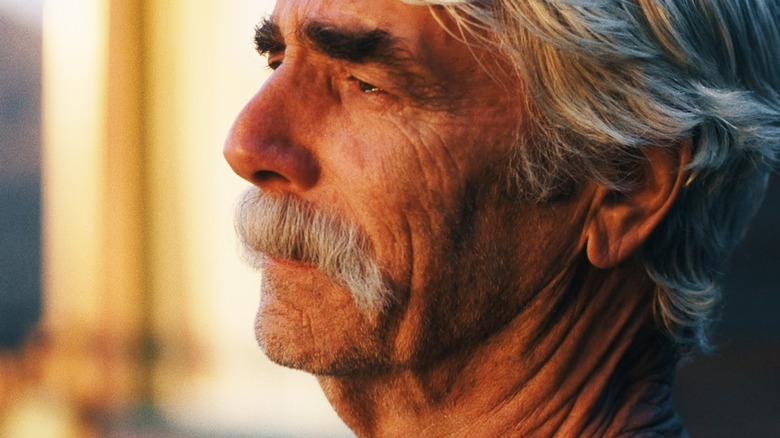
Sam Elliott is one of the greatest Western actors of all time, and hasn't lost a step in his latest role as T.L. Norris on "Landman." But his career is a lot more than just Oaters and the occasional Taylor Sheridan series. Elliott often branched out, like when he made the war drama that affected him more than any other project. In fact 2002's "We Were Soldiers" was, according to the actor, "the most difficult" film he's ever made.
The movie was written and directed by Randall Wallace, who re-teamed with star Mel Gibson after having written his hugely successful, and historically inaccurate epic "Braveheart." "We Were Soldiers" was based on the 1992 book "We Were Soldiers Once ... and Young" by retired Lieutenant General Hal Moore and reporter Joseph L. Galloway. The book and movie dramatize the real-life Battle of Ia Drang, which took place across five days in November 1965. Gibson played Moore, who was chosen to lead a battalion against the North Vietnamese in what was the first major conflict of the Vietnam War. Elliot played the austere Sgt. Maj. Basil Plumley, who accompanied Moore on the mission. Both men were battle-hardened thanks to their experiences in Korea, but nothing could prepare them for what they faced in the highlands of Vietnam.
Evidently, Elliott found the experience of recreating this bloody overture to the Vietnam war overwhelming at times. In an interview with author Scott Holleran, the actor spoke about his experience on "We Were Soldiers," saying, "Of all the films I've done, that was the most difficult to make [...] It was a very powerful movie — I walked off some of those scenes in tears. By the time we'd gotten into production, I'd met my character in real life. He was amazing."
We Were Soldiers was a somewhat accurate retelling of a major Vietnam War battle
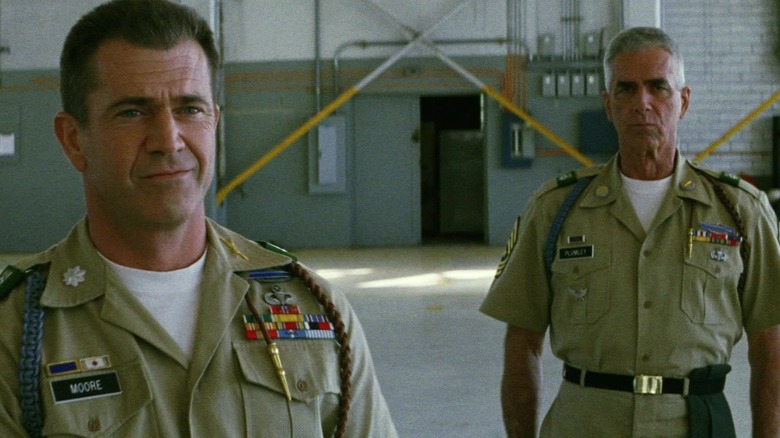
The Battle of Ia Drang was the first major conflict between the United States and the North Vietnamese forces, the People's Army of Vietnam (PAVN). It saw U.S. soldiers overcome their Vietnamese counterparts in one engagement using air support, while another engagement saw the PAVN overwhelm the American battalion via close-quarters combat. According to the Vietnam Veterans Memorial Fund, the latter was "the most successful ambush against U.S. forces during the course of the entire war."
In the end 305 Americans and an estimated 2,000 North Vietnamese soldiers lost their lives in the Battle of la Drang. Naturally, the U.S. claimed victory, but this battle was a microcosm of the Vietnam war as a whole in the sense that the "victory" was a bloody affair which saw the Americans sustain major losses despite holding their ground.
It was this sort of misleading propaganda that later compelled Sam Peckinpah to make "The Wild Bunch" with its gruesome finale. The director saw the film as a way to shake audiences out of their desensitization to the violent images coming out of Vietnam at a time when those in power consistently claimed the U.S. was dominating the war. John Wayne didn't help when he made a film that Roger Ebert called "cruel and dishonest." "The Green Berets" was made with the U.S. government's direct involvement, and merely served as yet another piece of propaganda. "We Were Soldiers" was not entirely accurate (a final charge led by Gibson's Lieutenant didn't actually occur) but it was a heck of a lot more realistic than Wayne's attempt at whitewashing the bloodbath in Indochina.
Even before We Were Soldiers, Sam Elliott felt guilty for not serving in Vietnam
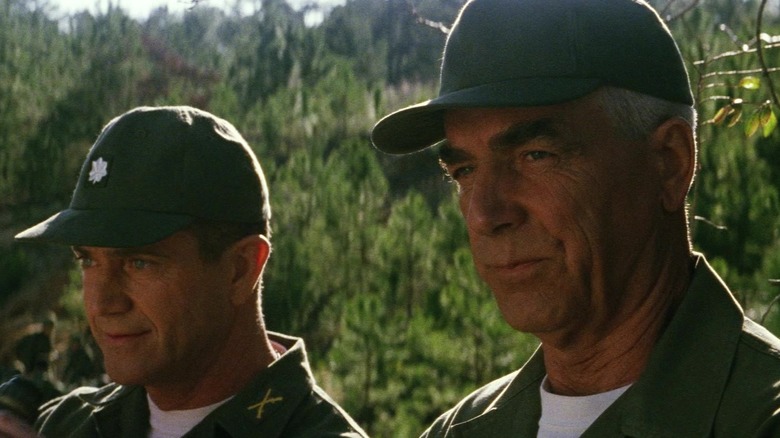
In his interview with Scott Holleran, Sam Elliott characterized "We Were Soldiers" as "an opportunity to get the Vietnam War right," adding, "most of the veterans who come up to me tell me we did." Indeed, the film was more historically accurate than "Braveheart," even if it did feature many of the classic Hollywood war movie hallmarks. It might not be one of the greatest war movies of the 21st Century, but maintained a somewhat nuanced perspective on the horrors it showcased.
Roger Ebert certainly thought so. The critic, who had been personally offended by "The Green Berets" in the late '60s, found "We Were Soldiers" to be much more palatable. Ebert praised the way in which the Americans in the film "do not automatically prevail in the style of traditional Hollywood war movies," and commended the filmmakers on including a dedication to both the U.S. and Vietnamese soldiers who fought at Ia Drang. As such, it probably was quite an emotional experience for Elliott and everyone else to make a film that constantly maintained a sense of just how tragic the battle itself was, regardless of who notched up more kills.
What's more, Elliott previously served as part of the California Air National Guard's 146th Airlift Wing, enlisting in the late '60s but never being deployed. He told Bang Showbiz that he carried significant guilt for not serving in Vietnam. "I've always felt guilty about the fact that I didn't go," he said. "I got into the National Guard, and I was one of the lucky ones." Elliott was therefore even more sensitive than his co-stars to the plight of those they portrayed.