

Battlestar Galactica Inspired Two Crucial Alien Races In The Mass Effect Video Games
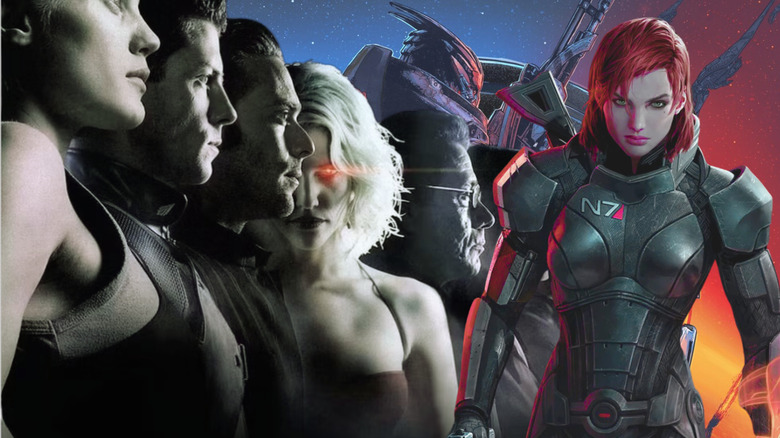
BioWare's sci-fi video game series "Mass Effect" is becoming a TV series, but a crucial element of the story is player choice. The appeal of the games is that you get to be the main hero of a classical space opera story and shape the narrative by your own decisions. If the world and characters of "Mass Effect" ever seem archetypal, it's by design.
"Mass Effect" is built on homage to stories like "Star Wars," "Star Trek," and "Battlestar Galactica." In fact, two of the alien races in "Mass Effect," the quarians and their robotic creations the geth, have a backstory and conflict with deep parallels to humanity and the Cylons in the reimagined "Battlestar Galactica."
In the late 19th century (by Earth's calendar, anyway), quarians created the geth as a servant race, but the robot's data-sharing network gave rise to true artificial intelligence. Soon the geth were asking their masters, "Does this unit have a soul?" The quarians fearfully struck first to deactivate their creations and the geth responded in kind.
The geth prevailed in the subsequent war, wiping out most of the quarian population while a few million survivors fled in starships. In the "present day" of "Mass Effect," the geth maintain control of the quarian homeworld Rannoch, while the quarians are nomads living in a starship flotilla.
"Mass Effect" writer Chris L'Etoile has said (in this forum post) that the quarian culture and language was largely based on the Jewish diaspora. Some critics have in turn read the quarian/geth conflict as an allegory for Israel and Palestine, though debate which side is which. (Some note, for instance, the quarians' hooded outfits resemble Muslim hijabs.)
Looking to other science-fiction, though, the clearest parallels between quarians and geth are humanity and the Cylons in "Battlestar Galactica."
The quarians and geth in Mass Effect, explained
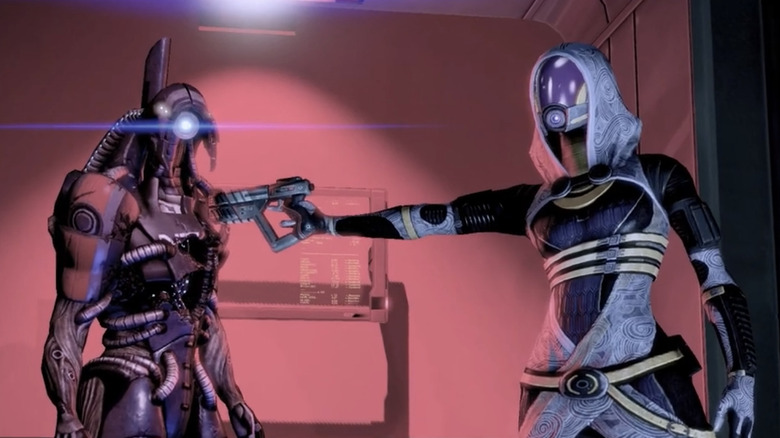
Now, obviously the robot uprising story is not unique to "Battlestar Galactica." Science-fiction is a genre filled with evil robots, from Skynet ("Terminator") to the Sentinels ("X-Men"). What cinches this comparison, though, is how the quarians now live in a starship fleet, like how the Galactica protects a "ragtag fugitive fleet" of surviving humans fleeing the Cylons and searching for a new home.
The quarians have lived on their flotilla for centuries when "Mass Effect" — the current generation has never even stepped foot on Rannoch, though they dream of retaking it. The games explore in detail how quarian culture has evolved to fit their nomadic existence.
Since quarians have lived in contained environments for generations, their immune systems are extremely weak, so they always wear containment suits with faceplates. If Galactica's fleet never found Earth and kept roaming the stars for centuries, their descendants might have to dress like the quarians to fight off infectious diseases.
In the original "Mass Effect," Shepard's squad includes the precocious quarian Tali'Zorah (Ash Sroka). Meanwhile, the geth soldiers are the main enemy unit in the game. The main villain in "Mass Effect" is Sovereign (Peter Jessop), a "Reaper" or a starship-sized artificial intelligence, and the geth worship it. Between that and their history with the quarians, this suggests the geth innately despise organic life.
But "Mass Effect 2" delves deeper into both the quarians and the geth, and the truth is not so black and white. (The game also debuts EDI, the AI of Shepard's ship the Normandy. Who voices her? Tricia Helfer, most famous for playing the religious Cylon Number Six on "Battlestar Galactica." Casting Helfer as another robot woman is another tipped hat to "Galactica" from "Mass Effect.")
The shades of the quarian and geth conflict in Mass Effect
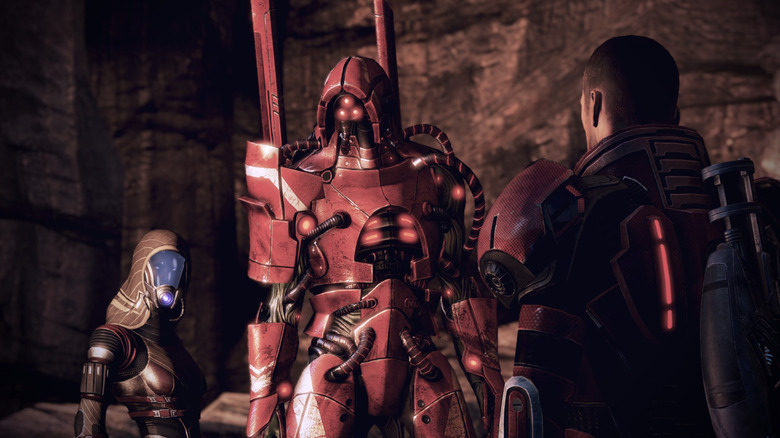
In "Mass Effect 2," a geth unit (D.C. Douglas) joins Shepard's squad. Named "Legion" (as geth "individuals" are really many programs contained in one unit), they allow the games to redefine the geth as more than killer robots.
A key difference between the geth and the Cylons? In "Battlestar Galactica," the Cylons relentlessly pursue Galactica's fleet to finish wiping out humanity. The geth, though, never hunted the quarians. They tend to Rannoch, so that if their creators can aside their fear and hatred, they can return. The quarians tried to kill the geth first so the onus of peace is on them.
"Mass Effect 2" also lets you visit the quarian flotilla after Tali is charged with treason for supposedly bringing geth software to the flotilla. (She's innocent, of course, and the objective of the mission is for Shepard to prove it.) This mission explores the inner politics of the quarian leadership; quarian Admiral Zaal'Koris (Martin Jarvis) is throwing the book at Tali, but he's also the one most sympathetic to the geth.
In "Mass Effect 3," the conflict boils over. Depending on the choices the player has made as Shepard in all three games up to this point, it's possible to broker a peace deal. Using a dead Reaper, Legion rewrites geth software to make each unit a true individual (though Legion must sacrifice themselves), and Shepard convinces the attacking quarians to stand down. But if you've made the wrong decisions, you'll have to pick a side, and one race winds up destroyed by the other.
This story is all the more thrilling (or, depending on how you play the game, crushing) because the choices and consequences in "Mass Effect" are yours to bear.