

G.I. Joe's Cobra-La Was A Sneaky Homage To An Underrated Hayao Miyazaki Anime
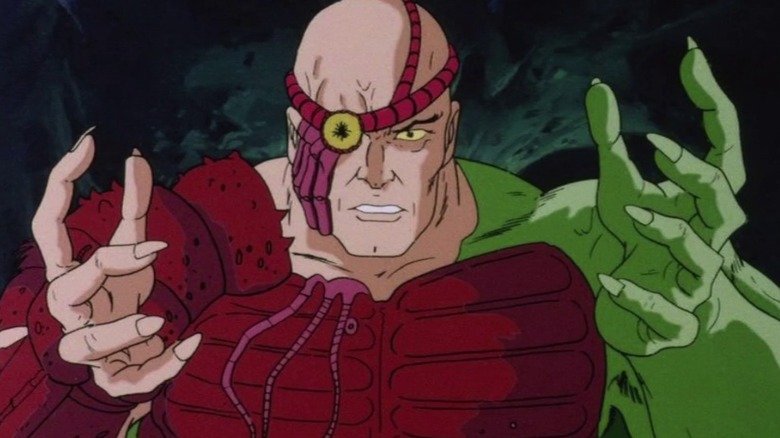
The 1980s cartoon "G.I. Joe: A Real American Hero" brought toy giant Hasbro's action figures to life, featuring the eponymous military unit fighting the ruthless (and eccentric) terrorist group Cobra.
The show's primary villain was Cobra Commander (Christopher Collins), and he was an enigma, even hiding his face behind a mask. That meant "G.I. Joe: The Movie" (final draft written by the show's head writer, Buzz Dixon) had a wide open door to reveal the Commander's origin in a wide left turn. The Commander actually came from Cobra-La, a prehistoric civilization that ruled the Earth with bio-mechanical machines before humankind evolved. The Ice Age destroyed Cobra-La, but survivors retreated to the Himalayas and waited patiently to retake the world.
Cobra-La regards mankind's non-living technology as abominable. Their weapons and machines resemble clams, snakes, insects, crabs, etc. — all sorts of creepy crawlies that us mammals instinctively revile. Their ruler, Golobulus (Burgess Meredith), plans to seed the Earth with spores that will devolve mankind to beasts; the delivery mechanism is skyscraper-sized plant stalks that launch missile-like pods into Earth's atmosphere.
In a commentary track for "G.I. Joe: The Movie," Dixon revealed the aesthetics and monstrous creatures of Cobra-La were inspired by Hayao Miyazaki's 1984 post-apocalyptic fantasy film, "Nausicaä of the Valley of the Wind" (based on Miyazaki's original manga). Though made before the founding of Studio Ghibli, "Nausicaä" brought the studio's founders together.
In 1985, a heavily edited "Nausicaä" titled "Warriors of the Wind" was released in the U.S. It's not clear if Dixon saw that or the Japanese original, but the film left an impression on him: "I didn't want to one-to-one emulate ['Nausicaä'], but I did want to capture that kind of feeling, bring that to an American story."
The monsters of Cobra-La look like they came from the Valley of the Wind
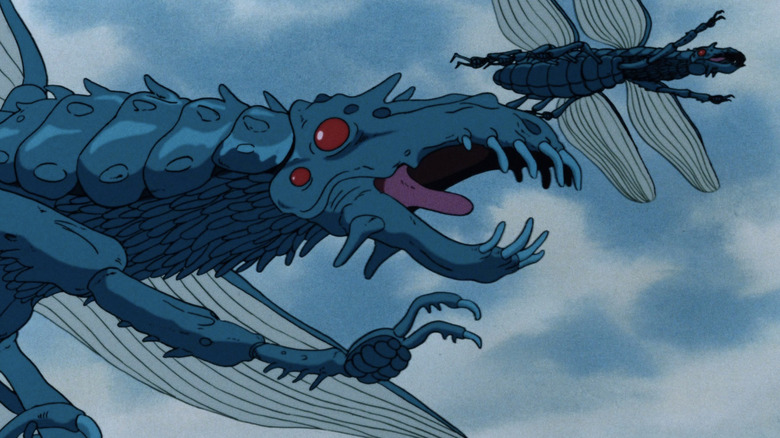
In the "G.I. Joe" commentary track, Dixon described "Nausicaä of the Valley of the Wind" as "'Dune' with fungus" — he's not the only one to compare "Dune" and "Nausicaä."
"Nausicaä" is set in the far future, long after human civilization destroyed itself in a fiery war. Most of the world is now covered in a vast desert and toxic jungle, filled with giant insects, save small kingdoms like the Valley of the Wind. Princess Nausicaä can communicate with the bugs, such as the enormous beetle-like Ohm, and seeks to snuff sparks of conflict.
Due to the toxic atmosphere, characters in "Nausicaä" often have to wear breathing masks; the Cobra-La soldiers' bug-eyed helmets bear a passing resemblance to the mask of Lord Yupa. The backstory of an ancient civilization destroyed in a cataclysm evokes "Nausicaä," too. Cobra-La is portrayed as entirely malevolent, though, so there's no hope for peace or co-existence.
The anime influence on "G.I. Joe: The Movie" doesn't end there. The movie, like its sister picture "The Transformers: The Movie," was animated by famous Japanese studio Toei (which had distributed "Nausicaä"). Toei had worked as chief animation studio on both "G.I. Joe" and "Transformers," but the rushed production schedules meant both shows typically had underwhelming and error-prone animation. With the movies' higher budgets, both "Transformers" and "G.I. Joe" finally developed an anime-esque detail and texture to the characters.
"The Transformers: The Movie" has some especially breathtaking sequences, such as when Galvatron vaporizes the treacherous Starscream, or when the chief villain Unicron (Orson Welles) transforms from planet to massive humanoid. While "Transformers" fans typically revere that movie, "G.I. Joe: The Movie" is more divisive... and Cobra-La is a big reason why.
The conception and legacy of Cobra-La, explained
Many "G.I. Joe" fans and creatives (including famed "G.I. Joe comic writer Larry Hama) reject Cobra-Laand its "Nausicaä"-aesthetic. How did a military-themed series like "G.I. Joe" embrace such out-there science-fiction? Buzz Dixon discussed the origins of Cobra-La with blogger Todd Matthy in 2016.
During production of "G.I. Joe" season 2, Hasbro requested the show introduce a new character: "Cobra Emperor" (eventually renamed Serpentor). Since the show had never suggested anyone outranked the Commander, Dixon proposed two origins: Cobra's Doctor Mindbender creates a new and more competent leader, or a twist that Cobra was actually a front for another organization. Hasbro combined the ideas; the movie retcons that Golobulus planted the idea for Serpentor's creation in Mindbender's head.
"To explain Dr. Mindbender's brilliant DNA insight, we needed a vastly ancient and technologically superior (albeit bio-tech) civilization, otherwise a more human scale secret cabal ala the Illuminati might have worked," Dixon recalled. Using a bio-tech civilization also allowed him to pay homage to "Nausicaä" and Miyazaki's giant Ohms.
"Cobra-La" was also Dixon's placeholder name for these secretive snake people. (You might notice the portmanteau of "Cobra" and "Shangri-La," the ancient Himalayan civilization from the 1933 novel "Lost Horizon" by James Hinton.) Dixon thought it was a stupid name and wanted to change it, but Hasbro overruled him. He likewise regrets the Himalayan setting: "Logically the Amazon basin would have been a better location for a snake-based civilization."
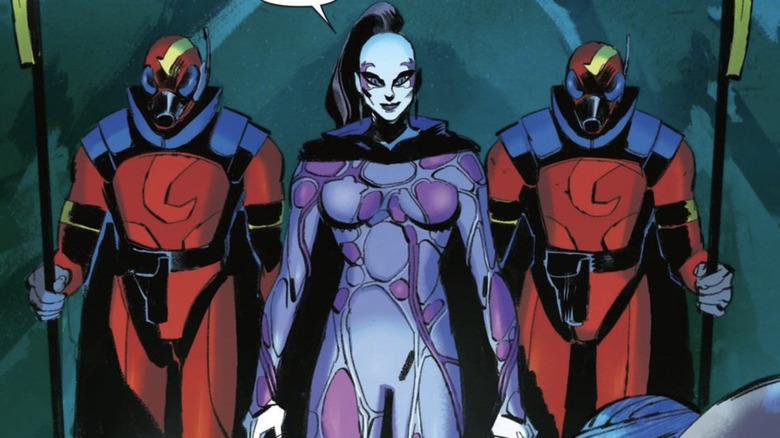
However, Cobra-La has found new life in Skybound Entertainment's Energon Universe, a new comic book publishing line (and soon-to-be animated series) combining "G.I. Joe" and "Transformers" into one universe. Given Cobra-La's hatred for mechanical technology, they make more sense as adversaries of the Transformers (i.e. living machines) than they do as "G.I. Joe" villains.