

George R.R. Martin Did Not Hold Back About Battlestar Galactica
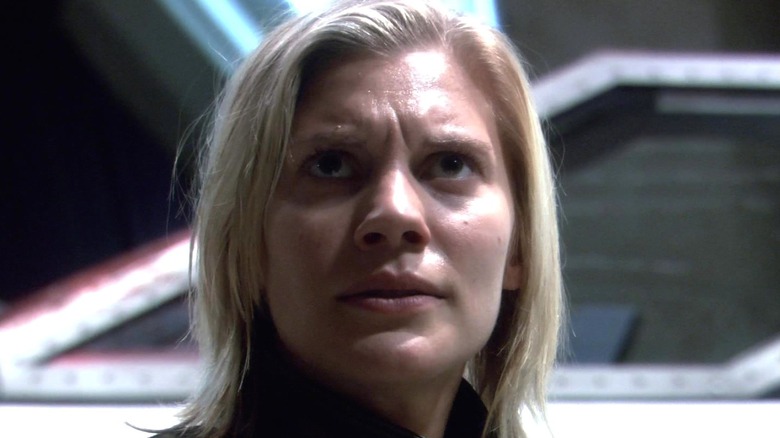
When you're telling an expansive story, it can be difficult to wrap everything up in a satisfying way and stick the landing. For every truly brilliant TV series finale, there are dozens that didn't deliver for audiences, leading to plenty of TV show endings that fans still argue about to this day. Among them is the ending of the science fiction reboot series "Battlestar Galactica," which had a pretty divisive final season and ending, leaving many fans feeling bitter — including "A Song of Ice and Fire" author George R.R. Martin.
The author has never been particularly shy about sharing his feelings, and in a blog post by Martin from 2009 titled "Writing 101," he bashed the ending of "Battlestar Galactica" pretty thoroughly. In his opening salvo against the finale, he wrote that it "looks like somebody skipped Writing 101, when you learn that a deus ex machina is a crappy way to end a story."
"Deus ex machina" refers to a trope that originated in classic Greco-Roman dramas, where a god would appear at a convenient time to bail a character out of an otherwise hopeless situation. Since the actors playing the gods had to be lowered from above the stage on cranes, they were referred to as deus ex machina, or "a god from a machine." While the trope has come to mean any unrealistic and easy out writers give themselves to get out of narrative corners, the "Battlestar Galactica" finale, "God Did It," literally uses a deity to take care of many of the show's loose threads.
Martin's not wrong about the finale leaning on an ancient trope, but his sheer vitriol toward it is kind of funny given his own track record.
George R.R. Martin lashed out against a trope his own fans accuse him of

After briefly lamenting the ending of "Battlestar Galactica" on his blog, George R.R. Martin went on to critique the ending of the television series "Life on Mars" and the Nicolas Cage movie "Knowing" for using the deus ex machina trope as well. He was pretty harsh, writing:
"Writing 101, kids. Adam and Eve, God Did It, It Was All a Dream? I've seen [writing workshop] Clarion students left stunned and bleeding for turning in stories with those endings."
Yikes. While it's fair for him to point out that certain tropes are wildly frustrating for readers, it's also kind of funny given the fact that readers of his "A Song of Ice and Fire" books have pointed out a few deus ex machinas in Martin's own work. Since we don't know exactly how closely the final seasons of the television adaptation of "Game of Thrones" mirrors Martin's plans for his unfinished "A Song of Ice and Fire" novels because he's distanced himself from the final season, the truly egregious uses of deus ex machina in those episodes aren't necessarily his fault. However, there are a handful of instances in the books and series, like Iron Throne hopeful Renly Baratheon (Gethin Anthony) getting taken out by a magic smoke monster or Jon Snow being saved by Stannis Baratheon North of the Wall, that some fans think are in the same deus ex ballpark.
Martin ends his blog post worried that the series "Lost" might use the "they were dead all along trope," and while it ultimately didn't, exactly, the "Lost" ending probably isn't among the author's favorites. May we gently suggest completing your own ending before critiquing others?