

Pillion Star Harry Melling Explains One Intimate Act You Didn't See In The Film [Exclusive Interview]

Consider this our safe word. This interview discusses plot points and spoilers for "Pillion."
"Pillion," Harry Lighton's sweet, sexy gay romance starring Alexander Skarsgård and Harry Melling, has already proven itself to be one of the most quietly subversive films of 2026. An adaptation of Adam Mars-Jones' novel "Box Hill: A Story of Low Self-Esteem," the film centers on two men entering a new dominant/submissive relationship. On paper, it might sound too salacious for the average viewer, but Lighton approaches the material with such emotional clarity that "Pillion" transcends any easy provocation, emerging as one of the year's most tender and unexpectedly crowd-pleasing films.
Melling's Colin is a tenderhearted young man with "an aptitude for devotion" who meets his seemingly dominant match in Skarsgård's Ray, a taciturn biker who lives by a strict ruleset that requires Colin to cook, clean, obey, and even sleep on the floor beside the bed. On its face, Ray's demands might seem harsh, but "Pillion" is far less interested in shock value than it is in the emotional logic of consensual power exchange. Colin doesn't submit out of fear or coercion; he submits because it fulfills him.
I recently spoke with writer/director Harry Lighton and star Harry Melling about bringing "Pillion" to life, including the intimate scenes Lighton deliberately chose not to show in a film bold enough to feature Colin giving Ray a hummer in a back alley less than 15 minutes into its runtime. For those willing to take a walk on the wild side, the A24 "dom-rom-com" will be a surefire hit.
Note: This interview has been lightly edited for clarity and brevity.
Harry Melling related to Colin's journey in Pillion
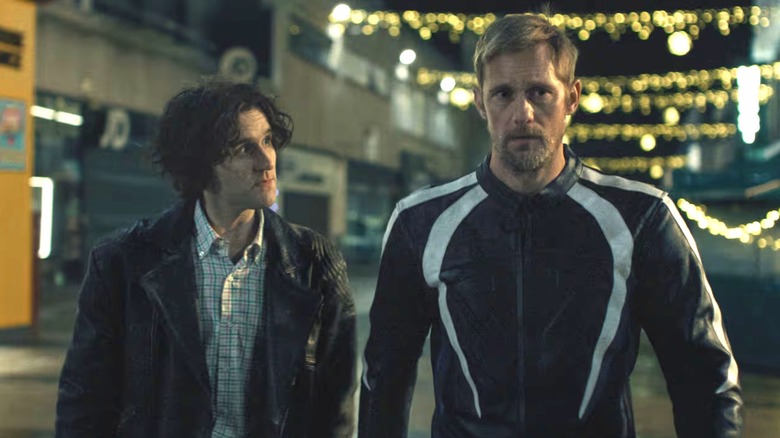
Colin's path of self-discovery happens through an avenue that so many people are terrified to explore, not just because they're afraid that they won't like it, but they're terrified that they will like it. Was there ever a time in your life when self-discovery was gained by allowing yourself to just go for it?
Melling: To be honest, every single acting job, to a certain degree. You do your homework, you go, "Oh, here we go. I hope I can be of service to this brilliant bit of writing, or this very intriguing, complex character." And you're like, "What have I done? I'm the wrong person. I'm not going to be able to do it. " And then obviously there comes a point when you're in your trailer before jumping onto the set, where you're like, "Okay, this is the moment, it's sink or swim," and you sort of jump. So yeah, I could very much relate to Colin's courageousness, the journey that he goes on in the film. I could connect to that, for sure.
Lighton: Yeah, me too. I think starting out making films and then also starting out exploring being gay, I think they sort of fall in a similar place in a way for me, in that it was like they both were intimidating, but offered the opportunity for self-discovery. And the intimidating thing was also the rewarding thing in a way, was that I felt like I'd have to make a commitment to both of them in order to gain what I wanted from either. And yeah, it's ongoing, I guess, and it's always intimidating, but the reward feels worth it.
Absolutely. I mean, I'm a lesbian, and my wife is trans, and when we first started dating, I was like, "I'm about to blow up my entire life to be with this person, and every day is a new adventure," and yet it's still the best decision I've ever made.
Lighton: Preach.
Pillion collaborated with real gay bikers
The casting of Alexander Skarsgård for Ray makes complete sense because he's Alexander Skarsgård, but I cannot imagine anyone else playing Colin. What was it about him that made you go, "It has to be him. This is my Colin"?
Lighton: Well, it's funny you say that, because it was a similar thing. I mean, I didn't write with Harry in mind, but as soon as I started the casting process, he was the only person I could think of. You always draw up a shortlist, and Harry was at the top of the list. I couldn't think of anyone else, really, to put on the list who I thought would be a viable backup, and I think it's because Harry had proven through different roles he'd done that he was able to be incredibly magnetic and captivating to an audience, but in a way that was the antithesis of what I wanted from Ray. He could be magnetic in a way that wasn't macho or alpha, and that's a very rare quality on screen, I think.
It's all in the eyes. I love watching actors look at other people, and the way that you [Melling] look at Ray ... you did such a wonderful job.
Melling: Well, he's a lovely man to look at, so ... [laughs]
I don't even like men! And yet, looking at him, it's like, "Have I been wrong?" [laughs]
Melling: Maybe! [laughs]
So, counterculture sex communities are so stigmatized that I think that there is a responsibility for those telling these stories to not further that stigmatization, while also still being truthful to the story that these characters are having at the center. What do you think was the biggest challenge in ensuring that you were doing right by the real people who do live this way, while also keeping Ray and Colin's story honest?
Lighton: I think the biggest challenge for me was, I mean, it's sort of what you've just described. It was making sure that this story stayed the story of one dom-sub relationship that was complicated and didn't serve as the blueprint for a community, while simultaneously showing that it wasn't the blueprint for a community. I guess the way I ultimately sought to address that was by representing a variety of dom-sub relationships within the community, whilst still centering Ray and Colin's. And that's where building the bike gang around them emerged from, and doing that with people from the gay biker community and the kink community. So making sure that we had their input in telling their stories whilst also allowing Colin and Ray's to remain specific and individual and not like a kind of public service announcement.
Melling: Yeah, I think the fact that members of the GBMCC, which is the Gay Bikers Motorcycle Club, alongside some people that were in the kink scene locally to London, the fact that they were involved in the movie was so important. I think from an acting viewpoint, it was just super useful and helpful. If there was a question about, "How would one lean over this trestle table before an orgy scene?", they would be on hand to help us make sure that what we were presenting was true and was correct. So I'm so grateful that they were brave enough to get involved and to trust us, I guess, with this story. And I'm thrilled, it seems, that they seem thrilled with it as well.
Because it's very scary to act on screen, especially if you haven't done it before. It's a very intimidating thing to do, and they did it and then some. And to see them seemingly feel proud of the story that we told and the fact that this now exists in the world for people to see, I think it was a lovely moment to be a part of.
Harry Melling didn't need aftercare; the set of Pillion was 'lovely'
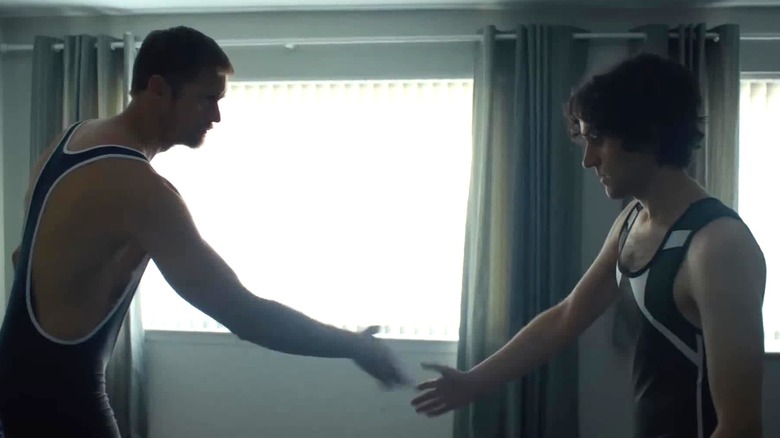
This unquestionably is also the sweetest movie to feature somebody being put in a surfboard stretch. And I felt myself getting kicky feet in the theater with joy, watching such an intimate physical exploration of two characters learning so much about each other. Was there ever a moment during production when "cut" was called, and you could still feel that joy hanging in the air?
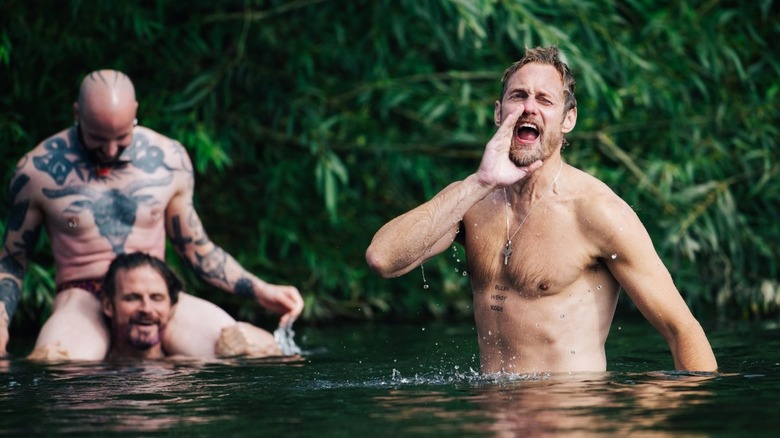
Lighton: Yeah, all the time with this. I mean, I was yelling cut, so I guess it's different for me. But when we were filming the scenes in the water, where they all ran into the water after the bike trip. It was doing something like that where, while it's meant to look joyful, the water's also freezing. It created a camaraderie, and so after the take, some of them would be charging out and running for their dressing gowns, and then the others would be taking the piss out of them as they hankered down. One of the film couples went and just sat on a rock in the water and cuddled each other in between takes. It was very present throughout that day, but also throughout the shoot. Whenever we were filming with the bike gang, it was very loud in the mix, that feeling of joy.
Melling: I was charging out, of course, trying to find my dressing gown as quickly as possible because it was so cold. [laughs] No, that was a really fun day. Often, when you are in situations where you can't deny the reality of it — i.e., going into a freezing lake or wrestling, you can't deny the fact that you're tussling and you're on top of each other — often, those days are super fun, and you do feel incredibly energized by it, as well as surprised. I mean, there were countless moments where you start a scene, and you end the scene, and it's gone a somewhat different direction or it's got a slightly different flavor to it. And again, those moments are really energizing because it pushes you onto the next, and you start building, and it was a really lovely shoot.
Harry Lighton intentionally didn't show Colin's collaring or de-collaring in Pillion
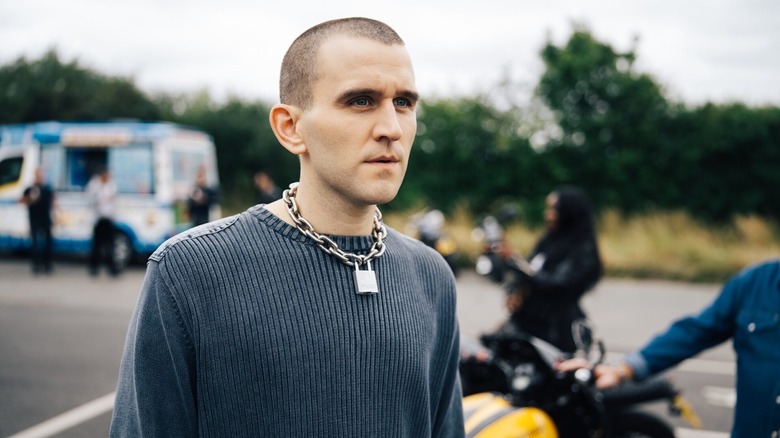
Over the years, I've talked to plenty of actors who've been in horror movies who have talked about how sometimes you know that you're acting, but your body doesn't know that you're acting, and then you have to decompress after, because your body is reacting as if you really were just fighting for your life against a slasher or a monster or what have you. So after spending so much time acting out as a submissive and being in this performative subspace, did you ever feel the urge of, "I think I need aftercare after having this day?"
Melling: [laughs] No, I think weirdly I felt the opposite. I found Colin's bravery quite inspiring in lots of ways. So maybe that sort of lingered for a bit. Way after shooting, but I would do things in my life that I don't think I necessarily would've done before. I guess there was a curiosity in me that maybe might've crossed over for a while. And that always happens. Like you say, every single role, there's some strange crossover that you can't quite put your finger on, but you just feel it, it's there. And I think actually for this, it was a sense of curiosity and bravery, and why not?
So, collaring is such a sacred act. And when we return to Colin after Ray leaves and we see him without it, I immediately was like, "Oh, this poor baby boy. What was that situation like to take that collar off?" What are your theories about when the de-collaring happened, and Ray wasn't there?
Melling: Yeah. Well, I was suggesting to Harry, like, "We should see the collar coming off, we should see it," and it was a really bad idea. It was a really bad idea, because dramatically it's very uninteresting. Because, of course, it's a big act, it would take some time to get that chain off.
Lighton: Yeah. And interestingly, speaking to someone at Mid-Atlantic Leather, which is this enormous leather convention, he picked up on the fact that you also don't see the collar being put on in the film. He was like, "No, I love that because collaring, it means something different to everyone who does it or has a collar put on them." So the fact that you don't see it allows it to exist in the imaginative space of the audience, rather than someone being like, "Oh, well, that isn't familiar to my experience of it." And I think often with those details, which do pack a lot of emotional weight to a lot of individuals who you know will be watching the film, sometimes treating them a bit like the monster in a horror film and letting them exist offscreen is richer for the imagination and richer for their ability to empathize with the experience of the character.
When I was watching Colin's dad driving him around, I just had this building dread. I was like, "If I have to see his dad take wire cutters to the lock, I'm going to barf in the middle of the screening."
Harry Melling: I'm sorry to say, that was pretty much my suggestion. [laughs] "Get the cutters!"
Oh my god! It would've been so powerful to see, but I would've been a mess.
Lighton: It would've been simultaneously powerful and comedically clumsy, I imagine.
Melling: So awkward! [laughs] Yeah.
Pillion is the definition of 'necessary sex scenes'
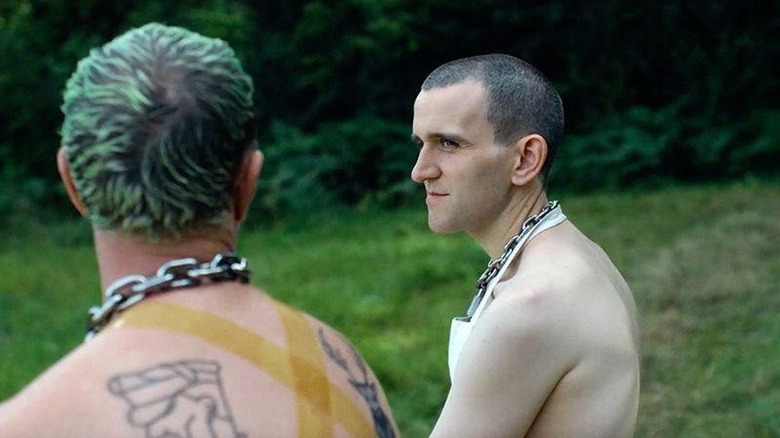
The last few years, there have been countless debates about "necessary sex scenes," and then we have a film like this or a show like "Heated Rivalry" becoming an international phenomenon, and "Pillion" wins all of these awards. What do you think changed?
Lighton: It's so interesting because I don't have an answer for it other than that maybe — because there was a lot of backlash to that discourse. At least in my circle, there were a lot of people being like, "Well, this is complete crap." And for me, I've always been pretty clear in my mind on what I find to be a "good" or a "bad" sex scene, and it's got nothing to do with sex in some categorical aspects, and everything to do with what the sex is doing in service of the storytelling or the characterization. So I mean, a version of "Pillion" without any sex in it, that would've been an egregious error to me. Telling a story about kink and keeping all the sex offscreen would've been like me passing judgment on that kind of sex. So this film, if someone writes an article about how the sex in "Pillion" was unnecessary, then I'd definitely have something to say about it, I think.
It would have been such a betrayal of the story and these characters. It's so necessary to see what we see and how they explore. Harry, for you as an actor, have you noticed a shift at all?
Melling: I mean, not really. What I will say about the sex scenes is that it's nice that, like Harry has just said, the scenes housed such a story. It's not often we see a sex scene go wrong and not work. You don't often see that. And coming to this, that's what I was so excited about in a way. How do you do that with honesty and authenticity? Maybe people got bored of or maybe people questioned the necessity of sex, because actually the way that sex was being portrayed became flat, and it wasn't actually addressed in a way which actually was looking at the people having sex and why they were doing it.
The thing that really excited me was that it felt like that's the only thing that this movie was doing. Sex is so vital in telling Colin's story of inexperience to an experience. And like we've all said, the sex not being there, it just would be a really s*** film. I haven't seen "Heated Rivalry," so I can't comment on that, but maybe it's something about the way in which sex is being portrayed on screen changing, and maybe that is what's allowing this new phase of people really enjoying that aspect of TV and film.
Henry Lighton didn't want to play it safe for Pillion
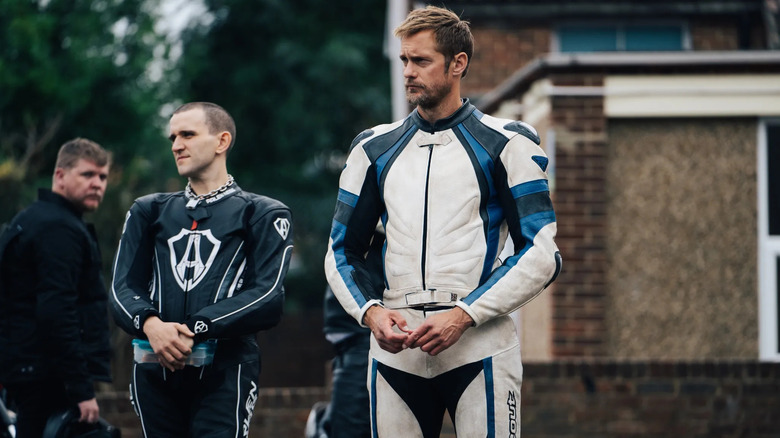
Many filmmakers play it safe for their feature directorial debut, and they'll start swinging for the fences on maybe film number two or film number three after they've "proven themselves," but you really came up the gate with such a confident and well-assured feature set in a world that is still viewed as taboo by the majority. So what was it about this story that you knew this had to be your first feature?
Lighton: I cared about the subject. My short films had explored some version of countercultural sex, and so I was looking for something in that kind of thematic world. But then I also am drawn to films where the tones don't necessarily sit neatly with the subject matter. And by neatly, I mean, in terms of an audience's preconceptions of what they're going to get when they go see a BDSM romance. And when I read the novel, that was the thing that really struck me.
And even though I think that the novel is totally a fair bit different from the film, it had this real sense of surprise that delighted me in the way it applied comedy and sincerity and shock and tenderness to a subject, which I think is often quite two-dimensionally treated. And I also was like, well, maybe I'll never get the chance to make another film in my life, so I might as well swing big. Because if I get to do only one film, I should have a crack at the one I want to make.
"Pillion" is now playing in many theaters nationwide.