

An Obscure Batman Comic Gave The Scarecrow His Own Harley Quinn
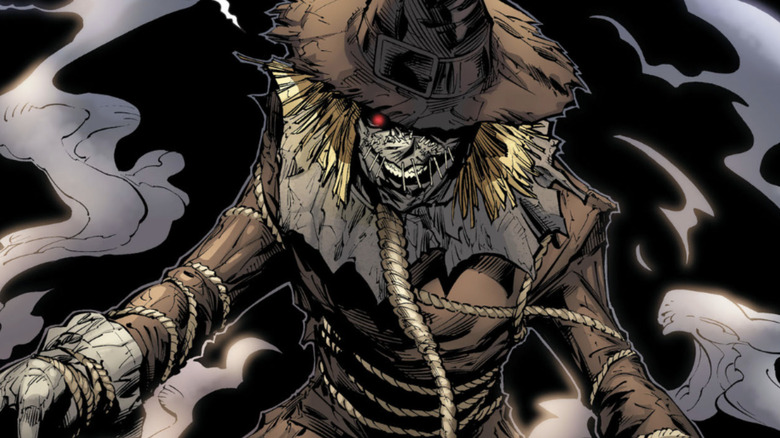
The Scarecrow is one of Batman's most enduring adversaries. Jonathan Crane calls himself the Master of Fear, but masters need apprentices. Scarecrow tries to recruit such a disciple in the 1998 story "Mistress of Fear." Published in the issue "New Year's Evil: Scarecrow," it's out of print, which is bad fortune for every Batman fan who enjoys a Scarecrow story.
"Mistress of Fear" was a collaboration between writer Peter Milligan, author of several Batman stories that veered into supernatural horror (like the underrated "Dark Knight, Dark City"), and artist Duncan Fegredo, known for his later work drawing some of the best "Hellboy" comics. (Milligan and Fegredo also worked together on the Vertigo comic series "Enigma.")
In "Mistress of Fear," Scarecrow is imprisoned at Arkham Asylum after a young law student, Becky Albright, testifies against him. Joker and Riddler mock Scarecrow, for the "Master of Fear" couldn't even scare a little girl into silence. Scarecrow won't stand for this humiliation, though, so he vows revenge on "Brave Becky."
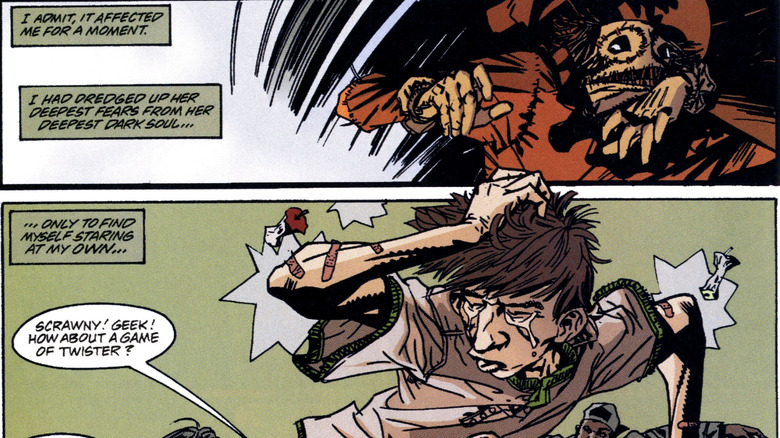
But Scarecrow's campaign of terror, which includes killing Becky's dog and poisoning her with his Fear Toxin, culminates in an unforeseen feeling: empathy. When Becky pleads "Leave me alone!" to hallucinated bullies, Crane recalls his childhood self sobbing the same words.
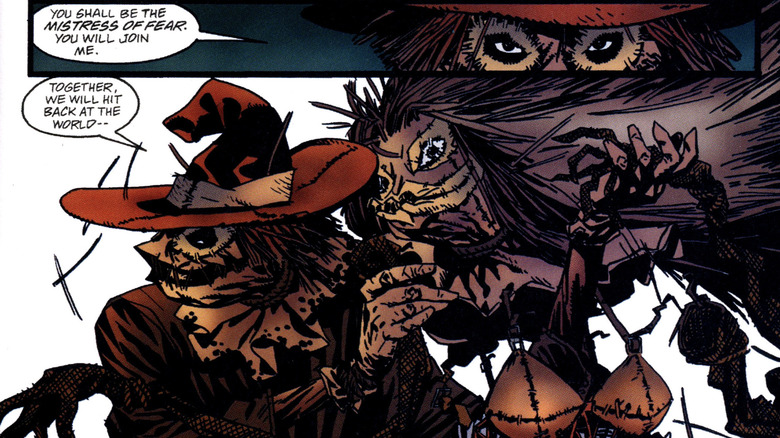
Scarecrow thinks he's found a kindred spirit; someone scared of the world who threw themselves into academia (law for Becky, psychology and chemistry for Crane) to escape it. Thus, he decides to "help" Becky by teaching her to frighten her tormentors as another Scarecrow.
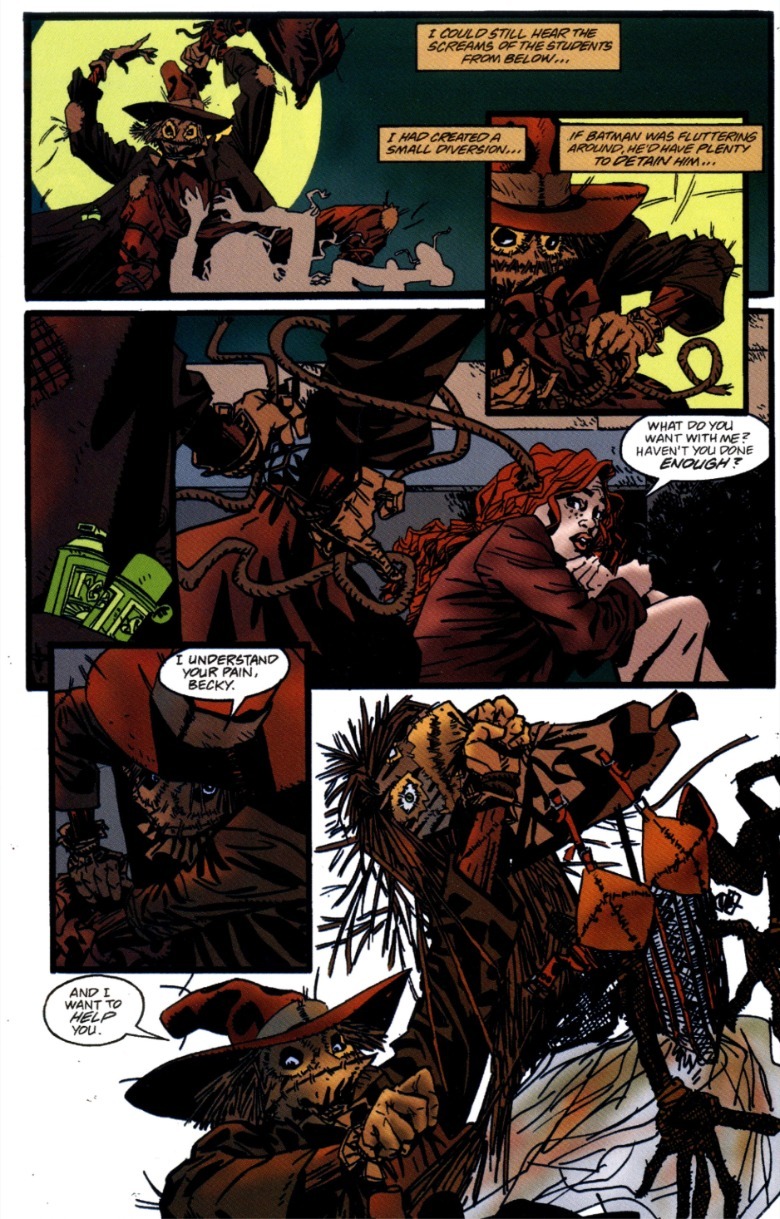 DC Comics
Reading "Mistress of Fear," one can't help but think of Bruce Timm and Paul Dini's comic "Mad Love," the origin of their "Batman: The Animated Series" character Harley Quinn. The Joker corrupted Dr. Harleen Quinzel, but does Scarecrow create his Mistress of Fear?
Among Batman comics, Mistress of Fear stands as a unique Scarecrow story
The Scarecrow spreads wanton panic through a drug of his own making, Fear Toxin, a terror-inducing hallucinogenic... and to be honest, it's his weakness as a super-villain.
While Fear Toxin gives writers/artists plenty of opportunity to depict different nightmares, it also means Scarecrow stories can be rote. Scarecrow doses Batman with Fear Toxin, Batman overcomes it, repeat. Crane is a scientist, after all, and repetition to observe results is a key part of the scientific method. Scarecrow also has no greater goal than spreading fear or petty grudges; if he steals, it's only to fund his experiments in terror.
Take the story "Fear for $ale," published in "Detective Comics" #571 by Mike W. Barr and Alan Davis (and later adapted into "Never Fear," a "New Batman Adventures" episode featuring Jeffrey Combs as Scarecrow). Scarecrow created a new drug that removes people's fear; without inhibitions, their lives fall into ruin, leaving them open to extortion for the antidote.
"Mistress of Fear" takes the Scarecrow in a more personal direction, with his ire focused on one helpless victim. Yet, it also stays true to the villain's roots. Since his debut in 1941's "World's Finest Comics" #3 (by Bill Finger and Bob Kane), Jonathan Crane has been defined as a social outcast.
Crane was introduced as a college professor nicknamed "Scarecrow" by colleagues due to his lanky frame and shabby clothes. Later stories have shown Crane was bullied in childhood as well. Per "Year One: Batman/Scarecrow" by Bruce Jones and Sean Murphy, Crane's first murder as the Scarecrow was Sherry Squires, a girl who'd pretended to be interested in him as a cruel prank. Jonathan Crane spent his childhood living in fear, so he now relishes the power of scaring others.
Mistress of Fear shows what scares the Scarecrow
Duncan Fegredo draws Scarecrow's mask wide like a Jack-o-lantern. Repeated close-ups emphasize the mask's stitching in front of Crane's teeth, making Scarecrow look especially monstrous. Behind the mask, Crane has red hair; it's no coincidence that Becky Albright does, too. Yet, her hair and freckles also reflect youthful innocence, and in the end, that wins out.
Becky refuses Crane's offer, baffling him as she fits the "classic psychological profile" to become a super-villain. When Crane settles for killing her instead, Batman arrives and subdues him. As Batman observes, a bully like Scarecrow fears nothing more than someone like Becky, who isn't scared of them.
It's a similar ending to Alan Moore and Brian Bolland's "The Killing Joke," where the Joker tries and fails to break Commissioner Gordon psychologically to prove everyone's "one bad day" from becoming a super-villain. Becky spurring Crane tears apart his claim that his sadism is a "perfectly rational response to [his] traumatic experiences."
Scarecrow and Becky Albright thus serve as a mirror image of the Joker and Harley Quinn. In "Mad Love," Harley is the one devoted to the Joker, who made her into a super-villain to see if he could. Compare that with Scarecrow's fixation on Becky, who only wants to be left alone; the super-villain is the one obsessed with the girl, not the other way around.
At the end of the comic, Crane is sent back to Arkham, where Joker and Riddler once more laugh at him. Fegredo closes with a close-up of Crane's eye with a spiral-shaped pupil, suggesting the Scarecrow himself is spiraling down. While "Mistress of Fear" should not be forgotten by "Batman" readers, it works perfectly well as a one-shot story — and Becky's happy ending shouldn't be disturbed.