

Christopher Walken's Creepy Fantasy Horror Movie On Paramount+ Has A Wild Premise
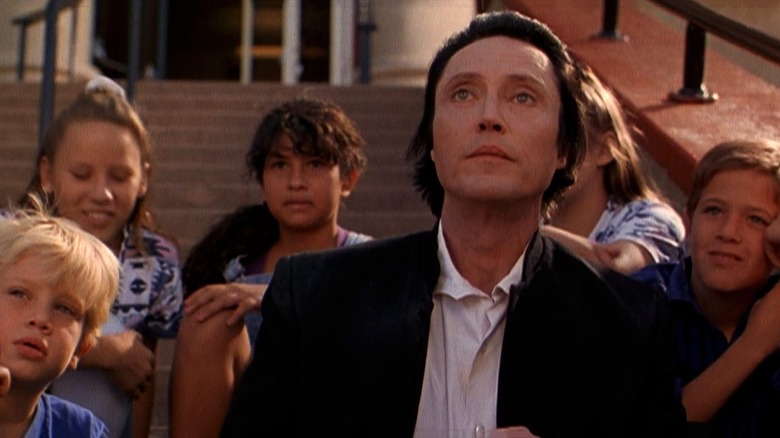
Gregory Widen's 1995 film "The Prophecy" takes some familiar premises seen in multiple Bible-based horror movies and skews them into something fascinatingly new. "The Prophecy" envisions angels — like, actual Heavenly seraphs — to be black-suit-wearing supervillains who secretly lurk among the humans on Earth, executing devious, ineffable, unholy plans. They don't have wings, but they can perch in precarious places like birds. They appear as males but are intersex beings. When an angel dies early in "The Prophecy," a wisecracking pathologist finds their blood chemistry to be similar to that of a fetus.
Angels are also, we learn, a bitter lot who constantly resent God's love of humans. There is a war brewing between splintered angel factions. The central antagonist of "The Prophecy" is the archangel Gabriel, played by an excellent Christopher Walken, and he aims to take possession of the soul of a recently deceased war criminal named Hawthorne. The soul is so evil, it seems, that whoever possesses it could tip the balance of the angel conflict. Gabriel's plans are being foiled by the benevolent angel Simon, played by Eric Stoltz, who has cleverly hidden Hawthorne's soul in the body of a young girl named Mary (Moriah Shining Dove). That, as you can imagine, isn't very good for Mary's health or well-being. Virginia Madsen plays Mary's teacher.
The main character of "The Prophecy" is a cop named Dagget, played by the always great Elias Koteas. Dagget nearly entered the priesthood years earlier, but instantly lost his faith when he had a deathly vision of fighting angels. It will be through Dagget's eyes that the audience learns all the above information about angels and souls.
It's a pretty great movie, and you can currently stream it on Paramount+.
The Prophecy reimagines Biblican angels as Goth icons
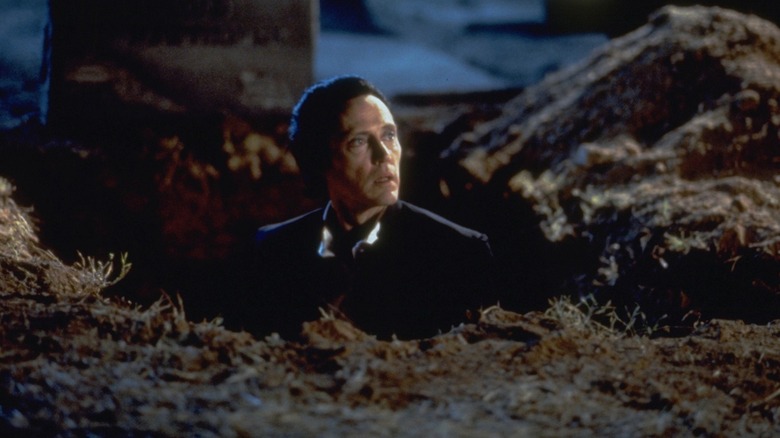
In terms of its tone, "The Prophecy" has more in common with a Goth-inflected genre flick like "The Crow" – a film with a long history of its own — than it does with other Biblical horror films like "The Omen." The angels in "The Prophecy" all sport cool hairdos, perch on tall buildings, and wear long black coats. They have fixed, ambivalent expressions. One can almost picture them slipping into a pair of headphones and firing up a Smiths cassette. The angels aren't so much messengers from God as they are refugees from a Goth club.
That is a compliment. The new angelic mythology in "The Prophecy" is unique and cool. It feels like an appropriate '90s update of a genre. "The Prophecy" is not nearly as stylish as something like "The Crow," but it is memorable for '90s teens who lived on the broody and/or Roman Catholic end of the Goth matrix. Those familiar with the Old Testament might recognize writer/director Gregory Widen's vision. Angels are not always, well, angelic. Sometimes they are motivated by dark desires of their own.
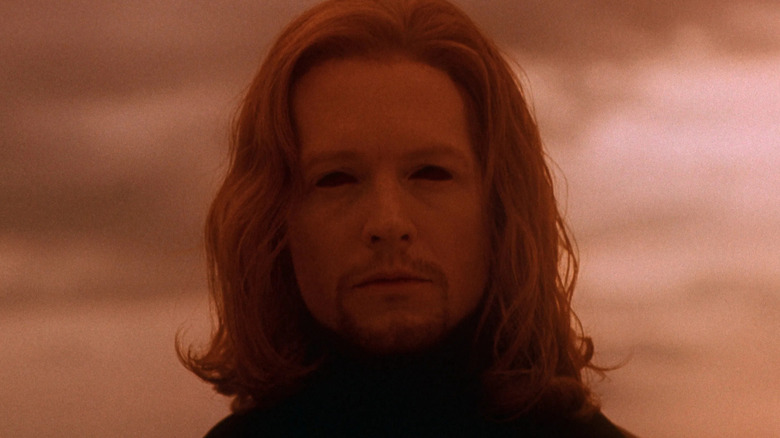
Oh, and this is cool: Late in the film, the Virginia Madsen character is visited by Heaven's most notorious fallen angel, Lucifer, played by Viggo Mortensen. Lucifer does have a scary, cenobite-looking demon in his company, but he himself looks just like all the other angels in the film. He explains that if Gabriel wins his angelic war, he'll essentially usurp Heaven and turn it into a second Hell. Lucifer cannot abide by that idea; one Hell is enough.
The Prophecy wasn't loved by critics
Critics weren't terribly kind to "The Prophecy." Based on 24 reviews, the film only has a 42% approval rating on Rotten Tomatoes. It was released during a slow time of the year in 1995 (specifically September 1), when its main horror competition was Clive Barker's "Lord of Illusions," released the previous week. Audiences may have also still been flocking to "Mortal Kombat," which came out in mid-August. "The Prophecy" wasn't a notable hit, either, making only about $16 million domestically. Three weeks after "The Prophecy" was released, the world would be hit with David Fincher's "Seven," effectively pushing Gregory Riden's film out of the consciousness. David Fincher eventually did tell us what was in that box.
But something about "The Prophecy" lingered. Fans began to watch it on home video, and cultural interest stayed strong. Strong enough, at the very least, to warrant the making of "The Prophecy II" in 1998. The sequel, directed by Greg Spence, saw Christopher Walken return as Gabriel, but Elias Koteas was replaced by Bruce Abbott from "Re-Animator."
And the "Prophecy" series kept rolling forward after that. Walken returned a second time for "The Prophecy 3: The Ascent" in 2000, but stepped away from playing Gabriel for "The Prophecy: Uprising" in 2005. The series ended later in 2005 with the release of "The Prophecy: Forsaken." The last two films were written and directed by B-movie luminary Joel Soisson, who also wrote the "Dracula 2000" film series, some of the "Highlander" sequels, and some of the "Pulse" sequels. The "Prophecy" sequels are your standard video store fare, and don't have quite the oomph or originality of the original. How could they?