

A Knight Of The Seven Kingdoms Finally Introduces An Important Element Of George R.R. Martin's Books
Winter is coming, and so are spoilers. This article discusses plot details from episode 3 of "A Knight of the Seven Kingdoms."
"A Knight of the Seven Kingdoms" has proven to be a breath of fresh air for the live-action version of George R.R. Martin's world of ice and fire. After nearly 15 years of dark, depressing, and often tragic medieval fantasy television where everyone is miserable, this particular "Game of Thrones" spin-off series has made for a nice change of pace. The show takes place in the same miserable, cruel, and otherwise unforgiving world featured in "Game of Thrones" and "House of the Dragon," yet it focuses on a humble protagonist who is eternally earnest and hopeful.
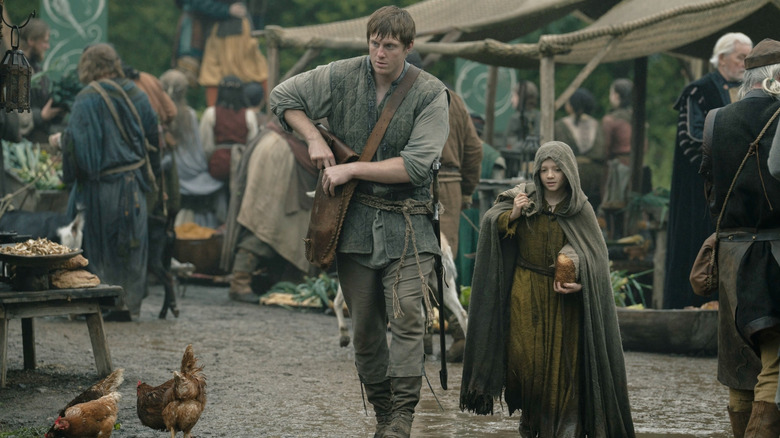
Indeed, Ser Duncan the Tall (Peter Claffey) – a hedge knight with a heart of gold who is nevertheless thick as a castle wall – is nothing like the characters we've met in previous "Game of Thrones" shows. The series' tone is vastly different, too. While "Game of Thrones" also had a sense of humor, especially in season 1, it quickly got drowned out by its epic story and the constant misery its characters faced. "A Knight of the Seven Kingdoms," however, is funny as hell and full of terrific visual comedy thanks to its clever editing and use of smash cuts and flashbacks.
It's not all jokes, though; there's also lots of singing and dancing. In fact, one of the best things about "A Knight of the Seven Kingdoms" is that it recognizes that songs, in particular, are an essential part of Westeros the way that Martin originally envisioned it in his source material (in this case, the "Tales of Dunk and Egg" novellas).
A Knight of the Seven Kingdoms acknowledges that music is important to Westeros
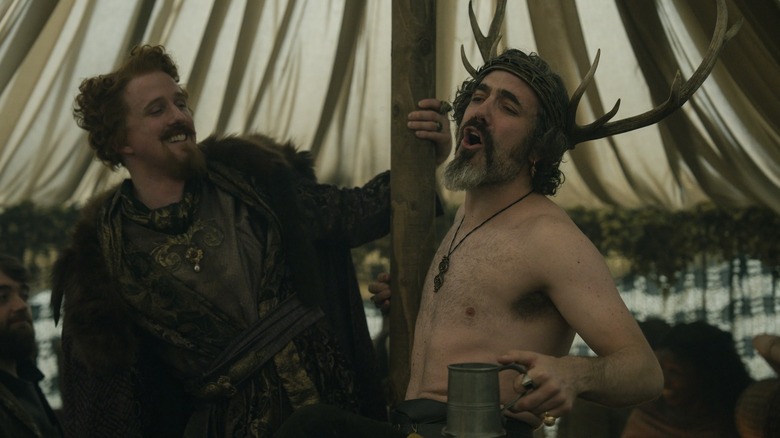
Like J.R.R. Tolkien's Middle-earth, George R.R. Martin's Westeros is filled with songs. We got a couple in "Game of Thrones" but they were mostly relegated to playing over the end credits for the show's episodes and being sung by real-life bands (see: "The Rains of Castamere"). "A Knight of the Seven Kingdoms," on the other hand, features full-blown tunes sung by the characters in its actual episodes. Everyone from Egg (Dexter Sol Ansell) to assorted commoners, the best character in the show, Lyonel Baratheon (Daniel Ings), and even Ser Arlan the well endowed (Danny Webb) are partial to singing a song every once in a while.
It's an aspect of Martin's world that's been neglected by previous TV adaptations. Without question, songs are important to his written version of Westeros (hence the title "A Song of Ice and Fire") and are as vital to its citizens' daily lives as battles and feasts. They're a primary source of entertainment, sure, but they're also how history is kept alive. And much like our reality, the oral tradition is crucial to Westeros in general. We've already seen how legends are kept alive through puppet shows on "A Knight of the Seven Kingdoms," but songs serve the same purpose. Commoners may not have access to messenger ravens or books, yet they can learn about great battles through music.
Ultimately, by incorporating songs the way it does, "A Knight of the Seven Kingdoms" is able to focus on the common folk of Westeros much more than previous "Game of Thrones" TV shows have. It's yet another reason why this series has made for such a rejuvenating change of pace.
New episodes of "A Knight of the Seven Kingdoms" drop on Sundays.