

How X-Men '97 Limited Morph's Shape-Shifting Abilities With One Definitive Rule
We may receive a commission on purchases made from links.
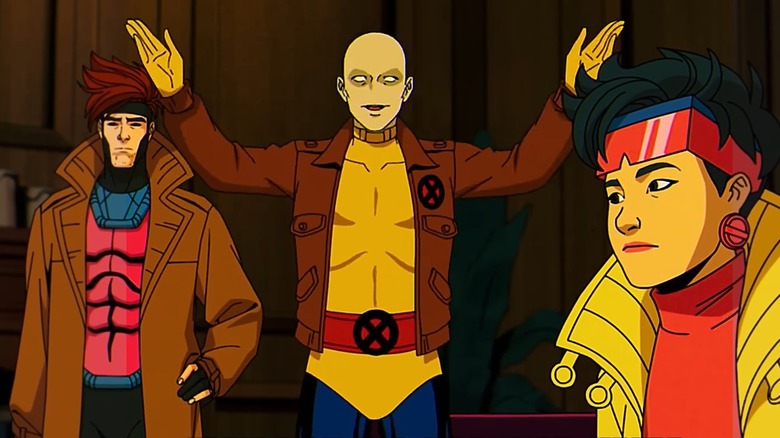
"X-Men '97" was a show geared towards those who felt nostalgia for "X-Men: The Animated Series," which was a hugely important show for Marvel in the '90s. But it was more than solely a nostalgia play. The new series was completely divorced from the Marvel Cinematic Universe, which allowed it to truly be its own thing while honoring the legacy of what came before. A big part of that was including beloved characters such as Cyclops, Storm, and the shape-shifting Morph.
While Morph can change into just about any mutant he pleases, the creators of the show did have a rule to help limit his abilities so he didn't become too overpowered. In the book "X-Men '97: The Art and Making of the Animated Series," series director and producer John Castorena explained the definitive rule he and his colleagues used when it came to Morph's powers. In short, it's all about the physical elements and not about mimicking mutant abilities. Here's what Castorena had to say about it:
"The definitive rule we came up with is that Morph can adhere to any physical attributes of anyone that they morph into. For example, if Morph turns into Colossus or Juggernaut or Psylocke [from] the muscle memory of said character, Morph has to concentrate and regenerate those cells all the time for that. So for the metal skin, if they're doing Colossus, that comes at a cost. But what Morph cannot do is mimic any sort of mutant power ability, like laser fire, anything like that. That isn't the physical attribute of the character."
So, when "X-Men '97" let Morph briefly transform into the Hulk, he could Hulk out, so to speak, because his strength is a physical attribute. But he couldn't, for example, use Professor X's telekinetic powers, as that's a mutant ability.
Morph offered X-Men '97 lots of cameo opportunities
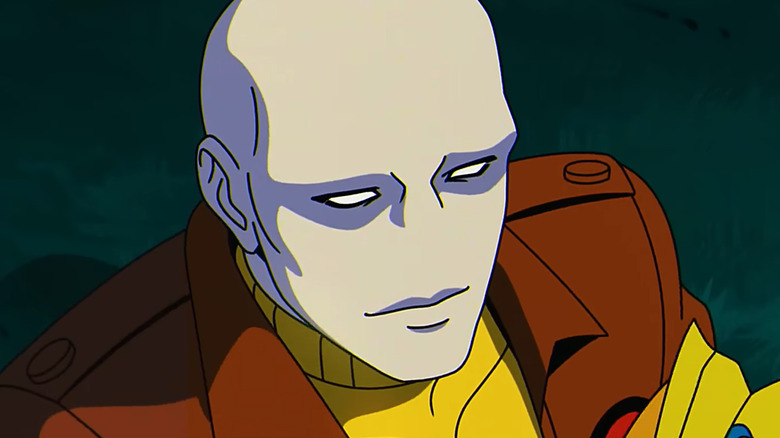
There is a great deal of fun to be had with a character like Morph, and the show took full advantage of those possibilities. "X-Men '97" season 1 saw Morph transform into a number of mutants from the Marvel universe, be it for fun or for use in combat. His abilities, in theory, make any cameo from the Marvel universe possible. That's a good thing, but it's also an easy thing to abuse.
As the book explains, the creatives put careful thought into their choices when it came to Morph's transformations. They avoided using characters who may have bigger roles in the future, or ones who wouldn't work for other logistical reasons. Episodic director Emmett Yonemura explained that using Morph to squeeze in cameos always had to have a greater purpose:
"If Morph's going to be a physical replicator but can't do powers, why would you do [a specific] character? So we really try to find the physical ones, like the ninjas, the brawlers, and then the fun Easter eggs, too, that remind you that the original series was its own Multiverse already. It always becomes a treat and a conversation of 'Okay, what's the goal of the cameo? What's the story point of the cameo?' But then, also, who are we all just as fans excited to see?"
It all worked out. "X-Men '97" is one of the best-reviewed Marvel projects of all time, and was met with near-universal praise upon arrival. Season 2 of the show is in the works now and is due to arrive sometime in 2026. Meanwhile, Marvel Studios is also working on a live-action "X-Men" movie reboot within the MCU, though details on that remain scarce.
You can stream "X-Men '97" on Disney+.