

Why X-Men '97 Gave Up Making Logical Sense Of The X-Mansion

We may receive a commission on purchases made from links.
The "X-Men" franchise is filled with memorable iconography, ranging from Wolverine's Adamantium claws to the X-Men's signature jet, the Blackbird. At the center of it all is the X-Mansion, the large house that Professor Charles Xavier uses to house his school for gifted youngsters. In the world of the animated series "X-Men '97," the X-Mansion is important to the proceedings, but the series' creatives stopped trying to make logical sense of it along the way.
"This assignment taught me the extent to which we'd have to copy the original show on some designs — that extent being 110 percent," as Anthony Go Wu, who served as the production designer on the series, explained in the book "X-Men '97: The Art and Making of the Animated Series" by James Field. "The extra 10 percent is our best attempt at interpreting the nineties footage for modern resolutions."
Though Stan Lee wasn't a big fan of "X-Men: The Animated Series," it was hugely popular and helped to redefine the mutants in popular culture. "X-Men '97" served as a much-anticipated revival of that iteration of the franchise. Still, as Wu noted, getting the X-Mansion right was tricky.
"I started with a very plausible mansion design referencing colonial architecture," he added. "This house is such an important tether between 'X-Men: The Animated Series' and 'X-Men '97.'" However, getting a precise layout of the mansion proved to be a fool's errand:
"We needed to include that bogus dome as much as A.J. [LoCascio] had to master Gambit's drawl. I also like that we placed the camera inside the dome for some nice moments in episodes 1 and 8. We tried early on to draw a coherent map of the mansion and decided it was unproductive because of the constant story edits that ran concurrently with design."
The X-Mansion is whatever X-Men '97 needs it to be
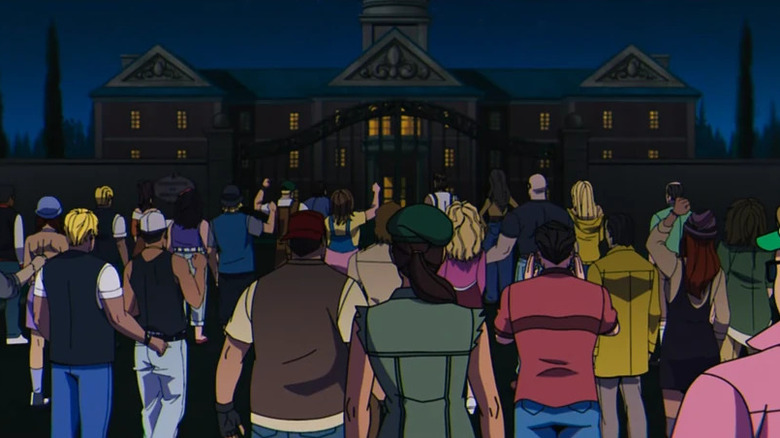
"The rooms are connected by vibes and editing, whatever the script needs," Anthony Go Wu quipped.
In the end, Wu and his team decided that having the X-Mansion suit the needs of the story at hand, and not being overly concerned with making sure the layout always made perfect sense, was more important. After all, "X-Men '97" is a cartoon about a bunch of super-powered mutants based on a comic book. At a certain point, worrying about strict architectural logic runs counter to the mission at hand.
It all seemed to work out quite well, in the end. "X-Men '97" season 1 is one of the best-reviewed Marvel projects of all time, with season 2 on the way later this year. The first season not only worked for fans of the original animated "X-Men" series, but it also pleased newer fans as well. It was a true best-case scenario for this sort of revival, which could have been pure nostalgia bait but instead became something truly special in the eyes of many viewers.
Outside of the animated shows, the X-Mansion has also been a fixture of the live-action "X-Men" movies dating back to 2000's "X-Men." It's going to continue to have a presence on the big screen as well, as one of the teaser trailers for "Avengers: Doomsday" focuses on the X-Men, suggesting that the X-Mansion itself will be a major part of the proceedings. Whether or not "Doomsday" directors Joe and Anthony Russo got caught up in trying to make sense of the mansion's layout? That's a question for another day.
"X-Men '97" season 1 is streaming now on Disney+.