

X-Men: The Animated Series' Creative Team Almost Quit Over The Show's First Villains
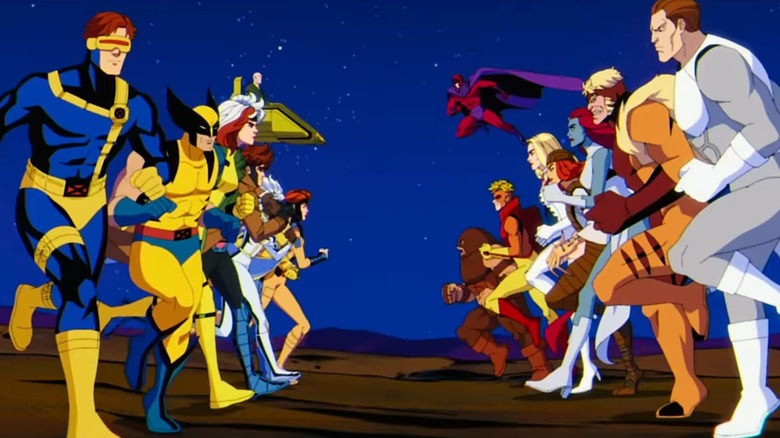
The very first episode of the 1992 "X-Men" cartoon was called "Night of the Sentinels," because it pitted the X-Men against said two-story-tall mutant-hunting robots. But starting the series like that wasn't an easy choice.
You see, a few years prior in 1989, "X-Men" director/producer Larry Houston and producer/storyboard artist Will Meugniot had worked as producers on a previous "X-Men" cartoon pilot, "Pryde of the X-Men," where Kitty Pryde (Kath Soucie) joins the X-Men as they battle Magneto (Earl Boen) and his Brotherhood of Mutant Terrorists. Meugniot and Houston had wanted the villains of "Pryde" to be the Sentinels so they could focus the story on introducing the X-Men themselves. But the powers that be insisted on the Brotherhood, so as to advertise all the bad guys for a planned toyline.
That did "Pryde" in, Houston and Meugniot maintain, because it meant the pilot was too crammed with too many characters. Considering "Night of the Sentinels" succeeded where "Pryde" had failed, history has proven them right. As "X-Men" showrunner Eric Lewald explained to Inverse in 2022, the Sentinels are the perfect starter villains for anyone concocting a new "X-Men" story:
"They're these 30-foot robots trying to hurt people so everybody understands they're a menace without much backstory. That meant we'd have more time to focus on the X-Men and get to know them better."
When Houston, Meugniot, and co. got a second chance with "X-Men," they insisted that the Sentinels be the villains. Still, some people in charge were hesitant. Houston recalled to Inverse that they delivered an ultimatum: "The whole creative team said, 'If this is what you want to do, we're the wrong creative team for this show and we all quit.' That made them back off and we got to do 'Night of the Sentinels.'"
X-Men's creators knew the first villains had to be the Sentinels
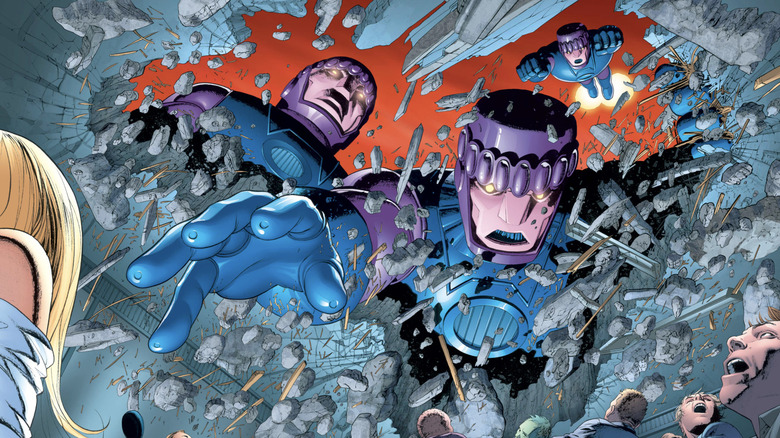
Eric Lewald didn't come to "X-Men" as a mutant or Marvel expert like Houston and Meugniot were, but he was a quick study. As he told Inverse, he realized that there are "two basic kinds of 'X-Men' stories." The first kind pits the X-Men against other evil mutants, which didn't speak to Lewald that much, "because it was so similar to every other superhero show."
"The other kind of 'X-Men' story was about X-Men trying to fit in with the greater human culture around them. It focused on their vulnerability. It's hard to make super-beings vulnerable, but a great way of doing it was to show that people feared them and hated them. For a pilot, we liked that better because it was very specific to the X-Men. The Sentinels were a great way to do that kind of story because they were the embodiment of human fear and hatred."
After "Night of the Sentinels" came "Enter Magneto," and this sequence flows much better thematically than starting with a mutant villain. The first "X-Men" episode establishes mutants are so feared that a "Mutant Control Agency" is cranking out Sentinels to hunt them down. From there, you can explore how different mutants react to people's hatred for them. Some, like the X-Men, try to heal the world. Others, like Magneto, strike back against humanity.
Magneto's (David Hemblen) first appearance has him trying to free an imprisoned Beast (George Buza). Beast prefers to stand trial, while Magneto says he's foolish for trusting in the justice of human law. Conversely, in "Pryde of the X-Men," Magneto and the Brotherhood come off like mere supervillains, with a plot to plunge the world into a new Ice Age.
X-Men '97 revisited the Sentinels
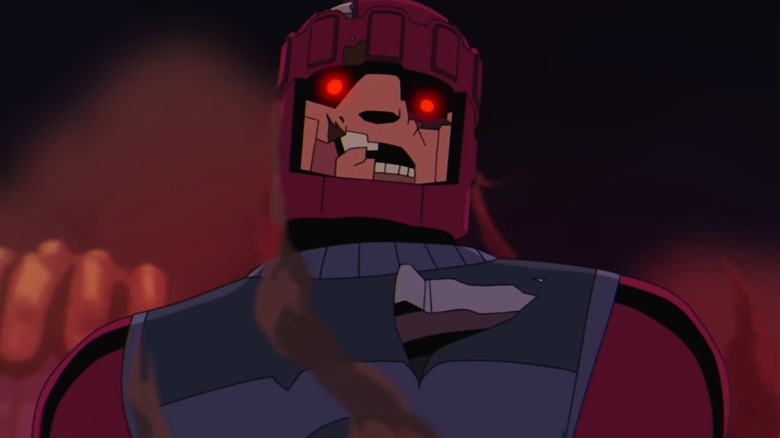
Starting with the X-Men fighting other mutants sends the same message as the ill-conceived tagline for the 2000 "X-Men" film: "Trust a few. Fear the rest." The Sentinels instead convey that the greatest threat is not mutants, but people fearing the other.
You can even see that with Stan Lee and Jack Kirby's original "X-Men" comics. The first handful of issues focus on the X-Men fighting Magneto and other mutant villains, and thus are stories with little distinct identity. It's only in "X-Men" #14-16, the first appearance of the Sentinels, that human prejudice becomes the book's true villain.
"X-Men" season 1 ultimately built its entire story around the Sentinels, culminating by adapting Chris Claremont and John Byrne's famous time travel "X-Men" story "Days of Future Past." In a dystopian future, mutants are herded into concentration camps while even "normal" humans live under the Sentinels' boot. Unless the Sentinels, and the forces that drive people to create them, are stopped, man and mutantkind are doomed.
The revival series "X-Men '97" echoed this smart storytelling. Its first episode, "To Me, My X-Men" also uses the Sentinels as villains to focus on reintroducing the X-Men themselves. Episode 2, "Mutant Liberation Begins" depicts Magneto (Matthew Waterson replacing the late David Hemblen) joining the X-Men, just as "Enter Magneto" followed up the Sentinels by showing the team's first fight with the Master of Magnetism. In fact, "X-Men '97" had basically the same overarching narrative as season 1 of the original show: the X-Men are trying to prevent a dark future where Sentinels — now led by Bastion (Theo James) — enslave mutants. The creators of "X-Men '97" knew they had to recapture the original show's social conscience; the Sentinels were once more the perfect way to blend that with mutant superpowered action.