

28 Years Later: The Bone Temple Review: The Horror Series Goes In Exciting New Directions With A Gruesome Sequel
When I saw Danny Boyle's "28 Years Later" in early 2025, I was impressed ... at first. Returning to the series they started with "28 Days Later," Boyle and screenwriter Alex Garland crafted a surprisingly emotional horror saga that focused on the inevitability of death and grief. "28 Years Later" unleashed plenty of gore and terror, but it was also uniquely reflective and hauntingly beautiful in its own way.
And then the bonkers ending nearly ruined everything.
In its final minutes, "28 Years Later" drastically changed its tone and unleashed a gang of goofballs dressed like notorious UK media personality and accused sex offender Jimmy Savile. These characters clashed terribly with everything that had come before, doing backflips and karate kicks and feeling like they had been teleported in from a completely different film. It didn't quite destroy everything that came before it, but it came pretty damn close. "Oh no," I thought. "If this is meant to set up the next film, I'm not so sure I'm interested in the next film."
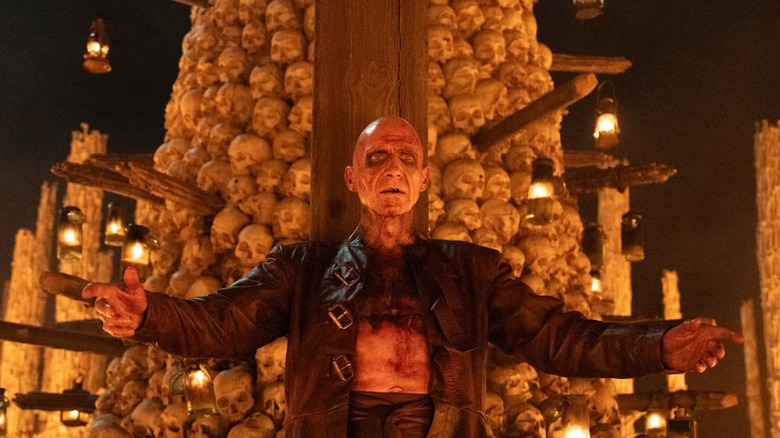
Well, the next film, "28 Years Later: The Bone Temple," is here, and I'm thrilled to admit my worries were for naught. Taking over for Boyle, director Nia DaCosta (working with another script by Garland) has created a violent, energetic, impressive sequel that advances the story to unexpected places. It's not quite as thoughtful as what Boyle and Garland pulled off in "28 Years Later," but it's a hell of a lot of fun. Although there's so much unflinching brutality and gore that "fun" might not be the right word. Then again, there's a scene where Ralph Fiennes dances around to an Iron Maiden song. What's that if not fun?
The Bone Temple reminds us that humans are the real monsters
In "28 Years Later," we met Spike (Alfie Williams), a teenager who has been living under quarantine his whole life as the zombie-like infected still wander across the United Kingdom (the film implied that the outbreak was contained to the UK while the rest of the world moved on). After losing his beloved mother and meeting the strange-but-kind Dr. Ian Kelson (Fiennes), Spike decided to venture out into the wilderness on his own and explore. He didn't get very far before he encountered that backflipping gang of Saville impersonators lead by Sir Jimmy Crystal, played with appropriate silly menace by Jack O'Connell.
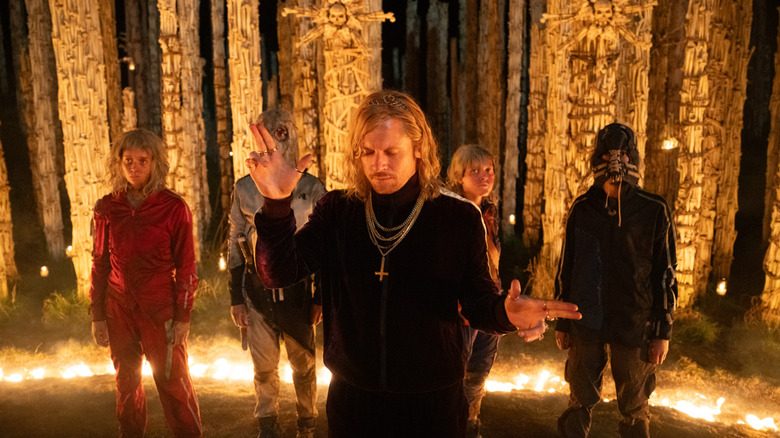
"The Bone Temple" picks up almost immediately after this finale, with Spike being inducted into Jimmy's gang. All the members must change their name to "Jimmy" and don tracksuits and ratty blonde wigs. They must also follow Sir Jimmy's lead as he makes them wander about brutally murdering survivors all in the name of Satan. Sir Jimmy blames the infected apocalypse on the devil himself, and sees it as his unholy mission to torture and kill any unlucky soul his band of ultra-violent miscreants comes across. They're like the Droogs in "A Clockwork Orange," but ten times worse.
Like countless zombie stories before, "The Bone Temple" wants to remind us that the infected aren't the real monsters: it's human beings who cause the most horror. Indeed, while the infected may be bloodthirsty ghouls, they're essentially blameless for their actions; they have little to no control. Jimmy and his gang, in sharp contrast, are a truly vile, repulsive bunch, and the only redeeming members are Spike, who is constantly horrified at the group's actions, and the sympathetic Jimmy Ink (Erin Kellyman), who takes a liking to Spike and tries to shield him from the non-stop horrors.
O'Connell played the memorable vampire Remmick in last year's "Sinners," and with his work in "The Bone Temple," he confirms that he's very good at playing bad guys. It's also a testament to O'Connell's skills that Jimmy feels like a completely different character than Remmick; he's not just recycling material, he's creating something new. Jimmy was just a child when the outbreak began, and he's grown into a childish adult. He's also clearly a psychopath with delusions of grandeur. O'Connell plays him with just the right amount of sadism and childlike innocence. Jimmy is not innocent, of course, but through O'Connell's scary performance, we get plenty of insight into his warped mind.
Some of the best scenes in the movie involve Dr. Kelson and Samson hanging out
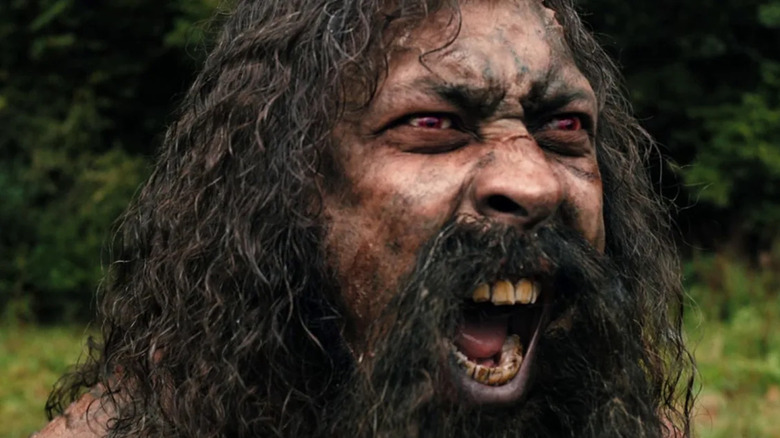
While Spike struggles to adapt to his new, blood-drenched life, Dr. Kelson finds an unlikely way to connect with Samson (Chi Lewis-Parry), the hulking (and frequently nude) Alpha leader of the local infected. While Samson, with his bulked-up physique and swingin' dong, is uniquely deadly (we're re-introduced to him in a horrifying scene where he rips some unlucky guy's head off and starts feasting on his brains), some experimentation has enabled Kelson and Samson to bond.
Fiennes is just as good here as he was in the first movie, bringing an usual warmth and kindness to this post-apocalyptic landscape, and Lewis-Parry manages to turn Samson into one of the best characters in the entire series with almost no dialogue (notice I said "almost"). There's a long stretch of "The Bone Temple" that involves Kelson and Samson simply hanging out in peace and solitude together, and I honestly would've been fine if that had been the entire movie.
But of course, that's not the entire movie. Eventually, Jimmy and his gang will cross paths with Kelson, and based on what we know about Jimmy, it's obvious that this is going to lead to some sort of problem. But Garland's script is refreshingly laid-back in unveiling its conflict; it's more interested in quiet character moments than it is in advancing the plot. That's not to say "The Bone Temple" is slow. DaCosta keeps things moving along at a steady pace, and the filmmaker creates a handful of truly ghoulish moments of brutal violence that are bound to make even the sturdiest of audience members squirm. This series has never shied away from blood and guts, but "The Bone Temple" is the goriest entry yet.
The Bone Temple will have you eager for the next movie in the new trilogy
All of that gore comes across as in service of the larger story, which has characters grappling with questions of faith and unrelenting horror. If there's one running theme in all of these movies — beyond the zombie-style mayhem — it's that humanity will claw and fight until its last breath. Even when things seem completely hopeless, human beings will find a way to adapt to some sort of normalcy. Are we being naive? Delusional? Are we in denial? Or are we so conditioned to survive that we have no choice but to keep stumbling along until we can't move anymore?
"28 Years Later" came across as a bit more thoughtful and meditative in regards to these details, while "The Bone Temple" is a pulpier, nastier follow-up; a kind of EC-comics-style answer to more intellectual question. But there are moments here that feel fresh, original, and invigorating, which is no small feat in a sub-genre that has been beaten to death again and again.
I left "28 Years Later" nervous about what might come next. After "The Bone Temple," I'm thrilled at the prospect of where this story could go. That's what I call progress.
/Film Rating: 8 out of 10
"28 Years Later: The Bone Temple" opens in theaters on January 16, 2026.