

Absolute Batman Isn't The First DC Story With A Heroic Killer Croc
We may receive a commission on purchases made from links.
A frequent criticism of Batman these days is that Bruce Wayne is a billionaire who "solves" Gotham City's problems by beating up working-class criminals. Writer Scott Snyder and artist Nick Dragotta's new comic reboot "Absolute Batman" directly addresses this criticism by changing Batman's origin story. This Bruce Wayne grew up in Gotham City's Crime Alley neighborhood. Thomas Wayne was a teacher, Martha Wayne was a social worker, and Bruce too has a day job as a city engineer.
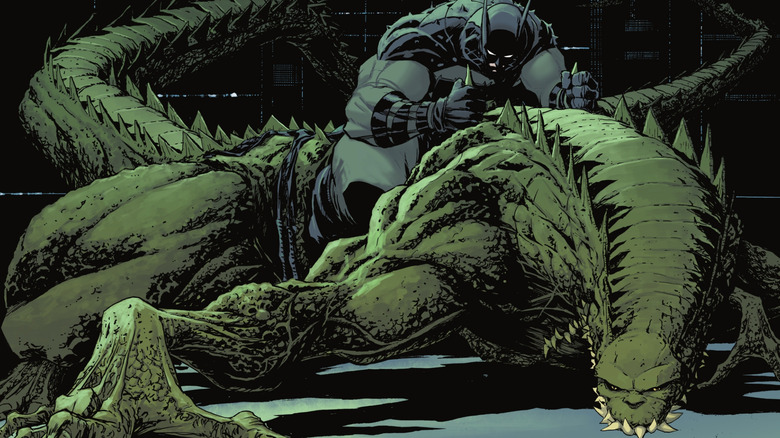
Thus, "Absolute Batman" redefines Batman for today's zeitgeist. This time, the Joker (real name Jack Grimm) is a trillionaire with endless resources. "Absolute" Batman is a more community-minded hero, too, because this Bruce grew up with a friend group: his girlfriend Selina Kyle, and his best bros Waylon Jones, Harvey Dent, Eddie Nygma, and Oz Cobblepot. Alas, in the arc "Abomination," Bruce's pals from Crime Alley are targeted and mutilated by the Joker's enforcer, Bane. Waylon, mutated in the Ark M facility into an enormous Killer Croc, arguably got it the worst. But while Waylon may be a "monster," he's still Bruce's friend.
The climactic "Absolute Batman" #14 sees Batman give Bane some payback, but he only defeats Bane with Waylon's help. In issue #10, Bruce hopped on Croc's back, like a knight riding into battle on a tamed dragon. "Absolute" Batman's huge stature and his primary axe weapon make him look like a barbarian warrior, and Killer Croc as his steed completes the image. But this isn't the first comic to use Killer Croc as Batman's surprise first sidekick: that honor goes to "Batman: Earth One," by Geoff Johns and Gary Frank. "Earth One" played on Killer Croc being the most monstrous-looking Batman villain to deliver a resonant "don't judge a book by its cover" message.
Batman: Earth One made Killer Croc into the Dark Knight's sidekick
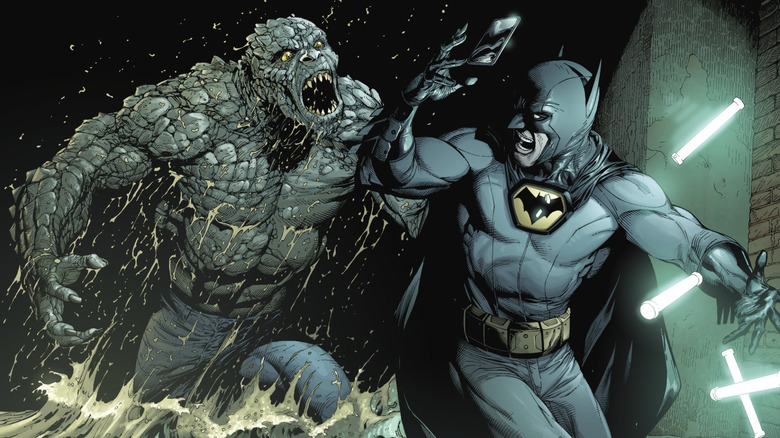
Before "Absolute Batman," DC tried in the 2010s to modernized its famous heroes with the publishing line "Earth One." These books were published not as ongoing comics but as serialized graphic novels. This format ultimately doomed "Earth One" — regardless of quality, the years-long gaps between new volumes made it hard for the comics to catch on. Thus, "Earth One" has been abandoned; the last comic of the line to be published was "Batman: Earth One" Volume 3 in 2021. Though a mixed bag of a series, "Earth One" offered a truly refreshing Killer Croc reinvention.
Waylon is introduced in Volume 2 and set up as a villain alongside the Riddler. Gotham's newspapers mention a "Killer Croc" hiding in the sewers and attacking people. When Batman tracks the Riddler to the sewers, Killer Croc bursts out of the water and attacks him. But it's a misunderstanding. As Waylon tells Bruce: "I don't eat people, a-hole. I am one."
A former circus attraction who suffers from the skin disease ichthyosis, Waylon lives in the sewers because whenever he leaves, people scream and sometimes shoot at him. So, he only wants to be left alone... until Bruce offers him friendship. In Volume 3, Croc uses his knowledge of Gotham's sewer network to help Bruce and Alfred build the Bat-Cave there. By Volume 3's end, Waylon is still by Bruce's side as part of the Bat-family.
Killer Croc is sometimes portrayed like Frankenstein's monster: an outcast who turns to violence because people rejected him. The "Earth One" Waylon has a frightening appearance, but a gentle soul. He's more like Merrick (a heavily made-up John Hurt) in David Lynch's "The Elephant Man."
Origins of Killer Croc in DC Comics
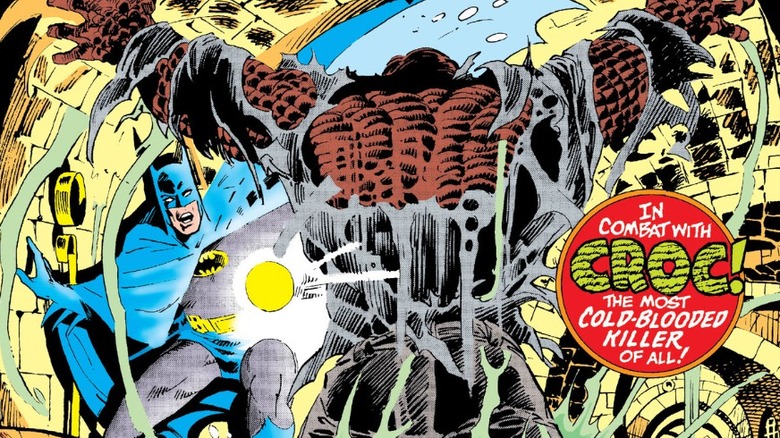
Killer Croc was created in 1983 by artists Gene Colan and Don Newton and writer Gerry Conway. Speaking about Croc's creation to SYFY in 2019, Conway said that he wanted a new kind of challenge for Batman:
"Batman's comfort zone is fighting crooks on rooftops, so I wanted to create a character that would put Batman down in the least hospitable place for a bat, a sewer.... I wanted someone who was basically just going to smash Batman into the wall. This was before Bane."
Conway attributed Killer Croc's endurance as an A-list Batman villain to "Batman: The Animated Series," which redesigned Croc to be less reptilian. Most Batman stories since have done the opposite. Conway's Croc was a gangster who hid his skin condition with a trenchcoat, but he's gradually been depicted more as a cannibalistic monster.
In the video game "Batman: Arkham Asylum," Croc (Steve Blum) is 11-feet tall and downright beastly. One mission, where Batman must venture into Croc's sewer lair, is out of a survival horror game; Croc can jump out of the water anytime and he's too strong to fight directly. If iterations like "Arkham Asylum" amp up Croc's monstrousness so he's basically no longer human, "Earth One" and "Absolute" Killer Croc remind us a person looking scary doesn't mean they're evil.
2022's "The Batman" pulls a bit from "Batman: Earth One" — Robert Pattinson's Batman isn't a mega-competent detective, like how "Earth One" gave Batman a vigilante learning curve. In both "The Batman" and "Earth One," Bruce Wayne is also descended from the Arkham family on his mother's side. Since "The Batman" ended with Gotham City flooded, the ideal environment for a crocodile, perhaps writer-director Matt Reeves can add a sympathetic Killer Croc to "The Batman Part II."