

Leonardo DiCaprio's Divisive Adaptation Of A Classic Novel Is Streaming On Prime Video
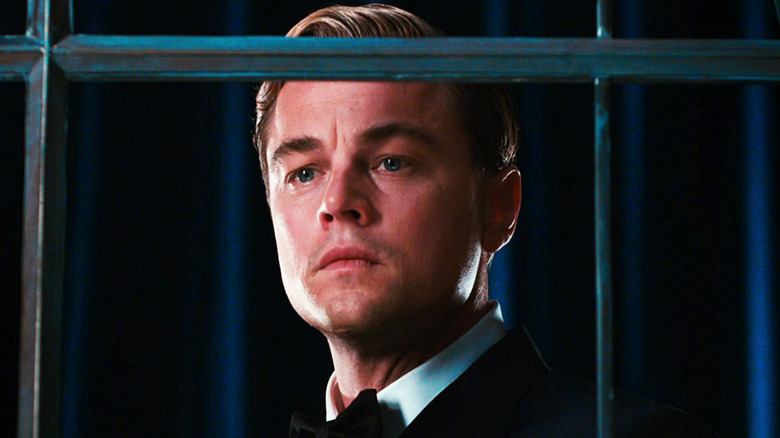
In 2013, Baz Luhrmann delivered a polarizing adaptation of "The Great Gatsby" that divided critics despite its impressive box office take. If you somehow missed the film, you can now make up your own mind as to whether the director did original author F. Scott Fitzgerald proud, as the movie is currently streaming on Prime Video at no extra cost to subscribers.
Though it was met with moderate reviews and became a commercial failure upon its 1925 debut, today "The Great Gatsby" is undeniably one of the great American novels. Unfortunately, it never received the definitive screen adaptation it deserved. According to Rotten Tomatoes, the best "Great Gatsby" adaptation is the almost entirely lost 1926 film version, which even Fitzgerald himself considered "rotten." Three other movie adaptations followed in 1949, 1974 and 2000, none of which managed to do justice to the source material (though they all had their charms).
Then, in 2013, Luhrmann took a stab at bringing the story to the screen. Unfortunately, while the film was a hit, many critics felt the director didn't fare much better than his predecessors in terms of honoring Fitzgerald's novel and its complex themes. The Aussie filmmaker produced a visually arresting take on the book that remained unapologetically swept up in its own jazz age reverie throughout. But Fitzgerald was never as taken with the hedonism or the wealthy elite of the 1920s, and for many critics, that made Luhrmann's film a misfire.
Critics weren't all convinced by Baz Luhrmann's The Great Gatsby
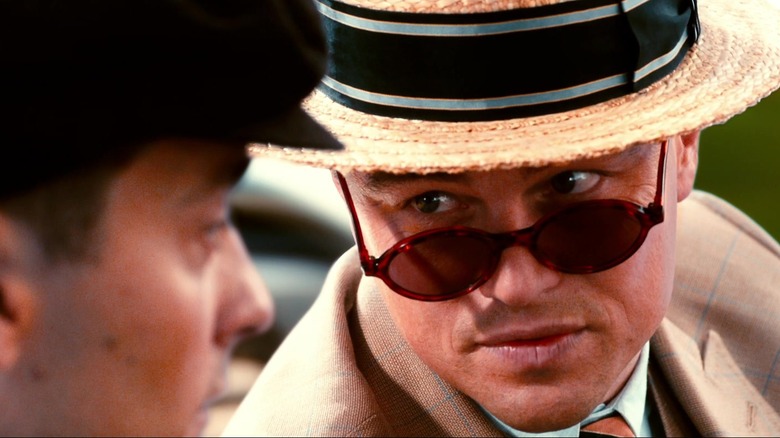
Baz Luhrmann's "The Great Gatsby" remains by far the most high-profile film adaptation of them all, not only because it was a $190 million Warner Bros. production but because of its top-notch ensemble. The film stars Leonardo DiCaprio as the titular millionaire alongside Tobey Maguire as Nick Carraway, Carey Mulligan as Daisy Buchanan, and Joel Edgerton as Tom Buchanan. But while F. Scott Fitzgerald was clearly interrogating the shortcomings of the American dream with his novel, Luhrmann often seemed more interested in the showiness that, in the book, masked deep fissures and failings at the core of 1920s American society.
When Fitzgerald's novel was first published, it received some positive and some negative reviews. The New York Herald Tribune's take fell somewhere in the middle, dubbing the author's third book "a literary lemon meringue" (which, of course, was not meant as a compliment). Nonetheless, it seems Luhrmann set out to make the film equivalent of a "literary lemon meringue" with his 2013 adaptation — a characteristically gaudy affair that dazzled with its visuals but which came under fire for misrepresenting, or worse, misapprehending the tone of the original novel.
Joe Morgenstern of The Wall Street Journal expressed something similar to the Tribune's criticism of the book when he called Luhrmann's film a "spectacle in search of a soul." Even the positive reviews had to acknowledge the lack of much substance, with The New York Times' A. O. Scott described it as both "a lot of fun" and as "a splashy, trashy opera." Whatever Fitzgerald set out to write back in the mid-20s, it surely wasn't a "trashy opera." But it seems audiences didn't really care, as Lurhmann's film was a success.
The Great Gatsby was a resplendent misinterpretation of the novel
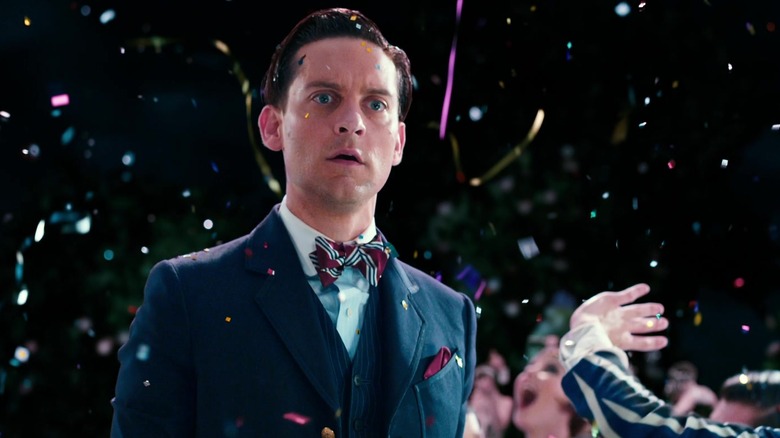
"The Great Gatsby" made $353 million at the global box office. Baz Luhrmann's 2022 biopic "Elvis," which applied a similarly meretricious sheen to its subject even as it conveyed the tragedy of the King's life, brought in $288 million, meaning "Gatsby" remains Luhrmann's highest-grossing film to date.
The film also won Best Production Design and Best Costume Design at the Oscars, which while impressive also reinforced the view that the movie was more about the visuals than anything else. On top of that, "The Great Gatsby" was released in 3D — hardly the kind of thing that you would expect from a film that placed F. Scott Fitzgerald's critical take on wealth, class, and the American dream at the forefront. Oh, it also featured a soundtrack overseen by Jay-Z.
As such, "The Great Gatsby" remains one of, if not the most, divisive Baz Luhrmann movie — a gorgeous visual treat that not only misses the deeper aspects of its source material but manages to say the exact opposite of what Fitzgerald was getting at in his book. As such, you're arguably better revisiting that time Luhrmann reinvented the musical with "Moulin Rouge!" Still, there is something fascinating about his "Great Gatsby" adaptation. Often the aesthetics of a film can be enough of an artistic statement on their own to sustain the project, and you could make that argument with "Gatsby." However, you'd also have to ignore the very pertinent critiques of wealth and class at the heart of Fitzgerald's story, which I suppose is possible to do but feels particularly uncomfortable a century after the story was first published (with very little having changed). You can see how easy or hard that is for you by watching the film on Prime Video.